
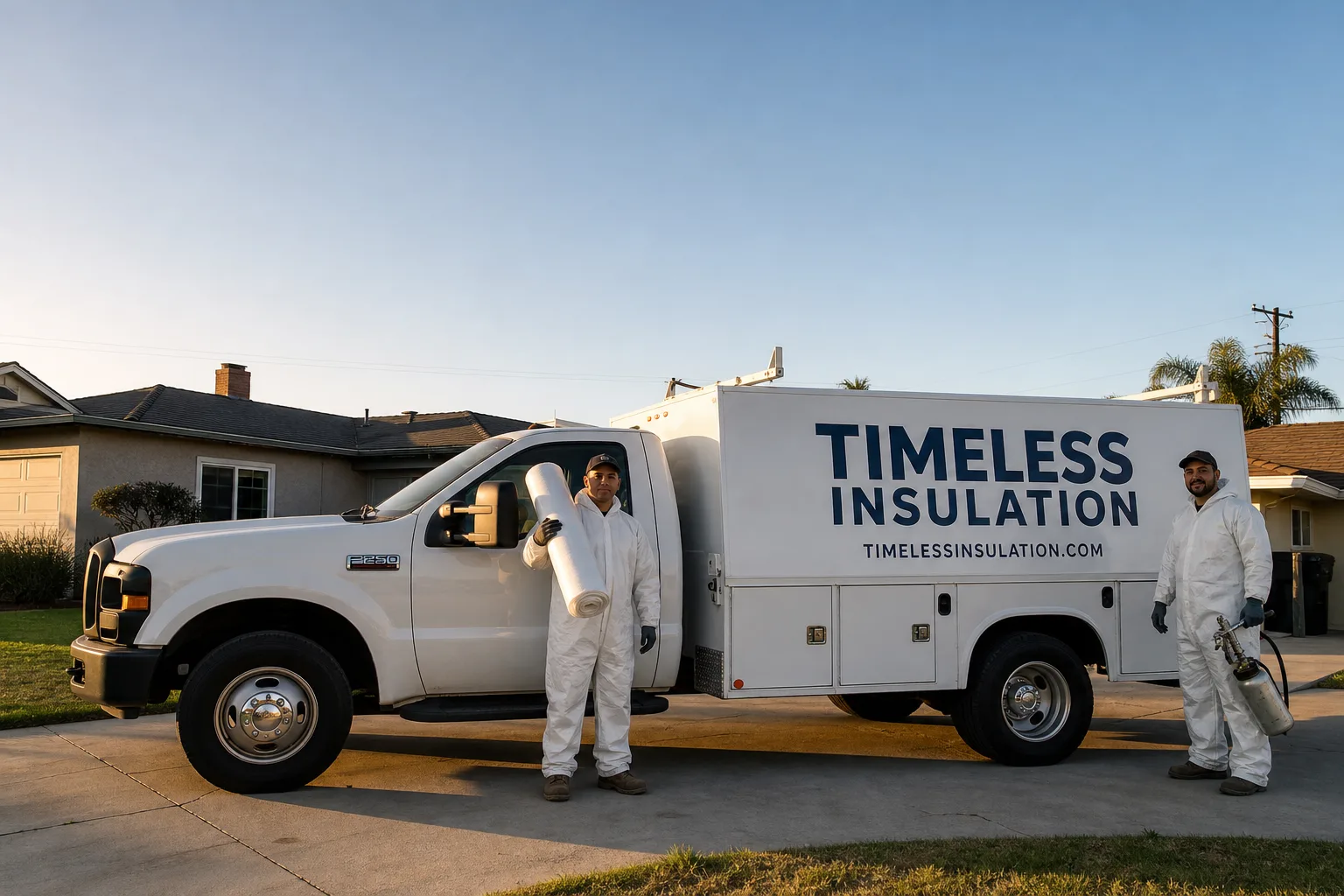
Spray Foam Insulation in West Rancho Dominguez: What It Costs and How It Works Here
Spray foam insulation in West Rancho Dominguez typically runs $2.50 – $7.00 per board foot installed, with most commercial roof deck and warehouse shell projects landing between $4,500 and $18,000 depending on square footage and foam type. We serve the 90248 corridor directly from our Compton shop, usually within one to two business days for quotes and scheduling. The short version: closed-cell foam handles the flat metal roof decks and shared commercial walls that dominate this industrial pocket, while open-cell makes sense for the mid-century homes tucked along the residential edges. Call (866) 507-5394 and we’ll give you real numbers for your building before anyone opens a wall.
Fast, Reliable Spray Foam Insulation Across West Rancho Dominguez
We know West Rancho Dominguez as the unincorporated industrial corridor it is: warehouses off Alameda Street, older commercial shells along Santa Fe Avenue, and modest 1950s homes sitting a block or two from a machine shop. That mix changes how insulation gets specified. A warehouse roof absorbing July sun and a spare bedroom under a flat ceiling are two different problems, even when they share a property line. Our crews work both sides of that equation in one day when the job calls for it. We understand the buildings here, we know what the heat load does inside them by early afternoon, and we show up prepared for the structure in front of us. That’s why we answer calls to West Rancho Dominguez from (866) 507-5394 with a real person and a real appointment, not a callback queue.
What makes local work different here is the distance between diagnosis and installation. A warehouse off the 405 needs a spray foam contractor who understands sealant compatibility on corrugated metal and the movement that steel goes through between morning and late afternoon. An older stucco house near the 110 side needs someone who can explain why attic ventilation matters as much as the foam itself. We’re that team.
Why Timeless Insulation Is West Rancho Dominguez’s Preferred Spray Foam Insulation Company
Our reputation in West Rancho Dominguez comes from the commercial side especially. Property managers and owner-operators along the corridor know we don’t bring a one-material answer to every building. We stock eight manufacturer lines because the right product for a flat metal roof off Santa Fe Avenue isn’t the same product that belongs in a crawlspace on a residential block near Willowbrook Avenue. When a building owner calls us about a warehouse that won’t hold temperature, Nelson Ibarra walks the structure first. He’s led our crews long enough to know which foam fails on which substrate, and he’ll tell you before we ever quote a board foot.
Response time to the 90248 area is a day or two for site visits, and same-week scheduling is typical for most spray foam work. The commercial tenants we’ve served along the corridor keep calling back because we air-seal the transitions properly, the place where a roof meets a wall, where a shared partition meets a mezzanine, where heat finds its way through. Those are the details that decide whether a foam job holds up for five years or thirty.
Open Cell Spray Foam in West Rancho Dominguez
Open cell spray foam in West Rancho Dominguez is the better choice when you’re insulating the interior of a wood-framed structure: the attic of a mid-century home near the Dominguez Channel, a garage ceiling off Central Avenue, or an interior wall where sound bleed matters. The foam expands into the cavity, fills odd shapes, and quiets the noise that comes with living next to an active industrial area. It runs about $1.20 – $2.50 per board foot installed and works well where the primary goal is air movement control rather than bulk water resistance.
Where Open Cell Fits Here
Mid-century homes along the residential edges of West Rancho Dominguez have roof framing and wall cavities that open-cell foam handles cleanly. The material’s flexibility works with the settling and movement that older light-frame construction goes through. We also use it on interior partition walls between office and shop space.
One thing to know: open cell is not a roof-deck product for flat metal commercial roofs. It’s vapor-permeable, which is fine inside a ventilated attic but wrong for the underside of a sun-baked steel panel where condensation forms on the metal. We’ll tell you when open cell is the right call, and just as firmly when it isn’t.
What You Don’t Get With Open Cell
Closed-cell thickness for water resistance isn’t what open cell provides. If your building has a history of roof leaks or you’re sealing a shared warehouse wall where one side is conditioned and the other isn’t, open cell won’t stop that moisture drive. Where thermal value per inch matters most, closed cell wins. We stock both Icynene open-cell and Demilec products, so the recommendation comes from the building’s actual condition, not what’s on the truck.
Spray Foam Insulation Contractors in West Rancho Dominguez
Spray foam insulation contractors in West Rancho Dominguez do most of their work on commercial shells and light-industrial buildings, and that’s exactly where our experience runs deepest. A contractor who works the residential South Bay won’t know how to handle movement joints on a steel roof deck, or how to air-seal a parapet wall correctly, or how to stage equipment around loading docks without shutting down a tenant. That’s what we do. The work typically involves spraying the underside of roof decks, sealing wall-to-roof transitions, and insulating perimeter walls where offices sit inside warehouse boxes.
Roof Deck Application
The flat metal and low-slope roofs across the corridor bake under direct sun from about 11 a.m. onward. When we spray the underside of a roof deck, we’re stopping radiant heat before it radiates downward into occupied space. Closed-cell foam at a minimum two-inch thickness gives you both insulation value and an air seal across the deck seams. On an industrial building, that’s often the single biggest energy win available.
Shared Walls and Mixed-Use Buildings
One of the oddities of West Rancho Dominguez is a warehouse and a house sitting ten feet apart. With Spray Foam Insulation applied correctly, we can address both structures without pushing the heat load from one into the other. The coordination matters because sealing one side of a shared wall while ignoring the adjacent tenant space just moves the problem. We map where the heat is going before we decide where foam goes.
Trusted Brands We Service in West Rancho Dominguez
Timeless Insulation works with Icynene and Demilec for spray foam specifically, both open-cell and closed-cell product lines. We also carry Owens Corning, Johns Manville, Knauf, Rockwool, CertainTeed, and GreenFiber across our fiberglass, mineral wool, and cellulose offerings. For West Rancho Dominguez customers, that breadth means we can spec closed-cell Icynene for a metal roof deck in the morning and GreenFiber blown-in for an older house down the block the same week. If you already know which product your engineer or consultant specified, we can usually match it without a special order delay.
Common Spray Foam Insulation Problems We See in West Rancho Dominguez Homes
- Foam pulling away from metal roof panels. Solvent-blown foam applied to a steel deck without accounting for thermal expansion will blister or separate at the panel seams. The steel moves every afternoon as the sun hits it. We see failed applications along the corridor where the original contractor treated a metal roof like a wood attic.
- Condensation trapped between foam and metal. When open-cell or incorrectly specified foam goes onto the underside of a steel roof deck, moisture collects at the steel surface and sits there. Closed-cell foam applied at the right thickness prevents the dew point from forming at the metal.
- Shared walls pushing heat into the next space. Air-sealing one side of a warehouse-to-office or warehouse-to-house wall without addressing the adjacent zone just drives the thermal problem sideways. We’ve seen tenant spaces in the same building with a 20-degree difference because someone foamed half the partition and called it done.
- Sealed attics on mid-century homes with no ventilation plan. The dry climate here makes attic ventilation essential, not optional. A sealed-off attic on an older home near the residential edges traps heat and moisture that the structure was designed to breathe out. Adding foam without addressing airflow creates its own set of problems.
Pricing for Spray Foam Insulation in West Rancho Dominguez, CA
Open-cell spray foam in West Rancho Dominguez runs $1.20 – $2.50 per board foot. Closed-cell runs $2.50 – $4.50 per board foot. A typical commercial roof deck on a small warehouse, say 2,000 square feet at two inches of closed cell, lands around $10,000 – $14,000. An average mid-century home attic with open cell runs $3,500 – $6,500. A garage ceiling runs $1,800 – $3,200. Your numbers depend on square footage, access, substrate condition, and how much prep the existing surfaces need. We come out, measure, and hand you a written quote with those numbers in plain sight. Estimates are free, and Nelson Ibarra goes over the scope with you before anything gets signed. Call (866) 507-5394 to schedule one.
We Also Serve Cities Near West Rancho Dominguez
Timeless Insulation works throughout the corridor and the nearby residential South Bay. In addition to West Rancho Dominguez, we run daily routes through Gardena, Compton, Alondra Park, and Carson. If your building sits near a city line, give us a call and we’ll confirm coverage. You can also read more about our work across the region on the West Rancho Dominguez page.
Serving West Rancho Dominguez, CA — Our Local Coverage Area
We’re based in the West Rancho Dominguez area and know this community well. Use the map below to see our service coverage — if you’re nearby, we can almost certainly help.
FAQs About Spray Foam Insulation in West Rancho Dominguez
Yes, and it’s one of the jobs we do most often here. Closed-cell spray foam applied directly to the underside of a corrugated metal roof deck stops the radiant heat from the sun-baked panels before it reaches the space below. The foam has to be closed-cell, applied at a thickness that keeps the dew point away from the steel, and installed by a crew that knows how steel moves. Our crew foamed a mid-century light-industrial roof deck off the Rancho Dominguez corridor near the 405/110 interchange, where the tenant’s mezzanine office sat under that steel and was running portable AC units by noon. We taped the penetrations, air-sealed the wall-to-roof junction, and the office side held temperature without the spot coolers. Call (866) 507-5394 for a site walk and a quote on your roof deck.
Yes, and we do this regularly because the mixed-use pattern is common across the 90248 corridor. The approach is different for each structure: closed-cell on the warehouse roof deck or perimeter wall to reject radiant heat and block air movement, and open-cell or blown-in on the residential side depending on framing and existing insulation. The critical part is sequencing and coordination, we make sure we’re not sealing one side of a shared wall and pushing the heat load into the neighboring space. One crew handles both buildings in the same visit when the scope is mapped beforehand.
For older light-frame construction, open-cell foam is usually the better fit because it fills irregular cavities and moves with the frame. For masonry shells, closed-cell foam provides an air and vapor barrier that will handle the moisture drive through the block or brick. The deciding factor is what the wall does with moisture, and what the roof above it is made of. We walk the structure and tell you which foam matches what’s actually there.
Yes. We run both Icynene and Demilec spray foam product lines, which covers open-cell and closed-cell across a wide range of performance targets and budgets. We also carry Rockwool, GreenFiber, CertainTeed, and other manufacturer lines for any adjacent work that calls for mineral wool or blown-in instead of foam. The point is matching the material to the structure, not forcing one product onto every problem.
Because the climate here is dry and sunny, and heat builds in attics fast. A sealed attic without a ventilation plan traps that heat and pushes moisture into places it wouldn’t normally go. The mid-century homes along the residential edges were built to breathe, which means spray foam work on those structures has to include a plan for airflow, not just a plan for foam. Skipping that step is how you get trapped heat and moisture problems a year or two after the install.
Written by Nelson Ibarra, Owner at Timeless Insulation, serving West Rancho Dominguez and the South Bay corridor.