
Spray Foam Insulation in Gardena: What It Costs and How It Solves the Marine-Layer Moisture Problem
Spray foam insulation in Gardena typically runs $3.75 to $7.25 per board foot installed, with a standard 2×4 wall cavity on a 1950s stucco bungalow landing between $1,900 and $4,200 for a full exterior wall treatment. Closed-cell runs higher than open-cell because it adds structural rigidity and a built-in vapor barrier, which matters more in Gardena than almost anywhere else in the South Bay. Wait, let me back up. The reason this city’s insulation math looks different from Torrance or Redondo Beach is the marine layer, and we’ll get to that. For now, know this: the real decision in Gardena isn’t spray foam versus fiberglass. It’s moisture control first, R-value second.
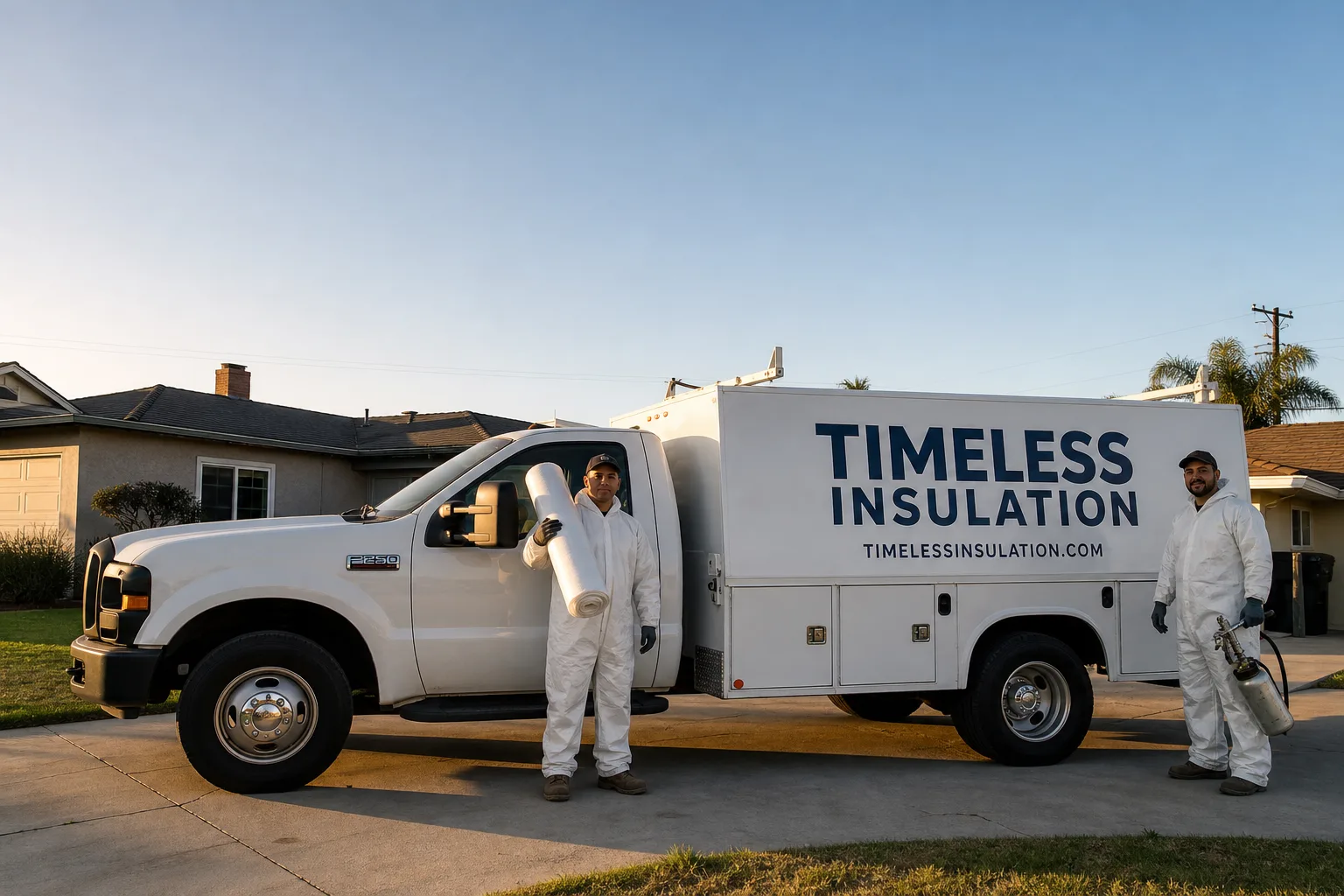
At Timeless Insulation, Spray Foam Insulation is what we do every day, and in Gardena specifically, we’ve learned to read the houses before we recommend a product. Nelson Ibarra, who runs our crew out of Compton, grew up working these South Bay neighborhoods and will tell you straight: a 1952 stucco box near Rowley Park has a different failure mode than a 1960s ranch in 90249. Both need foam. Not the same foam. Not applied the same way. That’s the difference between a quote and a diagnosis.
Call (866) 507-5394 for a free estimate. We’re licensed, insured, and we show up when we say we will.
Why Timeless Insulation Is Gardena’s Preferred Spray Foam Insulation Company
We’re an insulation-only contractor. No HVAC, no roofing side hustle, no “we also do kitchens.” Every technician on our Gardena jobs is there for one reason: to get the right insulation into the right cavity the right way. That single-trade focus means we’re not trying to upsell you into a new furnace while we’re in your attic. We’re looking at your top plates, your rim joists, your crawl-space vapor barrier, and your existing batts, and we’re making a material decision based on what your house actually needs.
Our Gardena customers call us back because we carry eight brands, Icynene and Demilec among them for spray foam, plus Rockwool and CertainTeed for mineral wool and rigid applications. That matters in a city like this, where the job might call for closed-cell below the floor line and open-cell above the roofline in the same visit. Most insulation contractors stock one or two products and sell you whatever they have. We show up with options and then explain, in plain language, why one goes here and the other goes there. Nelson Ibarra has built the crew around that principle: education before installation.
Response time to Gardena is same-day for most calls and next-morning for everything else. We’re based twelve minutes east in Compton, so when you call from near Rowley Park or off Western Avenue, we can be at your door with an infrared camera and a moisture meter before the fog burns off.
Spray Foam Attic Insulation in Gardena
Spray Foam Attic Insulation in Gardena means treating the roofline, not just the ceiling. Most of the attics we open here are unvented or minimally vented, which creates exactly the scenario that ruins insulation. In the 90248 and 90249 corridors where late-summer heat pushes into the 90s, an unvented attic with old blown fiberglass is a heat battery. The fiberglass absorbs radiant heat all day, then radiates it down into the living space all night. Closed-cell foam on the roofline changes that physics. It seals the attic envelope, stops the heat transfer, and in Gardena’s humidity, it also locks out the moisture-laden air that feeds mold on the roof sheathing. A typical Gardena attic between 800 and 1,200 square feet of roofline runs $4,800 to $9,600 for closed-cell at 3 to 4 inches depth.
Open-Cell vs. Closed-Cell on the Roofline
Open-cell spray foam on the roofline in Gardena costs less, between $3.75 and $5.00 per board foot, and it works well in attics where the thermal barrier code is met and the home already has a functional exhaust. But it breathes. That’s normally fine in dry climates, but Gardena’s marine fog can push enough moisture through open-cell that the sheathing never fully dries in June. We use open-cell on the roofline in specific cases, often when budget is the controlling factor and the attic already has a good exterior vapor profile. More often in Gardena, we’re applying closed-cell to the roofline and explaining why the extra cost is earned by the moisture equation.
Air-Sealing the Top Plates First
Before any foam goes into a Gardena attic, we seal the top plates, wire penetrations, and light fixture boxes. This is not optional. In a 1940s or 1950s stick-framed house, the wall-to-attic transition is a highway for warm, moist interior air. Once foam is on the roofline, those bypass points are the only way attic air escapes, and if you skip sealing them, you’re paying to insulate a sieve. The sealing step adds roughly $500 to $1,100 to a Gardena attic job, depending on the number of penetrations, and it’s where we catch most of the problems other bidders miss.
Spray Foam Wall Insulation in Gardena
Spray Foam Wall Insulation in Gardena is where the marine layer problem shows up hardest. The classic scenario is the north-facing wall of a post-WWII stucco bungalow. Warm interior air from the living room migrates into the wall cavity through outlets, baseboards, and old plaster cracks. When that air hits the back of the cold stucco, it condenses. The original insulation, if there was any, soaks up that moisture like a sponge. What we find in Gardena, over and over, is black, sodden batts slumped in the bottom third of the cavity, with staining spreading upward. The fix is not more batts. The fix is a product that does not absorb water and does not leave an air gap for condensation to form. Open-cell spray foam for existing 2×4 walls, or closed-cell for new construction and rim joist applications, solves both problems at once. A four-wall retrofit on a 1,200-square-foot Gardena home generally lands between $5,800 and $9,900 for open-cell, or $8,400 to $14,000 for closed-cell, depending on access and how much failed material we have to remove first.
2×4 Wall Cavities and What They Mean for Foam Choice
Most Gardena homes from the 1940s, 50s, and 60s have 2×4 exterior walls, not 2x6s or 2x8s. That limits cavity depth to 3.5 inches. Closed-cell foam in a 3.5-inch cavity gets you to about R-24.5 and makes the wall more rigid, which is a real benefit in stucco homes that are starting to show hairline cracks. Open-cell in the same cavity gives you roughly R-12.8. That’s a big difference, and in Gardena it’s often the difference between a wall that stays dry and a wall that slowly collects moisture. We usually recommend closed-cell for north-facing walls and leave open-cell as the budget option for south-facing exposure, where the sun bakes the moisture out every afternoon.
Replacing Failed Batts Before You Retrofit
Spray foam over failed, moisture-laden batts is a serious mistake. The foam locks the moisture in place, and you get hidden rot, termite damage, and a wall that still smells like a wet basement every June. Before we spray, we remove the old material and inspect the sheathing. In Gardena’s older homes, we’ve found enough hidden damage behind wet batts that the removal step sometimes triples the job scope. It’s the part of the quote you don’t want to skip, because skipping it is how you pay twice.
Trusted Brands We Service in Gardena
We install and service both Icynene and Demilec spray foam systems, which means we can offer you open-cell and closed-cell products across a real range of price points and performance specs. If the job calls for rock wool, we carry Rockwool; if it needs a rigid or fiberglass component adjacent to the foam, we have CertainTeed in the truck. For Gardena customers, that multi-brand setup means your quote is built around your house’s failure points, not around whatever our supplier happened to have on sale. We stock the common densities and cure-time products for the Gardena market, and because we’re twelve minutes away, we can return same-day if a touch-up pass is needed. You’re not waiting for a distributor shipment from Riverside. The material is here.
Common Spray Foam Insulation Problems We See in Gardena Homes
- Closed-cell foam delaminating from damp stucco. In north-facing walls, if the stucco sheathing is still damp from years of condensation, closed-cell foam can fail to bond properly. It looks fine for the first season, then separates, and moisture gets behind it. We test moisture levels before we spray, which most crews skip.
- Open-cell foam in unvented attics without the required ignition barrier. In the 90248 and 90249 heat spikes, unprotected open-cell foam can exceed its temperature tolerance and degrade. Code in Gardena requires an ignition barrier or thermal barrier on foam in attics. Not every bidder includes it. We do.
- Spray foam over sagging, black batts in a crawl space. In Gardena’s pier-and-beam homes, the north-facing crawl-space wall holds damp all summer. Spraying foam over the failed batts hides the moisture and the rot and the termite tunnels. The right move is removal, inspection, then closed-cell foam on the crawl-space walls.
- Wrong foam density for rim joist applications. The rim joist in a 1950s Gardena ranch is often the biggest single air leak in the house. Closed-cell foam is the only correct product there. Open-cell in the rim joist under high-humidity conditions can pass moisture through to the band board. We see this misapplication often enough that we always inspect it as part of the estimate.
On a 1952 stucco bungalow near Rowley Park, we found exactly this split: the north wall’s original batt insulation hung black and sagging, wet all the way through, while the south attic was full of baked-in dust and degraded fiberglass. We removed everything, sealed the top plates, and applied closed-cell foam to the crawl-space walls and open-cell to the attic roofline. That home stopped smelling like earth within a week, and the owners told Nelson the summer temperature swing in the living room dropped by a third. That is the Gardena pattern, and the fix has been the same since we started working this city.
Pricing for Spray Foam Insulation in Gardena, CA
Here are the ranges we quote most often in Gardena. An attic roofline on an 800 to 1,200 square foot home runs $4,800 to $9,600 for closed-cell. Open-cell on the same attic runs $2,900 to $5,800. A full four-wall spray on a 1,200 square foot bungalow is $5,800 to $9,900 for open-cell and $8,400 to $14,000 for closed-cell. A rim joist treatment for a typical 900-square-foot crawl space lands between $1,200 and $2,400. Removal of failed batts, if you have the classic north-wall moisture problem, adds $800 to $2,000 depending on how much material and how much damage we uncover. Every estimate is free, and we give you the number in writing before we start. Call (866) 507-5394 for a quote based on your exact floor plan.
We Also Serve Cities Near Gardena
Beyond Gardena, our crews cover Spray Foam Insulation in Gardena‘s neighboring communities, including West Rancho Dominguez, Alondra Park, West Athens, and Lawndale. If you’re in one of those cities and seeing the same marine-layer moisture problems in your crawl space or north-facing walls, call the same number and we’ll schedule the same week.
Serving Gardena, CA — Our Local Coverage Area
We’re based in the Gardena area and know this community well. Use the map below to see our service coverage — if you’re nearby, we can almost certainly help.
FAQs About Spray Foam Insulation in Gardena
Yes. Closed-cell spray foam on the crawl-space walls stops the condensation cycle by creating a continuous, non-absorbent air and vapor barrier. The old batts have to come out first, because spraying over them traps the moisture and the mold stays active. Once the foam is in, the north-facing dampness no longer gets into the wall cavity, and the black batt problem does not come back. Call (866) 507-5394 and we’ll inspect your crawl space before you commit.
You can, but you shouldn’t, and we won’t. Existing fiberglass batts in a 1950s Gardena attic have usually been sitting in humid marine air for decades, and they’re often contaminated with dust, rodent debris, or moisture staining. Foam needs a clean, dry substrate to bond. We remove the old batts, inspect the sheathing and top plates, air-seal, then apply foam to the appropriate depth. The removal adds cost, but it’s the only way the foam performs as designed.
No. Spray foam goes into the existing 3.5-inch wall cavity, between the studs, not on top of them. It adds zero thickness to the wall and won’t affect your trim, baseboards, or window casing. The foam expands to fill the cavity, then we shave it flush with the stud faces before you reinstall drywall or re-clad the wall. Your interior dimensions don’t change.
Closed-cell spray foam has an R-value of about 7 per inch and, more importantly, it stops the air movement that makes batts fail in heat spikes. In Gardena’s 90248 and 90249 zones, where late-summer temperatures push into the 90s, fiberglass batts allow hot air to filter through the wall assembly. Foam creates a continuous air seal, so the heat stays outside, and the insulated cavity stays at indoor temperature. The difference on a west-facing wall in August is measurable, often a 10 to 15 degree reduction in interior wall surface temperature.
Yes, when the right product is used in the right place. Closed-cell foam on the rim joist and crawl-space walls is standard practice in pier-and-beam homes, and it handles Gardena’s damp north-side conditions better than any batt or vapor barrier combination. The key is prep: we remove any rotted wood, treat for termites where needed, and confirm the ground vapor barrier is in place before spraying. Then the foam seals the crawl space and keeps the marine moisture out for the life of the structure. Nelson Ibarra has been working on South Bay pier-and-beam foundations long enough to know exactly when foam is the answer and when the subfloor needs attention first.
Written by Nelson Ibarra, Owner at Timeless Insulation, serving Gardena and the South Bay since our first day.