
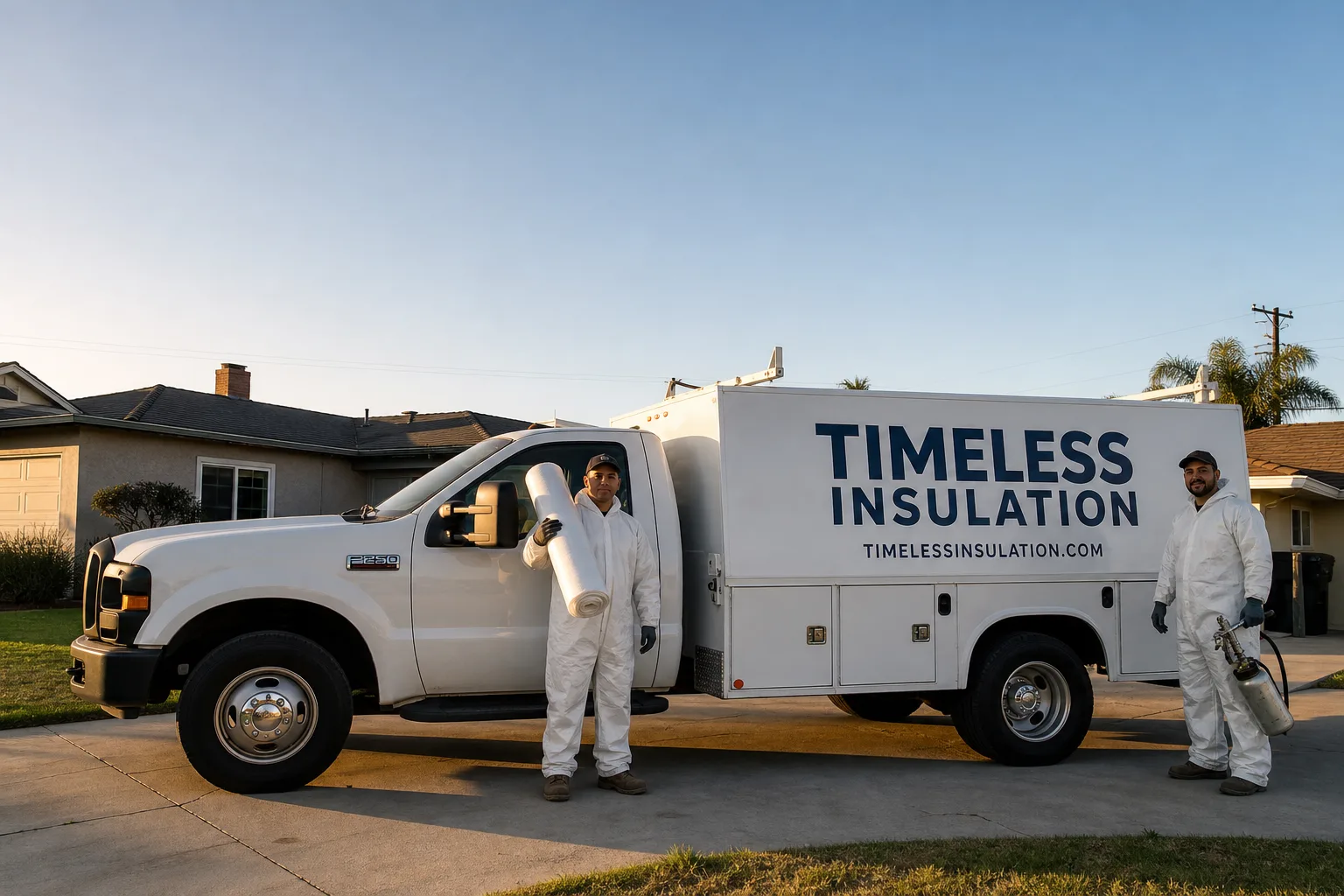
Fast, Reliable Spray Foam Insulation Across Long Beach
Spray foam insulation in Long Beach costs between $2,100 and $7,400 for a typical retrofit, with wall installations running $4.50 to $9.00 per square foot and rim joist work landing around $18 to $28 per linear foot. The real question isn’t whether foam works here. It’s whether the installer understands that Long Beach’s marine layer changes everything about how foam should be applied, sealed, and specified. We do. Timeless Insulation works throughout Long Beach weekly, from the stucco bungalows off Belmont Avenue in 90803 to the post-war ranches inland near 90808, and we spec every job for salt air, onshore humidity, and the old wall cavities this city is built on. Call (866) 507-5394 for an estimate that accounts for what your actual house actually needs.
Why Timeless Insulation Is Long Beach’s Preferred Spray Foam Insulation Company
Long Beach homeowners keep calling us for a simple reason: we carry eight insulation brands, including Icynene and Demilec spray foam lines, so our recommendation for your Belmont Heights bungalow or your Lakewood-adjacent tract house is driven by the house, not by what’s sitting in our warehouse. That matters in a city where a 1920s stucco-and-lath wall in 90804 has nothing in common with a 1970s wood-frame ceiling near El Dorado Park. Our team is insulation-only. Every technician who shows up at your Long Beach door has spent their entire workday, every workday, on insulation. Spray foam, blown-in, attic retrofits, nothing else.
Response time to Long Beach from our Compton shop is typically same-week, and for rim joist or wall-cavity projects in 90802, 90803, and 90804 we’re often on-site within days. We know where the permit counter is, we know which inspectors want to see foam depth documentation, and we know which Long Beach neighborhoods need corrosion-rated fasteners versus where standard hardware holds up fine. Nelson Ibarra leads our crew, and he’s walked enough Long Beach attics to know what happens when foam goes in without addressing the roof leak above it first. We don’t do that. We fix the assembly before we seal it.
Why Spray Foam in Long Beach Is Different From Inland LA
In the 1920s-40s stucco-and-lath bungalows around 90803 and 90804, closed-cell spray foam is often the only way to get a vapor-and-air barrier into wall cavities that have no sheathing to dry against, because exterior drying is blocked by multi-coat stucco. Salt-laden onshore air also corrodes fasteners and foil facings within blocks of the beach, so we spec corrosion-rated fasteners and closed-cell (not foil-faced) where the marine layer keeps wall cavities damp. This is not the R-value pitch you’d get for a Pasadena or Glendale house. Long Beach is a coastal marine-layer city. The problem is not winter cold. It’s year-round moisture and salt air. The damp onshore flow off the Pacific pushes condensation into walls and attics that many inland-LA homes never see, and insulation work here has to be vapor-smart and corrosion-aware. Foil-faced and closed-cell choices matter more here than bragging-rights R-values, and pieces installed for a San Gabriel Valley house can fail a block from the beach.
On a 1938 Spanish-style stucco bungalow off Belmont Avenue in 90803, we opened the attic and found the original mineral wool batts collapsed to a matted two-inch pancake, black with old roof-leak staining and rust on every staple. After air-sealing the top plates and penetrations, we sprayed two inches of closed-cell foam across the attic floor and up the rim joists, then re-insulated over it, so the damp marine-layer air could no longer condense on a cold ceiling plane. That’s the kind of job that only makes sense if you understand Long Beach’s housing stock specifically. Stucco-and-lath walls, low-pitch or flat roofs, and older stud cavities with little or no existing insulation are common here, so retrofit access usually means working from the attic and exterior rather than easy cavities.
Spray Foam Wall Insulation in Long Beach
Spray Foam Wall Insulation in Long Beach typically means injecting or applying foam into wall cavities that were never insulated or have since settled, compressed, or been torn out during renovations. In the 1920s-40s bungalows near 90802 and 90803, those walls are stucco and lath, not drywall over sheathing. That changes access. We don’t gut your walls. We work from the attic, from the crawl space, and through small drilled openings in exterior stucco where it makes sense. Closed-cell foam, from Icynene or Demilec, is often the right call here because it gives the vapor resistance and air sealing those old cavities were never designed to have. Open-cell has its place too, especially in interior partition walls where sound control matters more than moisture resistance. Expect spray foam wall work in Long Beach to run $4.50 to $9.00 per square foot. A full exterior retrofit on a 1,200-square-foot bungalow usually lands between $5,800 and $9,600.
When to Choose Closed-Cell for Long Beach Walls
Closed-cell makes sense in Long Beach when the wall assembly can’t dry outward. That’s most stucco houses here. The foam itself acts as the vapor retarder, the air barrier, and the structural stiffener in one pass. Around 90804’s Spanish-style houses, we’ve seen closed-cell stop condensation that had been re-wetting wall insulation every damp morning for decades.
Open-Cell for Interior Walls and Sound Control
Open-cell foam is lighter and about half the material cost of closed-cell. For Long Beach homeowners who want to cut noise bleed between rooms in mid-century apartment conversions or duplexes near the water, open-cell is usually the better fit. It’s not a vapor barrier, so we use it in assemblies where moisture has a drying path.
Rim Joist Spray Foam in Long Beach
Rim Joist Spray Foam in Long Beach targets the band joist where your floor framing meets the foundation, a spot that leaks air in almost every pre-1980 house in this city. The rim joist is where the wood frame of your floor sits on top of the foundation wall, and in Long Beach’s 1950s-70s tract homes around 90805, 90806, and 90808, those rim bays were often left completely open or stuffed with a thin fiberglass batt that never sealed anything. We spray about two inches of closed-cell foam into each bay, which air-seals and insulates the cavity while also dampening the crawl-space moisture that rises constantly in coastal soil. Rim joist work in Long Beach typically runs $18 to $28 per linear foot. An average single-story ranch with a 120-foot perimeter lands around $2,300 to $3,600, and it’s usually done in one day.
Crawl Space Moisture and Long Beach Rim Joists
Long Beach’s high water table and marine humidity push moisture into crawl spaces year-round. A sealed rim joist keeps that damp air from drafting up into your walls. This matters more than R-value here, and it’s a reason homeowners notice the difference in floor temperatures near exterior walls even on mild days.
When Rim Joists Have Already Been Foamed
We see failed rim joist foam in Long Beach when a previous contractor used standard fasteners within blocks of the beach. Salt air rusts those fasteners, and the foam debonds at the deck or rim. We replace it with corrosion-rated hardware and a new pass of closed-cell. You shouldn’t have to redo this every five years.
Trusted Brands We Service in Long Beach
We service and install spray foam from Icynene and Demilec, the two spray foam brands we stock alongside our full Spray Foam Insulation lineup. That gives Long Beach customers access to both open-cell and closed-cell chemistry without us having to push one product for every job. For homeowners who want a recycled-content alternative in blown-in work, we also carry GreenFiber. But for spray foam specifically, the Icynene and Demilec lines cover everything from a 90803 attic floor to a 90840 condo rim joist. We keep material on hand for Long Beach jobs, so turnaround is faster than ordering per project. And because our installers work with these products every week, they know cure times, temperature windows, and depth per pass without guessing.
Common Spray Foam Insulation Problems We See in Long Beach Homes
- Closed-cell sprayed over a damp legacy ceiling plane. When an old roof leak in a 1930s bungalow near 90803 was never fixed and closed-cell foam goes over the wet framing, the foam becomes a lid. Moisture gets trapped, and the paint blisters below within one marine-layer season. We always track down and fix the leak first.
- Foil-facing and standard fasteners corroding near the beach. Within blocks of the water in 90802 and 90803, salt air chews through standard fasteners and foil facings. Foam debonds at the roof deck or rim. We spec corrosion-rated fasteners and skip foil-faced products entirely in the beach zone.
- Over-applied foam on low-pitch or flat roofs. Older Long Beach stock has a lot of flat and low-pitch roofs. When foam gets applied too thick on the underside, the sheathing can’t dry inward, which causes rot at the eaves. Depth control matters here more than anywhere else in the county.
- Matted and compressed legacy insulation hiding air leaks. In attics around 90804, decades of marine-layer humidity compress old mineral wool or fiberglass into a thin damp mat. The insulation is doing almost nothing, and the real problem is air movement. We remove it, air-seal, then spray foam the floor and rim before re-insulating.
Pricing for Spray Foam Insulation in Long Beach, CA
A typical Long Beach spray foam job lands between $2,100 and $7,400, depending on scope and the age of the house. Wall insulation runs $4.50 to $9.00 per square foot. Rim joist work runs $18 to $28 per linear foot. Attic floor spray foam, which we do frequently in 90803 and 90804 bungalows, usually falls between $3,200 and $6,800. What moves the number: access difficulty in older stucco houses, whether we’re removing damp legacy insulation first, and whether the job is open-cell or closed-cell. Closed-cell costs more per board foot but delivers the vapor and air sealing Long Beach’s coastal houses actually need. Every estimate we give in Long Beach includes line-item pricing and a written scope. Call (866) 507-5394 for a free estimate. We’ll give you exact numbers, not a range with fine print.
We Also Serve Cities Near Long Beach
Timeless Insulation covers the full Long Beach area and the cities around it. We work regularly in Signal Hill, Lakewood, Carson, and West Carson. If you’re in one of those communities and shopping for Spray Foam Insulation in Long Beach quality without the bigger-company runaround, call us. Our crews route through the South Bay weekly, so scheduling stays tight and response stays fast.
Serving Long Beach, CA — Our Local Coverage Area
We’re based in the Long Beach area and know this community well. Use the map below to see our service coverage — if you’re nearby, we can almost certainly help.
FAQs About Spray Foam Insulation in Long Beach
Long Beach’s marine layer dominates the insulation picture. Pasadena gets cold nights and dry air; Long Beach gets cool damp mornings, mild winters, and constant onshore humidity. Vapor control and drying paths matter more here than raw R-value, and we spec closed-cell foam in Long Beach assemblies where an inland contractor would use open-cell or fiberglass without a second thought. If you want a quote that reflects coastal reality, call (866) 507-5394.
Yes, in most cases. We drill small access holes in the stucco or work from the attic and crawl space to reach wall cavities. The exterior stays intact. Closed-cell foam goes in through those openings, expands to fill the cavity, and we patch the holes to match. This is a standard retrofit for Long Beach’s older bungalows. Want specifics for your house? Call (866) 507-5394 and Nelson can talk you through it.
It’s usually both. The marine layer supplies the humidity, but a roof leak or failed flashing supplies the bulk water. The two combine in Long Beach attics and turn insulation into a compressed, ineffective mat. We inspect for leaks before spraying anything. In most 90803 homes we see, the fix is remove, air-seal, spray foam the attic floor, and re-insulate on top.
The cured foam is chemically stable. What salt air attacks is the hardware: fasteners, bracket mounts, foil facings. Within a few blocks of the water in 90802 and 90803, we use corrosion-rated fasteners and spec closed-cell rather than foil-faced products. That’s an easy thing to get wrong and a common reason we get called to replace someone else’s work.
Yes, but for a different reason than in cold climates. In Long Beach, the payoff is moisture control, air sealing, and comfort consistency, not furnace savings. Homes near the water get clammy and drafty even when it’s 65 degrees out. Closed-cell foam fixes the draft and the damp in one pass, and it lasts decades. Call (866) 507-5394 for an estimate on your specific house.
Written by Nelson Ibarra, Owner at Timeless Insulation, serving Long Beach and the surrounding South Bay cities.