
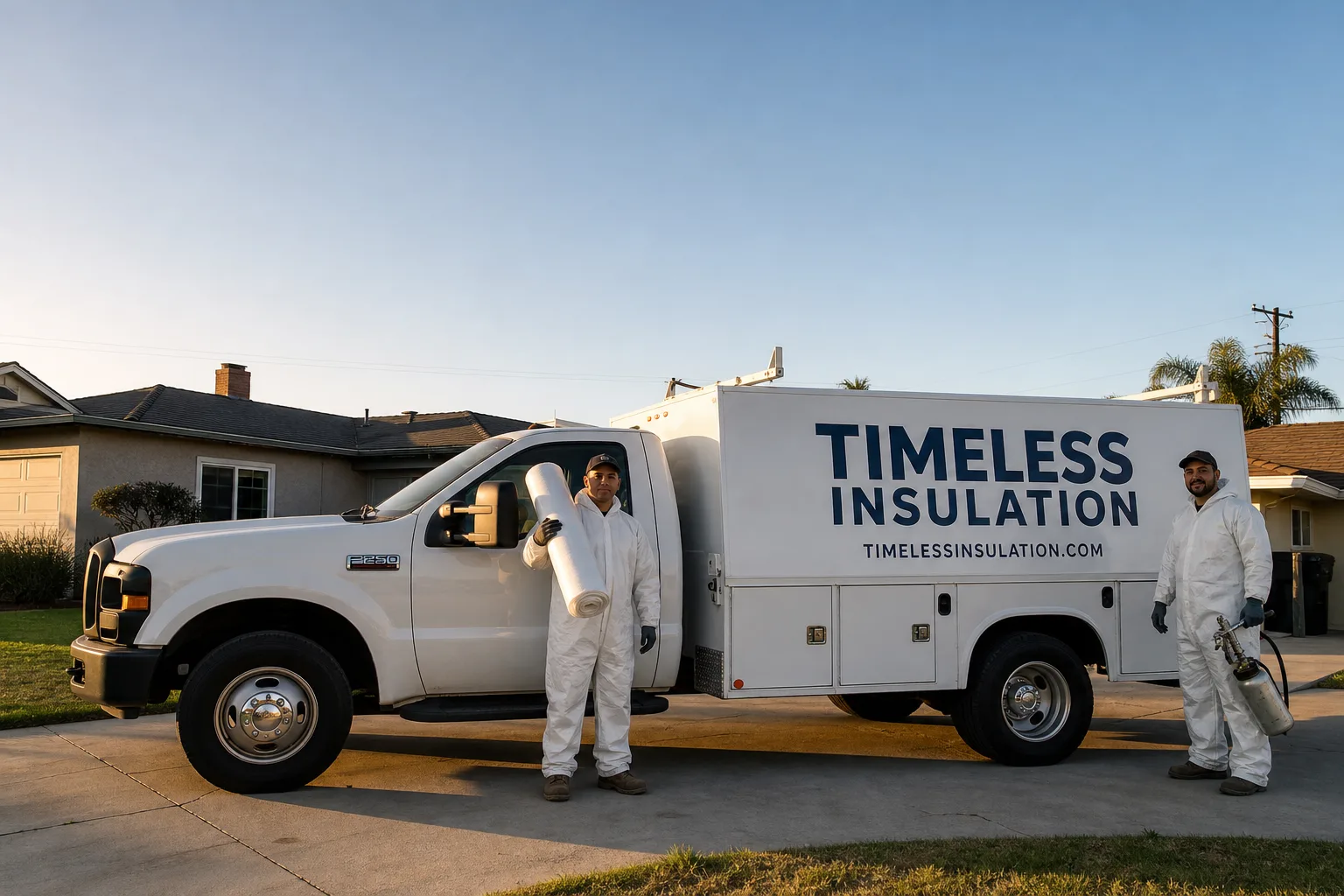
Fast, Reliable Spray Foam Insulation Across Lakewood
Spray foam insulation in Lakewood typically runs $2.80 to $6.50 per board foot installed, with most 1950s tract home retrofit projects landing between $4,200 and $9,800 depending on what we’re sealing. Closed-cell foam costs more than open-cell, but it’s usually the right call here because Lakewood’s coastal air and original construction demand more from insulation than a typical inland suburb. We know these blocks. We’ve worked the Lakewood Plan neighborhoods from Mayfair to Carson Park, and we know what’s behind those stucco walls: usually nothing. Call us at (866) 507-5394 for a free estimate, and we’ll tell you straight what your house actually needs.
Why Timeless Insulation Is Lakewood’s Preferred Spray Foam Insulation Company
We’re an insulation-only contractor, which sounds simple but it’s not common. Most companies that spray foam in Lakewood also do HVAC, roofing, or general remodeling. We don’t. Every technician on our crew works with insulation every single day, and we carry eight manufacturer lines including Icynene, Demilec, Knauf, and Rockwool so we’re never forced to sell you the only product on the truck. Nelson Ibarra built this company around the idea that a homeowner deserves a straight answer about what material fits their house, not a sales pitch for whatever’s in stock.
Lakewood homeowners call us because they’ve heard from neighbors that we actually show up, do the work cleanly, and don’t leave a mess in the attic or the driveway. Response time to Lakewood is typically same-week, often faster. We’re based in Compton, which puts us about fifteen minutes from most Lakewood addresses, and we keep our schedule flexible for the 90711, 90712, 90713, and 90714 zip codes. When we say we’ll be there Tuesday, we mean Tuesday morning. Nelson Ibarra still walks most of the larger Lakewood job sites himself, which is rare for a company our size, but it means the person quoting the job is the same person who will stand behind it.
Being local means we’ve seen what decades of salt air does to a garage door after we’ve insulated the ceiling. It means we know that a 1953 stucco tract home near Mayfair Park has different wall conditions than a 1985 addition near the Lakewood Country Club. That local knowledge isn’t something you can train into a franchise crew from another county. It comes from years of crawling through Lakewood attics and drilling into Lakewood walls.
Garage Spray Foam Insulation in Lakewood
Garage Spray Foam Insulation in Lakewood is one of the most common calls we take, because these postwar garages were built as uninsulated shells attached to the house. In Lakewood’s 1950s tract homes, the garage ceiling is often nothing but open rafters and bare roof sheathing, which means every degree of heat that hits that low-pitch roof radiates straight down into the garage and through the shared wall into the kitchen or den. We spray closed-cell foam directly onto the garage ceiling and the shared wall, typically running $1,800 to $3,400 for a standard one-car garage, and most jobs are done in a single day.
What many Lakewood homeowners don’t expect is how the salt air complicates the job. Those 70-year-old garage door springs and hinges have been corroding in coastal moisture since the Eisenhower administration. When we spray foam the ceiling, we also check the door hardware, because sealing the garage tighter means the door will be opened and closed far less, and corroded springs don’t like sitting still. We’ll swap in galvanized springs and stainless hinges where the rust has gone too deep, which keeps the door running smoothly for years after the foam has cured.
Attic-Linked Garages and Heat Transfer
Most Lakewood garages share not just a wall but an attic space with the main house. Spray foam on the garage ceiling doesn’t just cool the garage, it cuts the heat load on the adjacent living space. Homeowners near Long Beach Boulevard and Del Amo regularly tell us their kitchen stays cooler after we seal the garage ceiling, because that shared attic was acting like a radiant heater aimed straight at the house all afternoon.
Salt-Air Hardware Inspection
While we’re up there, we look at the garage door track, rollers, and opener chain. Lakewood’s coastal air means springs can snap within three to five years of exposure if they’re not coated. We recommend galvanized or powder-coated springs for any garage we insulate within two miles of the coast, and we inspect the hardware as part of the job, not as an add-on upsell.
Closed Cell Spray Foam Insulation in Lakewood
Closed Cell Spray Foam Insulation in Lakewood is the workhorse material for these homes, because it does two jobs at once: it seals and it insulates. Closed-cell foam cures into a rigid, dense layer that stops air movement completely, which matters in Lakewood’s original stucco walls where there may be no cavity insulation at all. Closed-cell runs roughly $1.10 to $1.60 per board foot more than open-cell, which translates to a typical Lakewood attic seal of $6,500 to $9,800 depending on square footage and depth. It’s the right product when you’re dealing with a bare attic floor, original wall cavities, and a low-pitch roof that bakes in the South Bay sun from April through October.
Closed-cell foam also adds structural rigidity to older framing. Many Lakewood plan homes have roof decking and rafters that have been through seventy Southern California summers, and the dense foam bonds to the wood and holds everything tighter. That’s a real benefit in a house built during the post-war construction boom, when materials were cheap and timelines were fast. Nelson Ibarra and our crew have dense-packed the exterior walls of dozens of these homes with closed-cell foam, and the difference in both comfort and sound deadening is immediate.
Exterior Wall Dense-Packing
This is the technique that separates Lakewood spray foam work from inland suburbs. Because these 1950s tract homes were built with bare stucco walls and no cavity insulation, we often have to drill from the outside and dense-pack closed-cell foam into the wall cavities. It’s slower than an open attic spray, but it’s the only way to fill a 2×4 wall that was never insulated in the first place. We match the stucco patch to the original texture and repaint to match, so the exterior looks untouched.
Low-Pitch Attic Radiant Heat Protection
Lakewood’s low-slung gable roofs trap summer heat like a solar oven. Closed-cell foam on the roof deck stops most of that heat from entering the attic, but we also recommend a radiant barrier or reflective coating on top of the foam for attics with full south or west exposure. The foam itself will last decades, but a radiant barrier over it extends its effective life and drops attic temperatures another 15 to 20 degrees in July and August.
Trusted Brands We Service in Lakewood
We stock Icynene and Demilec spray foam products for Lakewood jobs, and we carry Knauf and Rockwool for homes that need a hybrid approach: spray foam for the attic and mineral wool for interior wall cavities or soundproofing applications. Icynene’s open-cell and closed-cell lines cover most Lakewood retrofit needs, while Demilec gives us a high-lift closed-cell option for exterior dense-packing on stucco walls. Because we stock these locally and know these products inside out, we’re not waiting on a distributor for every Lakewood job. When a homeowner near Mayfair Park calls on a Tuesday, we can typically be in the attic by Thursday.
Common Spray Foam Insulation Problems We See in Lakewood Homes
- Bare attic floors on original 1950s construction. We regularly open attic hatches in Lakewood and find nothing between the ceiling joists but decades of dust. These homes were built before insulation was standard, and the attic floor may have never been touched since the day the house was finished.
- Corrosion on garage-door springs and hinges from coastal salt air. Lakewood sits close enough to the Pacific that marine air works its way inland, especially in the evening. Springs that would last ten years in Bellflower or Paramount can seize or snap in three to five years here. We replace them with galvanized hardware during garage insulation jobs.
- Uninsulated exterior walls behind original stucco. The Lakewood Plan builders simply skipped wall insulation. That means we’re often dense-packing from the outside through the stucco, which requires drilling, filling, and matching the patch texture. It’s more involved than an attic job, but it’s the only way to get foam into a wall cavity that’s been empty since 1952.
- Radiant heat damage to foam on low-pitch roofs. A low-pitch Lakewood roof with direct western or southern exposure can push attic temperatures past 140 degrees in late summer. Spray foam holds up, but we recommend a radiant barrier or reflective coating on these exposures so the foam isn’t doing all the thermal work alone year after year.
Pricing for Spray Foam Insulation in Lakewood, CA
Here are the numbers we quote on Lakewood jobs, so you have a real starting point before anyone shows up. Open-cell spray foam in a standard attic runs $2.80 to $4.20 per board foot, which lands most Lakewood attic seals between $3,800 and $6,200. Closed-cell foam runs $4.50 to $6.50 per board foot, with full attic and roof deck jobs running $6,500 to $9,800 depending on square footage and access. Garage ceiling insulation, which we do constantly in Lakewood, runs $1,800 to $3,400 for a one-car garage and $3,200 to $5,800 for a two-car. Exterior wall dense-packing, where we drill through stucco, runs $7 to $12 per square foot of wall area, and a typical four-wall Lakewood tract home lands between $8,000 and $14,000. Those are honest ranges, and we’ll give you a fixed quote before any work starts. Call (866) 507-5394 for a free estimate, and we’ll walk the house with you and explain exactly what you’re paying for.
We Also Serve Cities Near Lakewood
If you’re in Signal Hill, Bellflower, Long Beach, or Paramount, we cover those areas too. Our spray foam crews work throughout the South Bay coastal plain, and the same team that handles our Spray Foam Insulation projects in Compton and Lakewood serves those neighboring cities. And for a broader look at what we do in the area, see more about Spray Foam Insulation in Lakewood and the surrounding communities we serve. Same materials, same standards, same Nelson Ibarra standing behind the work.
Serving Lakewood, CA — Our Local Coverage Area
We’re based in the Lakewood area and know this community well. Use the map below to see our service coverage — if you’re nearby, we can almost certainly help.
FAQs About Spray Foam Insulation in Lakewood
Lakewood’s original 1950s tract homes were built with bare stucco walls and no cavity insulation, so there’s no existing material to remove or build on. Dense-packing from the exterior is the most reliable way to fill those empty wall cavities with closed-cell foam without tearing out interior drywall. We drill through the stucco, inject the foam at controlled pressure, patch the holes to match the original texture, and repaint. It’s the only method that works on these particular walls, and we’ve used it on homes throughout the Lakewood Plan area from Mayfair Park down to the 90713 zip code. Call (866) 507-5394 and we’ll assess your walls and tell you if dense-packing is the right move for your house.
It doesn’t affect the foam itself much; it affects the hardware around it. Lakewood’s coastal exposure means garage-door springs, hinges, and rollers corrode years faster than they would inland, and when you seal the garage with spray foam, the door gets opened less, which lets that corrosion sit and worsen. We replace corroded springs with galvanized or powder-coated versions and swap rusty hinges for stainless as part of our garage foam jobs. The foam will be fine for decades. Untreated hardware won’t make it five years.
Closed-cell spray foam is the better choice for Lakewood’s low-pitch roofs because of the intense summer radiant heat. Closed-cell foam has a higher R-value per inch, which matters when you have limited attic depth, and it holds up better under the 140-plus-degree temperatures these roof decks reach in August. We typically install closed-cell directly on the roof deck, then add a radiant barrier over it on south and west exposures to extend the foam’s effective life and drop attic temperatures further. For the original Lakewood Plan homes with bare attic floors, closed-cell on the roof deck is the most effective retrofit we offer.
Every two to three years in Lakewood, given the salt air. Coastal corrosion works slowly, but it works constantly, and the hardware on an insulated garage door sees less movement, which makes rust more likely to seize the springs or hinges. We’ll check the springs, rollers, and track when we do the initial foam job, and we recommend a quick annual visual check by the homeowner, with a professional inspection every two to three years. If the door starts sounding stiff or groaning when it opens, that’s the cue to have the hardware looked at before a spring snaps.
Yes, and we do it regularly. The original stucco on these 1950s Lakewood Plan homes is a cement-based render that handles drilling and patching well, which makes exterior dense-packing viable. We drill small access holes through the stucco, inject closed-cell foam into the empty wall cavity, then patch and texture-match the stucco so the exterior looks original. The real challenge isn’t the stucco itself; it’s that these walls have no insulation behind them, so the foam has to do all the thermal work from day one. Closed-cell is the right product for that, because it seals air movement and insulates in a single application. Call (866) 507-5394 for a free walk-through of your walls, and we’ll tell you exactly what we’d do and what it would cost.
Contact Timeless Insulation for Spray Foam in Lakewood
If you own one of Lakewood’s 1950s tract homes and you’re tired of rooms that won’t hold temperature, or a garage that feels like a kiln in August, call us. Nelson Ibarra and the Timeless Insulation crew have been dense-packing, attic-sealing, and garage-insulating these houses long enough to know exactly what your Lakewood home needs before we even open the attic hatch. We carry Icynene and Demilec closed-cell and open-cell foams, and we’ll recommend the right one for your walls, your roof, and your budget, not the one that’s easiest for us. Call (866) 507-5394 today for a free estimate, and let’s get your Lakewood home sealed up right.
Written by Nelson Ibarra, Owner at Timeless Insulation, serving Lakewood and the South Bay coastal plain.