
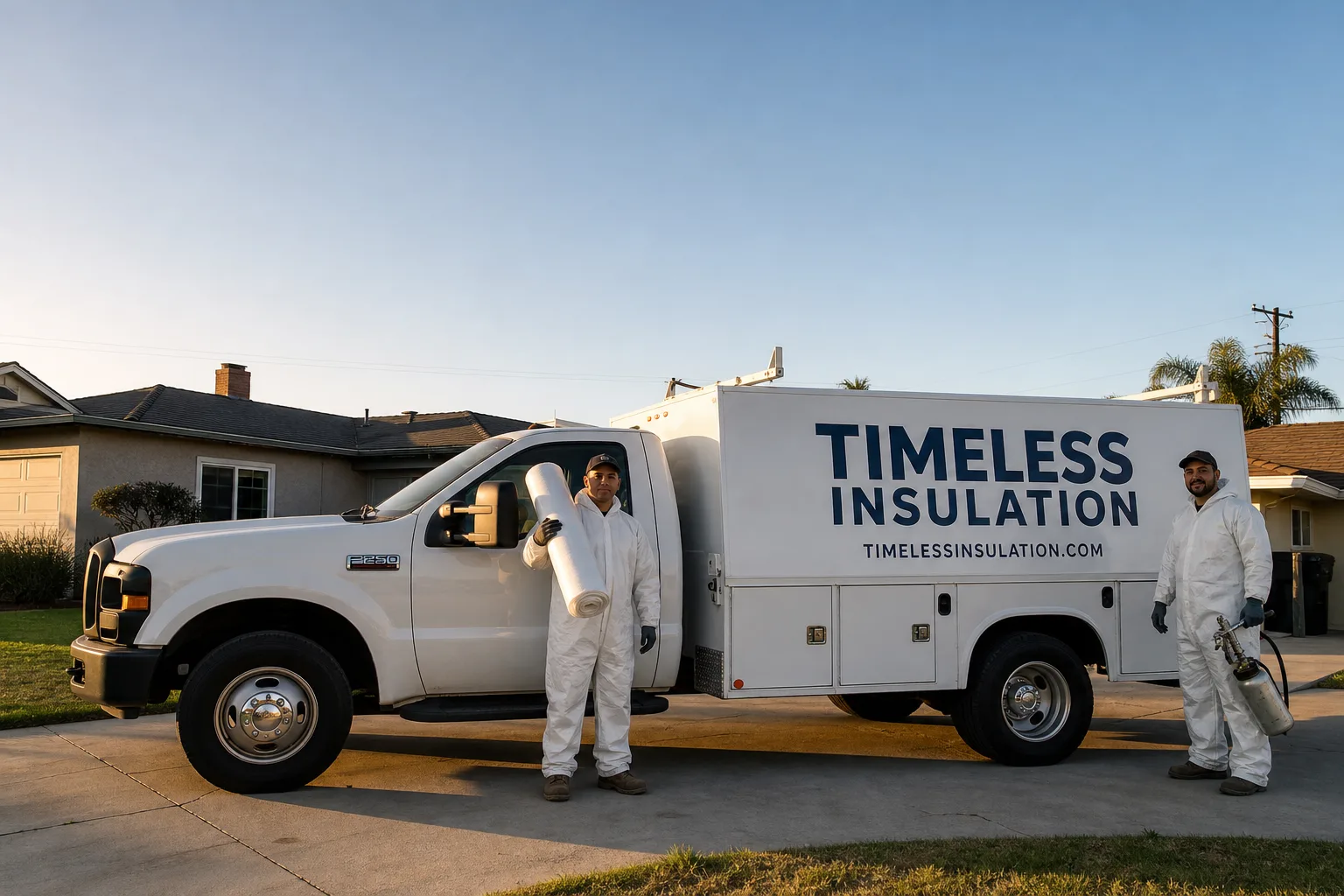
Spray Foam Insulation in South Gate: What It Costs and How It Works in Older Stucco Homes
Spray foam insulation in South Gate typically costs $2,800 to $7,500 for a full attic application in a pre-1960 stucco bungalow, with rim joist work running $900 to $2,300 and crawl space encapsulation between $3,200 and $6,800. Those are real numbers for this city’s housing stock, not national averages. Most South Gate jobs we do are retrofit work on homes built between the 1920s and 1960s, where old insulation has settled, compacted, or was installed wrong in the first place. The reason spray foam beats re-blowing fiberglass or cellulose in many of these houses comes down to access: when an attic is so low you can’t crawl through it, foam reaches the corners that loose-fill simply can’t.
We’re Timeless Insulation, an insulation-only contractor led by Nelson Ibarra, and we work across South Gate’s 90280 zip code from our base in Compton. Call (866) 507-5394 for a free estimate. We’ll tell you honestly whether spray foam is the right material for your house or whether something else makes more sense.
Key takeaways for South Gate homeowners:
- 1
Spray foam is often the only way to hit current R-value targets in low-slung, tight-lotline attics where loose-fill can’t be properly distributed.
- 2
Work on pre-1960 homes here almost always requires removal of old insulation first, which cheap blow-in quotes skip.
- 3
We stage equipment in alleys and run hose through windows when side yards are too narrow, because that’s what South Gate’s lot configuration demands.
- 4
Timeless Insulation carries eight brands, including Icynene and Demilec for spray foam, so the recommendation fits your house, not our inventory.
Fast, Reliable Spray Foam Insulation Across South Gate
If you live in South Gate and you’ve been fighting hot rooms every summer, you’re not imagining it. Homes along Firestone Boulevard, Tweedy Boulevard, and the residential blocks off Long Beach and Atlantic were mostly built when insulation was an afterthought. What’s in the attic now is often a tired layer of settled cellulose or rock wool from the Truman administration, maybe covered by a homeowner-installed fiberglass batt that’s compressed and doing almost nothing. Our Spray Foam Insulation team knows these houses because we’ve worked in dozens of them. We respond to South Gate calls within one business day for estimates, and we schedule work around your street’s parking situation. Call us at (866) 507-5394 and we’ll walk you through what’s actually in your attic before we quote a number.
Local knowledge matters here. South Gate’s homes sit tight to the property line. Side yards on the 1940s and 50s stucco bungalows are sometimes three feet wide. That changes how a spray foam rig gets set up, how hose gets run, and how long a job takes. A crew that’s never worked this area will park on the street, block your neighbor’s driveway, and still under-insulate the far corner of your attic. We plan for alley access, we know which blocks have the tightest lots, and we stage equipment accordingly.
Why Timeless Insulation Is South Gate’s Preferred Spray Foam Insulation Company
South Gate homeowners tend to comparison-shop hard, and they should. The difference with us is that insulation is the only trade we practice. Nelson Ibarra built this company around a single idea: if you’re going to recommend a material, you should carry enough options that the recommendation is driven by the job, not by what’s on the truck. We carry eight manufacturer brands, including Icynene and Demilec for spray foam, Knauf and CertainTeed for batt and blown systems, and Rockwool for specialty fire and sound applications. That’s not a marketing line. It means when a South Gate homeowner needs open-cell foam for an attic, we sell open-cell. When a rim joist needs closed-cell for moisture control, we sell closed-cell. We don’t upsell.
Our reputation in South Gate comes from showing up on time, doing the removal work other crews skip, and leaving the attic floor clean enough to walk on. Customers who’ve hired us on Tweedy, State Street, and in the neighborhoods north of Firestone regularly tell us the difference is the prep work: old insulation out, top plates air-sealed, wiring penetrations addressed before any foam goes in. That’s what makes the R-value actually perform. Estimates are free and we don’t pressure you into a decision on the spot.
Rim Joist Spray Foam in South Gate
Rim Joist Spray Foam in South Gate homes is one of the highest-return insulation jobs available, especially in the raised-foundation bungalows and minimal-traditional houses built between the 1920s and 1950s. The rim joist is the band of wood where your floor framing meets the foundation wall. In these older houses it’s almost never insulated or air-sealed, which means outside air moves freely under your floor and up through the walls. Closed-cell spray foam applied to the rim joist stops that air movement and adds structural rigidity. A typical rim joist project in South Gate runs $900 to $2,300 depending on the home’s footprint and whether the crawl space is accessible from inside or only through a side vent.
We emphasize this work in South Gate because so many homes here sit on raised foundations with vented crawl spaces. The concrete-slab tract homes built after about 1960 don’t have rim joists in the same way, but the earlier stock does. Spray foam is the right material here because it adheres to the wood and concrete, fills the odd gaps and notches around old plumbing and electrical runs, and doesn’t sag or settle the way batt insulation does in a damp crawl space.
Why Closed-Cell Is the Right Call for Rim Joists
Closed-cell foam acts as a vapor barrier as well as an air seal. In a South Gate crawl space, where winter moisture and summer heat both move through the foundation vents, open-cell foam would absorb that moisture over time. Closed-cell won’t. It’s a more expensive material per board foot, but for a rim joist application the total square footage is modest, so the cost difference is usually only a few hundred dollars.
Air Sealing Before You Insulate
We don’t spray foam over gaps and cracks; we seal them first. On South Gate rim joist jobs, that means addressing the plumbing penetrations, the old gas-line holes, and the gaps where floor joists sit on the mudsill. Foam goes in after that work is done. Skipping the air-sealing step is why some spray foam jobs underperform, and it’s a corner we won’t cut.
Crawl Space Spray Foam Insulation in South Gate
Crawl Space Spray Foam Insulation in South Gate addresses a problem that’s invisible until you’ve lived with it: floors that never warm up in January, cold drafts moving through the living room, and musty smells rising from below. Many pre-1950 homes in the 90280 zip code have vented crawl spaces with decades of deferred maintenance. Applying closed-cell spray foam to the crawl space walls and rim joists converts that damp, vented space into a sealed, conditioned area that doesn’t fight your HVAC system. Expect to pay $3,200 to $6,800 for a full crawl space spray foam job in South Gate, with the range driven by square footage, access clearance, and how much old debris and damaged insulation has to come out first.
The raised-foundation homes here weren’t designed with insulation below the floor in mind. The original builders assumed air circulation would handle moisture, and in a dry inland climate that mostly worked, but it also meant cold floors and wasted cooling every summer. Spray foam on the crawl space walls changes the thermal boundary of the house. Instead of insulating the floor (the old approach, which traps moisture), you insulate the perimeter. The crawl space becomes part of the conditioned envelope.
Moisture and Access Challenges in South Gate Crawl Spaces
Crawl spaces under South Gate’s older homes are often shallow, sometimes 18 to 24 inches of clearance, and access may be through a small exterior vent or an interior floor hatch in a hallway closet. Our crews work in that space regularly. We remove old debris, treat existing insulation that’s fallen or been torn by rodents, and apply foam to clean surfaces. If there’s standing water or active drainage problems, those get addressed before insulation goes in. Foam over a wet foundation is money wasted.
Closed-Cell vs. Open-Cell in a Crawl Space
We almost always recommend closed-cell for South Gate crawl spaces. It provides a vapor barrier, it resists moisture, and it won’t harbor mold the way open-cell or fiberglass can in a damp environment. The exception is when a homeowner is on a tighter budget and the crawl space has been dry historically with good drainage. In that case, open-cell on the subfloor between joists is an option. It costs less, but it’s a different performance tier. We’ll show you the numbers for both before you commit.
What We Find in South Gate Attics Before We Spray
South Gate’s pre-1960 stucco bungalows often have attic spaces so low and choked with settled cellulose, original rock wool, and mislaid fiberglass batts that spray foam is the only viable way to hit code-minimum R-value without a full tear-off and re-blow. The tight lot-line construction means we routinely stage rigs in the alley and run hose through second-story windows because side-yard access is narrower than the equipment. This is the local reality that shapes every estimate we write in South Gate, and it’s the reason cheap blow-in quotes here often fall short: you can blow cellulose over settled material, but the R-value you’re paying for exists on paper, not in your attic.
On a 1948 stucco bungalow off Tweedy Boulevard, our crew found original rock wool topped by compressed fiberglass batts and an exhaust fan dumping moisture straight into the attic. We removed the old insulation, air-sealed the top plates and wiring penetrations, applied Icynene spray foam to the rim joist and attic floor, then verified the job with a blower door test. The homeowner reported the back bedroom finally held temperature during a July Santa Ana event, and the alley-load setup kept our hose out of the street. That’s how the work actually goes here.
Trusted Brands We Service in South Gate
We’re not married to one manufacturer’s product line, and that’s the point. Timeless Insulation carries spray foam systems from Icynene and Demilec, plus fiberglass, mineral wool, and cellulose options from Knauf, CertainTeed, Rockwool, and others. For South Gate customers, that means the recommendation you get is based on your house’s age, access, and performance goals, not on what we happen to have in the warehouse. We keep material on hand for common South Gate applications so rim joist and attic jobs don’t wait on a supply run. When we quote Icynene open-cell for your attic, it’s because open-cell fits that space and budget. When we quote Demilec closed-cell for a crawl space, it’s because that material handles moisture in a way open-cell can’t. Eight brands so we can recommend the best one for you, not the only one we stock.
Common Spray Foam Insulation Problems We See in South Gate Homes
- Foam applied over knob-and-tube wiring. Homes built before about 1950 in South Gate often still have knob-and-tube circuits in the attic. Spray foam encases live wiring and can create a fire hazard. We inspect for this before any foam goes in, and we isolate or address it with a licensed electrician when needed.
- Low-pitch, unvented attics sealed too tight without a moisture plan. Many South Gate roofs are low-slope or nearly flat. Sealing the attic floor is fine, but sealing the roof deck without thinking through vapor drive leads to condensation and wood rot. We spec open-cell in these spaces when it’s appropriate, or we recommend a hybrid approach.
- Hose runs through narrow side yards causing incomplete coverage. If a crew can’t get hose to the far corners of the attic, the foam job is incomplete no matter what the invoice says. Our alley-staging approach on tight South Gate lots is a response to this specific failure mode.
- Old exhaust fans venting moist air directly into the attic. This is common in 1940s and 50s South Gate houses. Spraying foam over a bathroom fan that dumps moisture into the attic traps that moisture under the insulation. We reroute or properly vent these before foaming.
Pricing for Spray Foam Insulation in South Gate, CA
Spray foam insulation in South Gate runs $2,800 to $7,500 for a full attic application, $900 to $2,300 for rim joist work, and $3,200 to $6,800 for full crawl space encapsulation. What shifts the number is square footage, attic access, how much old material has to be removed and hauled, and whether the job is open-cell or closed-cell. Open-cell foam is the lower-cost option for attics and runs about $1.70 to $2.90 per board foot installed. Closed-cell, which we use for rim joists and crawl spaces, runs $3.10 to $4.60 per board foot. A South Gate homeowner with a 1,100-square-foot house and an accessible attic is looking at the lower end. A 1940s bungalow with a 22-inch attic, knob-and-tube wiring, and alley-only access is at the upper end. Call (866) 507-5394 for an exact quote based on your house, not a square-foot average. Estimates are free.
We Also Serve Cities Near South Gate
Timeless Insulation works throughout the Gateway Cities and southeast Los Angeles County. If you’re in Lynwood, Huntington Park, Walnut Park, or Bell, we provide the same removal-first spray foam approach we bring to South Gate jobs. Many of the homes in those areas share the same pre-1960 construction and tight-lot constraints, so the same preparation and access planning applies. Call us to schedule a free estimate in any of those cities.
Serving South Gate, CA — Our Local Coverage Area
We’re based in the South Gate area and know this community well. Use the map below to see our service coverage — if you’re nearby, we can almost certainly help.
FAQs About Spray Foam Insulation in South Gate
Yes, we do that regularly. Many 1920s through 1950s South Gate homes have their only attic hatch inside a hallway or bedroom closet, often with a scuttle opening of 22 by 30 inches or smaller. Our crews are experienced with closet-access attics, and we use drop cloths and containment to protect the closet and bedroom while hose and material move through. It doesn’t change the quality of the foam job; it just means we plan for the pathway before we start. Call (866) 507-5394 and we’ll tell you whether your particular access is workable, usually with photos over the phone.
We remove or reroute it. A bathroom or kitchen exhaust fan that dumps moist air directly into an attic is a mold problem waiting to happen, and spraying foam over it seals that moisture in. Before any insulation goes down, we vent the fan to the exterior through a proper roof or wall termination. That work is part of the job on many South Gate homes from the 1940s and 50s. If the fan itself is dead, we’ll remove it and seal the opening.
No, it’s not, and we won’t do it. Spray foam applied over existing fiberglass or cellulose doesn’t adhere to the ceiling properly, and more importantly, it hides whatever is underneath, including knob-and-tube wiring and moisture problems. South Gate attics frequently have settled cellulose, old rock wool, and compressed fiberglass batts layered on top of each other. The right approach is removal first, then air sealing, then foam. Skipping removal is how cheap quotes stay cheap, but the R-value you pay for never actually materializes.
Spray foam creates an air seal that blown-in fiberglass or cellulose cannot match. In South Gate’s inland-basin climate, where summer temperatures routinely run into the 90s and Santa Ana events push heat into the attic, the dominant heat transfer into your living space is radiant and convective. Blown-in insulation slows conductive heat but does nothing to stop air movement through the top plates, wiring holes, and recessed light boxes. Spray foam stops that air movement. That’s why a properly foamed attic in a South Gate bungalow can mean a 10 to 15 degree difference in the back bedrooms during a July heat wave, compared to just adding more blown insulation on top of settled material.
Yes, we specialize in it. Raised-foundation homes from the 1920s through the 1950s are a huge portion of South Gate’s housing stock, and most of them have never had their crawl spaces insulated properly. We apply closed-cell spray foam to the crawl space walls and rim joists to create a sealed, conditioned space under the house. The result is warmer floors in winter, less dust and moisture coming up through the flooring, and lower summer cooling loads. A typical South Gate crawl space job runs $3,200 to $6,800. Call (866) 507-5394 for a free estimate and we’ll inspect your crawl space before quoting anything.
Get a Free Spray Foam Estimate in South Gate
Timeless Insulation works in South Gate’s 90280 zip code every week, and we know these houses. If you’re tired of hot back bedrooms, cold floors, or energy bills that climb every summer, call (866) 507-5394 and speak with our team. Nelson Ibarra built this company to do one thing well: match the right insulation to the right house. We’ll inspect your attic or crawl space, show you what’s actually there, and give you a written estimate with real numbers, not ranges pulled from a national database. Estimates are free and there’s no obligation. Call today and get your South Gate home ready for the next heat wave before it arrives.
Written by Nelson Ibarra, Owner at Timeless Insulation, serving South Gate and the surrounding Gateway Cities.