
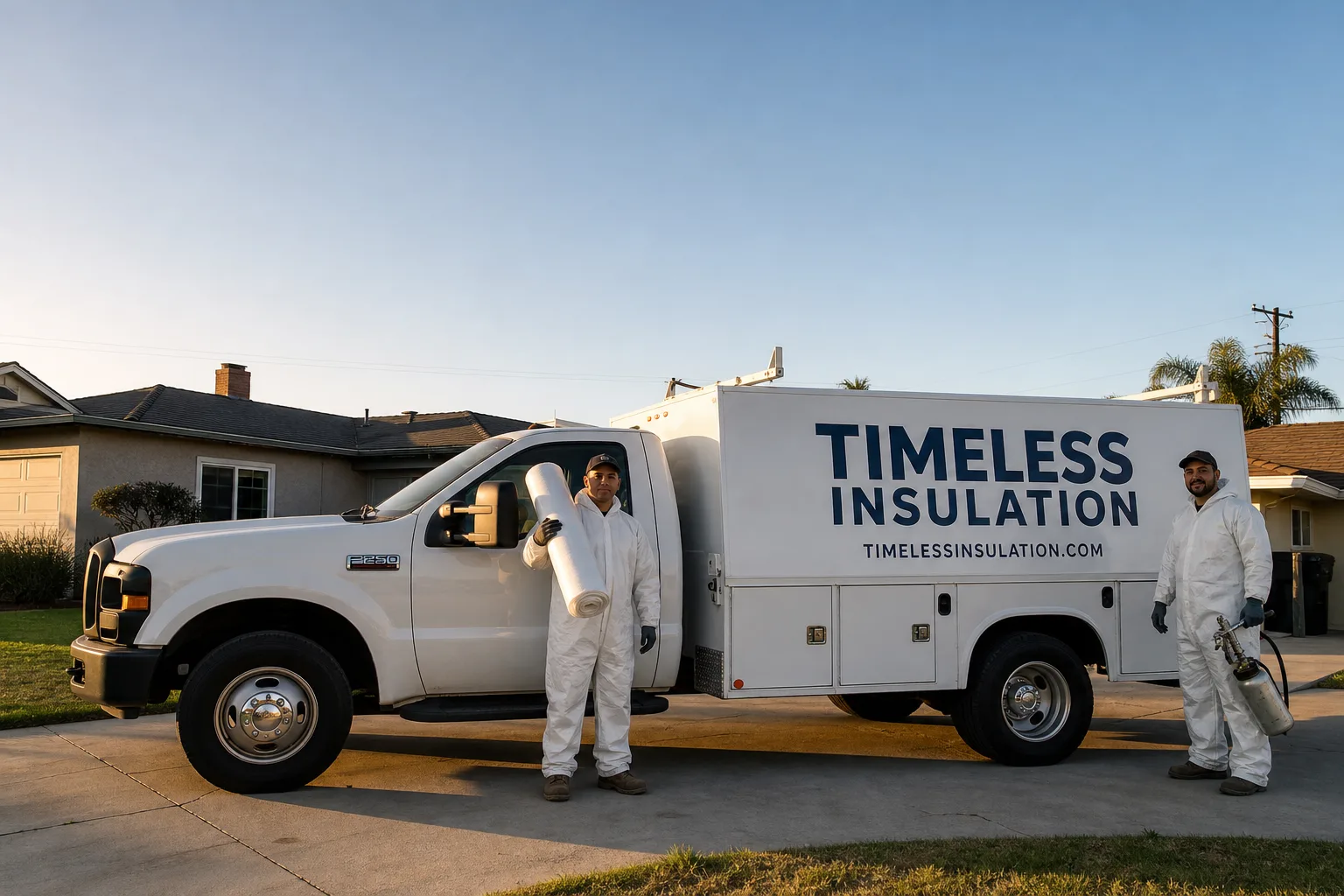
Fast, Reliable Spray Foam Insulation Across Rosemead
Spray foam insulation in Rosemead typically costs $2,800 – $6,400 for a whole-attic application on a standard 1,100 – 1,400 square foot single-story home, with garage ceiling and rim joist jobs running smaller at $900 – $2,200. Most Rosemead projects are completed in one day, and we’re usually on-site within 48 – 72 hours of your call. If you’re in a 1950s stucco tract home off Valley or Garvey with original rock-wool batts and rooms that bake by mid-afternoon, call (866) 507-5394 for a free estimate. We know these houses because we work in them every week.
Rosemead’s housing stock is not like newer San Gabriel Valley subdivisions. These are post-war single-story stucco homes on tight lots, many with converted garages and unpermitted additions. The wall cavities are irregular. The attics are shallow. Spray foam done right here means sealing actual air paths and legacy vents, not just filling a cavity and calling it done. The team at Timeless Insulation has spent years retrofitting exactly these homes across Rosemead, and we carry both Icynene and Demilec foam lines so the product matches the job.
Key Takeaways:
- Whole-attic spray foam in Rosemead runs $2,800 – $6,400; garage ceilings run $900 – $2,200.
- Most jobs are completed same-day, with 48 – 72 hour response typical for Rosemead.
- Older Rosemead homes need vent sealing and air-path correction before foam is applied.
- We stock Icynene and Demilec open-cell and closed-cell foam, matched to your specific house.
- Free estimates. Call (866) 507-5394.
Why Timeless Insulation Is Rosemead’s Preferred Spray Foam Insulation Company
Rosemead homeowners keep calling us because we’re an insulation-only shop. We don’t run HVAC crews, we don’t pour concrete, and we’re not a handyman service that insulates on the side. Every tech on our crew spends every workday inside attics, knee walls, and garage ceilings, which means we recognize the specific failure patterns in Spray Foam Insulation retrofits around Valley Boulevard and Garvey Avenue. That depth of focus translates to faster diagnoses and foam placed exactly where the air is actually moving.
Nelson Ibarra, our owner, set the standard early: carry more materials than you need so the recommendation is honest. That’s why we keep Icynene open-cell and Demilec closed-cell foam on the truck, plus Rockwool for fire-rated cavities and Knauf batts for jobs where foam isn’t the right answer. Rosemead customers regularly tell us they called two or three generalists before us and got a one-material pitch. We give you the material that fits the assembly you actually have.
Response time to Rosemead matters in July and August. We schedule most Rosemead estimates within two business days, and our crews know the parking situations on the residential streets near Garvey, the permitted work windows, and how to maneuver equipment into tight 1950s crawl openings. That local familiarity removes a lot of friction that out-of-area crews burn time on.
Open Cell Spray Foam in Rosemead
Open Cell Spray Foam is the most common retrofit foam we install in Rosemead’s 1950s and 60s homes because it expands into irregular cavities, seals air movement well, and costs substantially less than closed-cell. In a shallow attic off Valley Boulevard where original rock-wool batts have slumped to R-4 or worse, open-cell foam sprayed directly against the roof deck creates a semi-permeable air barrier that stops the stack effect pulling conditioned air out of the living space. For Rosemead’s climate, where cooling performance drives the project and high-90s afternoons bake low-pitch attics, open-cell at the roofline is usually the highest-impact dollar-for-dollar upgrade we can make. A typical 1,200 square foot Rosemead attic runs $2,800 – $4,200 depending on rafter depth and access.
Why Open-Cell Fits Shallow Attics
Many of the 1950s homes near Valley and Garvey have less than 30 inches of clearance at the ridge. Open-cell foam’s lower density and faster expansion make it the practical choice when space is tight and the deck structure is old enough that a heavier closed-cell application would add unnecessary stress or hide problems.
Air Sealing Before R-Value
In Rosemead’s older assemblies, the air leaks matter more than the rated R-value. Open-cell foam sprayed onto ceiling planes and knee walls closes the gaps where attic air, dust, and heat migrate into bedrooms below. We scope every Rosemead retrofit by finding those air paths first, because foam over an unsealed legacy vent is just an expensive pillow.
Spray Foam Insulation Contractors in Rosemead
Spray Foam Insulation Contractors working in Rosemead have to deal with what’s actually behind the walls: undocumented framing in converted garages, knee-wall cavities with no blocking, and old vent holes that were never sealed when rooms were added. We’ve foamed enough of these houses to know that the visible stud line only tells part of the story. A converted garage off Garvey might have a ceiling with a 2-inch cavity over original rafters, or a knee wall where the top plate sits 14 inches from the roofline. These are the details that determine whether the foam actually stops the heat, or just covers the most accessible surface. Closed-cell foam jobs in Rosemead for rim joists and garage ceilings typically run $1,500 – $3,200, and full attic retrofits range $4,000 – $6,400.
The Converted Garage Problem
Garage conversions in Rosemead were often built without permits, which means no framing inspection and no insulation continuity plan. Our techs regularly find original garage slab edges, old door openings, and rafters that were simply sheetrocked over, leaving the space between drywall and roof deck as an unsealed chimney. Open-cell foam works here because it fills these odd, broken cavities and delivers substantial air sealing even when the assembly is imperfect.
Sealing Legacy Vents Before Foam
One of the most common mistakes we correct in Rosemead is open-cell foam sprayed over old attic vents that were never closed. The original 1950s homes had passive gable or soffit venting designed for a ventilated attic. If you spray foam the roofline but leave those vents open, you create a moist microclimate against the old rock-wool or decking. We inspect for legacy vents on every Rosemead job and seal them properly before foam goes in.
Trusted Brands We Service in Rosemead
We carry eight manufacturer lines because Rosemead’s housing stock doesn’t fit one profile. We install Icynene open-cell for shallow retrofits and Demilec closed-cell for rim joists, garage ceilings, and any cavity that needs a vapor barrier or high R-value per inch. For customers who want mineral wool instead, we stock Rockwool batts and boards, which deliver fire resistance and sound dampening for specific code and comfort scenarios. If the job calls for blown-in, we pull GreenFiber cellulose from our own supply rather than subcontracting. For Rosemead customers, carrying multiple brands means we’re not trying to sell you the only foam we happen to buy in bulk. We recommend what actually works for your house.
Common Spray Foam Insulation Problems We See in Rosemead Homes
- Foam over original rock-wool without air sealing: In shallow 1950s attics near Valley and Garvey, open-cell foam sprayed directly over deteriorated rock-wool batts traps moisture against the old material instead of sealing the true air path. The foam looks fine, but the thermal boundary is compromised and the customer sees little change in upstairs comfort.
- Converted garage cavities that were never insulated in the first place: Many Rosemead garage conversions were done without permits, and the framing behind the drywall is undocumented. Foam sprayed to the visible stud line leaves hidden gaps above knee walls and around old door headers, so the room stays hot even after treatment.
- Low-pitch attics baking through high-90s afternoons: Rosemead’s summer heat saturates low-pitch roof decks, and foam sprayed without addressing radiant heat or existing ventilation paths leaves the top floor uncomfortable. The cavity is filled, but the heat still radiates through the deck structure into the ceiling plane.
- Legacy attic vents left open after retrofit: The original passive gable and soffit vents in 1950s tract homes were designed for ventilated attics. When foam seals the roofline but those vents stay open, moisture accumulates against the deck in winter. We find this on a significant share of Rosemead jobs where a previous contractor foamed without an air-sealing plan.
Pricing for Spray Foam Insulation in Rosemead, CA
Most Rosemead spray foam jobs fall into predictable ranges based on the assembly, not the square footage alone. A whole-attic open-cell retrofit on a 1,100 – 1,400 square foot single-story home runs $2,800 – $4,200 for Icynene. If you need closed-cell for rim joists or a garage ceiling, expect $1,500 – $3,200 depending on cavity depth and access. Full closed-cell attic jobs start around $4,000 and go to $6,400. The variables that move the needle in Rosemead are rafter depth, whether legacy vents need sealing, and how much irregular framing exists in converted or added-on sections. We give free estimates with a written line-item scope, and we quote the price before the crew shows up. Call (866) 507-5394 to schedule a walkthrough.
Rosemead Price Ranges:
- Open-cell attic retrofit (1,100 – 1,400 sq ft): $2,800 – $4,200
- Closed-cell rim joist or garage ceiling: $1,500 – $3,200
- Full closed-cell attic: $4,000 – $6,400
- Knee wall or converted garage air-seal + foam: $900 – $2,000 per section
We Also Serve Cities Near Rosemead
Our crews cover Rosemead and the surrounding San Gabriel Valley communities, including East San Gabriel, San Gabriel, South El Monte, and South San Gabriel. If you’re on the edge of Rosemead in the 91770 or 91771 ZIP codes and your street sits close to a neighboring city line, we can still get to you quickly. Call (866) 507-5394 and we’ll confirm your coverage area on the spot.
Serving Rosemead, CA — Our Local Coverage Area
We’re based in the Rosemead area and know this community well. Use the map below to see our service coverage — if you’re nearby, we can almost certainly help.
FAQs About Spray Foam Insulation in Rosemead
No, spraying foam directly over deteriorated or original rock-wool batts without first addressing the air paths and moisture boundary will trap condensation and fail to deliver the cooling performance you’re paying for. In most Rosemead homes near Valley and Garvey, the right sequence is to remove or evaluate the old material, seal legacy vents, and then spray open-cell foam onto the roofline or ceiling plane. Our techs assess the existing insulation before any foam goes in, and we’ll tell you honestly if the old rock-wool needs to come out or can stay in place under the right foam. Call (866) 507-5394 for an exact scope and quote.
Yes, and it’s one of the most effective fixes we do in Rosemead. Converted garages along Valley Boulevard and the surrounding streets often have uninsulated ceiling cavities, open knee walls, and gaps around the old garage door header that let heat pour in from the low-pitch roof deck. Open-cell spray foam fills those irregular cavities and seals the air path, which typically drops the room temperature noticeably within days during summer. We scope the hidden framing first, because the real heat gain is rarely where the visible drywall is. Estimates are free at (866) 507-5394.
Yes, and this is one of the most overlooked steps in Rosemead retrofits. The original 1950s-era homes were built with passive gable and soffit vents designed for a ventilated attic. If you spray foam the roofline and leave those vents open, moisture moves through the foam boundary and condenses against the deck or old insulation. We inspect every vent on the property before foaming and seal the ones that would compromise the new thermal boundary. This is standard on our Rosemead jobs, not an add-on. Call (866) 507-5394 and ask us to check your vents during the estimate.
We use Icynene open-cell foam for most older Rosemead retrofits because it expands well into irregular, shallow cavities and delivers strong air-sealing performance at a lower cost than closed-cell. For rim joists, garage ceilings, or any cavity needing a vapor barrier or higher R-value per inch, we switch to Demilec closed-cell. Carrying both lines means the product decision is based on your house, not on what’s loaded on the truck that day. Both are installed by our own crew, not subcontracted out. For a material recommendation specific to your Rosemead home, call (866) 507-5394.
In most Rosemead single-story homes, yes. The source of the discomfort is usually the shallow attic heating up in the high-90s afternoon sun and transferring that heat through the ceiling plane into the living space. Sealing the roofline or ceiling plane with spray foam reduces that heat path dramatically, which lowers cooling runtime and SCE bill spikes in July and August. We’ve seen Rosemead customers report noticeably cooler bedrooms within the same week of installation, and lower peak-season bills starting the first full month after the retrofit. A free walkthrough is the fastest way to see if your specific house will benefit. Call (866) 507-5394.
Written by Nelson Ibarra, Owner at Timeless Insulation, serving Rosemead and the surrounding San Gabriel Valley with insulation-only expertise.