
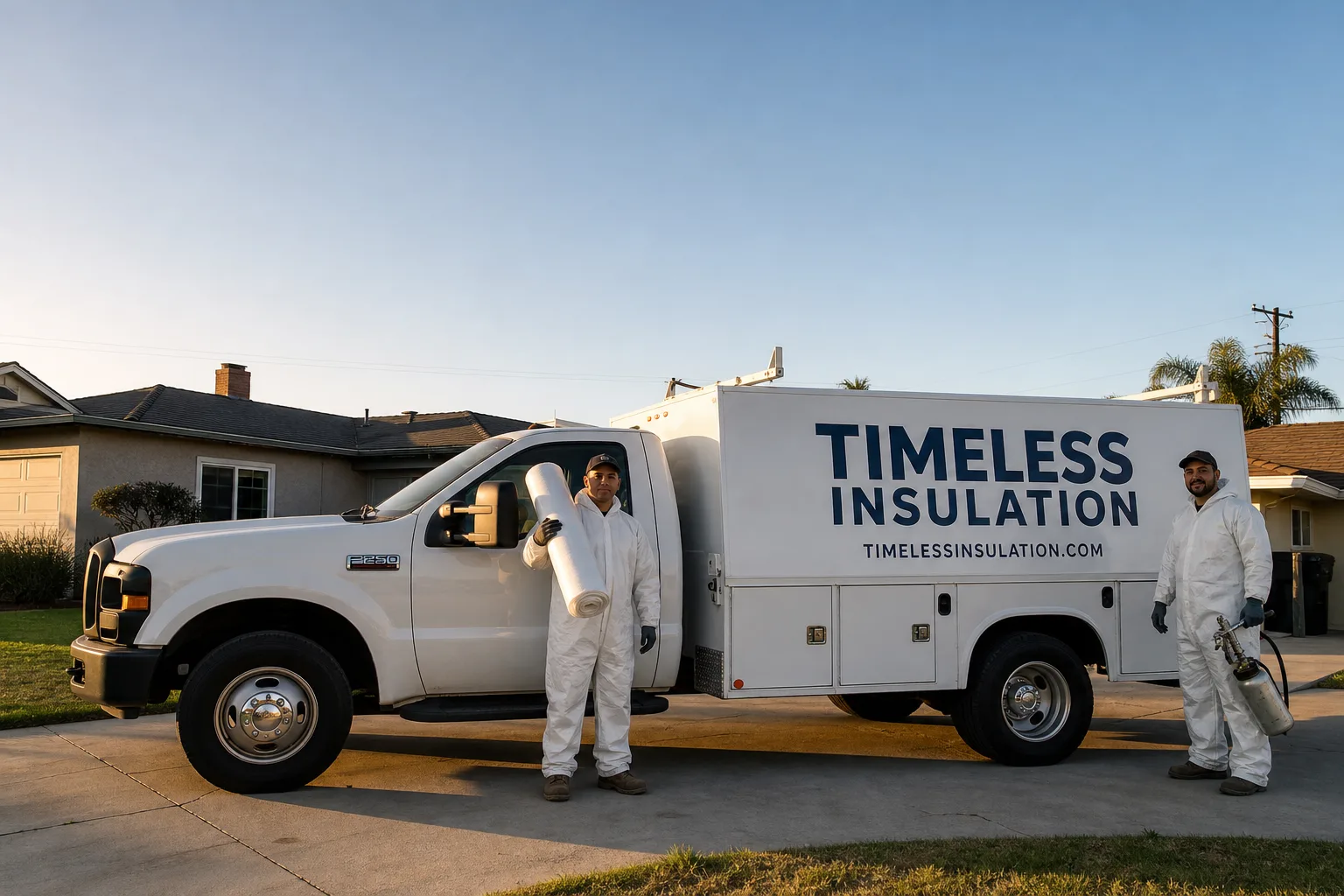
Fast, Reliable Spray Foam Insulation Across Pico Rivera
Spray foam insulation in Pico Rivera typically runs $1,200 to $4,800 depending on the area treated, with rim joist jobs starting around $900 and full garage ceiling applications landing between $1,500 and $2,800. Most homes in Pico Rivera were built in the 1950s and 60s with no wall insulation and thin attic layers, so we do a lot of targeted air-seal work here rather than full-cavity retrofits. Our crews reach Pico Rivera from Compton within about 30 minutes on a normal traffic day, and we know the tract-home layouts, the shallow attics, and the specific draft problems along the north walls during Santa Ana events. Call (866) 507-5394 for a free estimate, and we’ll walk you through what your specific house actually needs.
Why Timeless Insulation Is Pico Rivera’s Preferred Spray Foam Insulation Company
We’re an insulation-only contractor. That’s not a slogan; it’s who we are. Every technician on our crew thinks about insulation all day, every day, and none of them are splitting time with plumbing or electrical work. Pico Rivera homeowners call us because they want a clear answer about whether open-cell or closed-cell foam makes sense for a 1962 stucco ranch near the Rio Hondo, not a pitch for a remodel.
Nelson Ibarra leads our team, and he’s the one who reviews the specifics of Pico Rivera jobs before we send a crew out. Homes in the 90660 zip code near Whittier Narrows, the 90661 area around Smith Park, and the 90662 neighborhoods east of Rosemead Boulevard all have the same original construction pattern: wood-framed stucco with low-slope roofs and shallow attics. That pattern drives everything we recommend. We carry eight manufacturer lines, including Icynene and Demilec for spray foam, so when we tell you a particular product fits your rim joist or garage ceiling, it’s because it actually does, not because it’s the only thing on the truck. Our crews know that a foam job near the San Gabriel River flood control channel needs a moisture check first, and that many homes along Mines Avenue and Beverly Boulevard have crawl spaces that need a different approach than the slab-on-grade houses further north.
Rim Joist Spray Foam in Pico Rivera
Rim joist spray foam in Pico Rivera is one of the highest-value air-sealing jobs for the 1950s and 60s tract homes that dominate this city. The rim joist is the horizontal framing member where your floor meets the top of the foundation wall, and in a wood-frame house with an attached garage, it’s a direct air path from outside into your walls and living spaces. During Santa Ana wind events, that gap turns into a draft channel along the north-facing walls, and homeowners near Whittier Narrows feel it most. Typical rim joist spray foam in Pico Rivera runs $900 to $2,200 for a standard single-story home, with the price driven by linear footage, access to the crawl space or basement, and whether the garage ceiling junction needs treating at the same time. We use closed-cell foam here in most cases because it adds structural rigidity to the joist-to-sill connection and won’t absorb the moisture that open-cell can in tight, damp crawl spaces.
Air-Sealing the Garage-to-House Junction
Many Pico Rivera homes have attached garages with uninsulated ceilings, and the drywall seam where the garage meets the living space is a common air path. Sealing the rim joist without addressing that ceiling junction leaves the Santa Ana draft channel partially open. We inspect both points together and typically recommend sealing them in the same visit.
Closed-Cell Icynene for the Rim Joist
We recently sealed the rim joist and garage-ceiling penetration in a 1962 single-story stucco tract home near Whittier Narrows, where the homeowner had been feeling wind-driven drafts along the north wall during Santa Ana events. Our crew applied closed-cell Icynene to block the air path from the attached garage, then used Owens Corning sealant at the wall-penetration gaps. The homeowner noticed the draft stopped and the living room held temperature better through the next cold snap.
Crawl Space Spray Foam Insulation in Pico Rivera
Crawl space spray foam insulation in Pico Rivera is a specific job for homes with raised foundations, which are common in the older sections of the 90660 and 90661 zip codes. The crawl space under a 1960s wood-frame house is often vented to the outside, and those vents let cold winter air and hot summer air move directly under your floorboards. In Pico Rivera, where nighttime temperatures drop into the 40s during winter, an uninsulated crawl space means cold floors and drafts coming up through the floor assembly. A typical crawl space spray foam application here runs $1,800 to $4,500, depending on square footage, access clearance, and whether we’re sealing the rim joists as part of the same job. We use closed-cell foam on the crawl space walls and rim joist because it doubles as a vapor barrier, which matters for homes near the Rio Hondo and San Gabriel River flood control channels where soil moisture is higher than in the hillside neighborhoods.
Moisture Checks Before Foam Goes In
Homes near the flood control channels sometimes show moisture staining in wall cavities and crawl space framing. Foam applied to a damp surface will not adhere, and it traps the moisture inside the cavity where it causes bubbling, delamination, and eventually rot. We check moisture content before we spray, and if the reading is too high, we’ll tell you to address the drainage or ventilation issue first. That’s the difference between a job that lasts and one that fails in three years.
Ventilation and Foam in Shallow Crawls
Crawl spaces that are only 18 to 24 inches high are common in Pico Rivera’s original tract construction, and those tight spaces need a specific foam application strategy. We use low-profile spray equipment and apply foam in lifts rather than one thick pass, which prevents the material from curing unevenly against the subfloor. The goal is an air seal, not a foam bathtub.
Trusted Brands We Service in Pico Rivera
Timeless Insulation installs spray foam from Icynene and Demilec, which gives Pico Rivera customers access to both open-cell and closed-cell chemistry across two distinct product lines. We choose between those brands and chemistries based on the job: open-cell for interior wall cavities where sound control matters, closed-cell for rim joists, crawl spaces, and garage ceilings where moisture resistance and air-sealing performance are the priority. We also carry Rockwool and CertainTeed product lines for customers who want a hybrid approach, such as spray foam air sealing at the rim joist with mineral wool batts in the walls above. Because we stock material locally and send crews from Compton, we can usually schedule Pico Rivera jobs within the same week and often within a couple of days. Having eight brands on hand means our recommendation comes from the job, not from the warehouse.
Common Spray Foam Insulation Problems We See in Pico Rivera Homes
- Foam failure near flood control channels. Homes along the Rio Hondo and San Gabriel River channels can have elevated moisture in wall cavities and crawl spaces. Spray foam applied to a damp surface delaminates and traps water, creating a bubble-and-peel failure that looks bad and performs worse.
- Shallow attic overheating. Pico Rivera’s original low-slope roofs leave very little attic volume, and in summer the attic space can exceed 130°F. Closed-cell foam applied directly to the roofline without adequate ventilation can trap heat and cause blistering on hot days when outside temperatures pass 95°F.
- Unsealed garage ceilings defeating the rim joist work. A common mistake is sealing the foundation rim joist but leaving the attached garage ceiling open. Santa Ana winds push air through the garage ceiling seam and into the wall cavity, bypassing the rim joist entirely.
- Foam shrinkage in wall penetrations. Older Pico Rivera tract homes have plumbing and electrical penetrations through exterior stucco walls that were never properly sealed. If those gaps aren’t sealed before or during a spray foam application, the foam pulls away from the pipe or conduit as it cures, leaving a hairline air channel that still drafts during Santa Ana events.
Pricing for Spray Foam Insulation in Pico Rivera, CA
Here’s what you can expect to pay in Pico Rivera. Rim joist spray foam on a standard single-story home runs $900 to $2,200, depending on linear footage and access. Garage ceiling spray foam typically lands between $1,500 and $2,800 for a two-car garage. Crawl space spray foam insulation runs $1,800 to $4,500 based on square footage and clearance height. Open-cell spray foam for interior wall cavities runs $8 to $13 per board foot installed, and closed-cell runs $12 to $18 per board foot. The main cost drivers in Pico Rivera are access to shallow attics, moisture remediation near the flood control channels, and the size of the attached garage. Every estimate we give is free, and the number we quote is the number you pay. Call (866) 507-5394 and we’ll send a technician to measure and quote the same day or next day, depending on your schedule.
We Also Serve Cities Near Pico Rivera
In addition to spray foam insulation in Pico Rivera, our crews cover West Whittier-Los Nietos to the north, Montebello to the northwest, Santa Fe Springs to the south, and Bell Gardens to the southwest. If you own a rental property in any of these surrounding cities, the same material portfolio and the same Spray Foam Insulation approach applies. Call us and we’ll confirm your area and schedule a visit.
Serving Pico Rivera, CA — Our Local Coverage Area
We’re based in the Pico Rivera area and know this community well. Use the map below to see our service coverage — if you’re nearby, we can almost certainly help.
FAQs About Spray Foam Insulation in Pico Rivera
In most cases, yes. The drafts along north walls during Santa Ana events come from air moving through the rim joist gap where your floor framing sits on the foundation, and spray foam at that point blocks the air path. However, if your attached garage ceiling is uninsulated, the draft can bypass the rim joist and enter through the wall cavity from above, so we recommend inspecting and sealing both points together. Call (866) 507-5394 for an exact assessment and a free quote.
Yes, but the approach differs from a full attic encapsulation. In shallow low-slope attics, we typically use spray foam as a targeted air seal at the rim joists, garage-ceiling seams, and wall penetrations rather than spraying the entire roofline. Full roofline application in a shallow attic runs into ventilation and heat-trapping issues, and we’ll tell you if your specific attic geometry makes it the wrong choice.
Yes. Pico Rivera sits in the Whittier Narrows area where summer heat radiates off the Puente Hills and bakes the exterior walls of older tract homes. Spray foam at the rim joist and in wall cavities reduces the air movement that carries that heat into living spaces, but for full wall coverage in an existing 1950s or 60s home, we often recommend a combination approach: spray foam air sealing at the rim joist and penetrations, with blown-in insulation or mineral wool in the wall cavities. The right combination depends on your wall framing and whether the stucco has any water-intrusion history.
First, inspect for moisture staining on the interior drywall and on the cavity framing if you can access it. Homes near the Rio Hondo and San Gabriel River flood control channels sometimes show elevated moisture in wall cavities, and foam applied to a damp surface will not adhere and will trap the moisture inside. If there’s any sign of water intrusion, address the drainage or stucco integrity first, then foam. Our techs run a moisture check before we spray, and we’ll stop the job if the reading comes back too high.
Spray foam in the crawl space does not directly touch the stucco walls, so it won’t cause stucco problems. However, if the crawl space is poorly ventilated and has moisture issues, closed-cell foam applied to the crawl space walls can change the moisture profile of the floor framing above, and that can lead to condensation on the subfloor in the winter. The original 1960s wood framing handles closed-cell foam without issue as long as the crawl space is dry or the moisture problem is corrected first. Most Pico Rivera homes with raised foundations benefit from foam at the rim joist and crawl space walls, but we recommend a moisture assessment before any foam goes in near a flood control channel.
Get a Free Estimate From a Pico Rivera Insulation Specialist
If you’re noticing drafts, hot rooms in summer, cold floors in winter, or noise bleeding through your walls, spray foam may be the right answer, or it may not. Call Timeless Insulation at (866) 507-5394 and Nelson Ibarra or one of our techs will visit your Pico Rivera home, inspect the specific problem areas, and recommend the right material for your specific situation. Estimates are free, and our recommendation comes from the job, not from what’s on the truck. We serve all three Pico Rivera zip codes: 90660, 90661, and 90662.
Written by Nelson Ibarra, Owner at Timeless Insulation, serving Pico Rivera and the San Gabriel Valley with spray foam, attic, and blown-in insulation.