
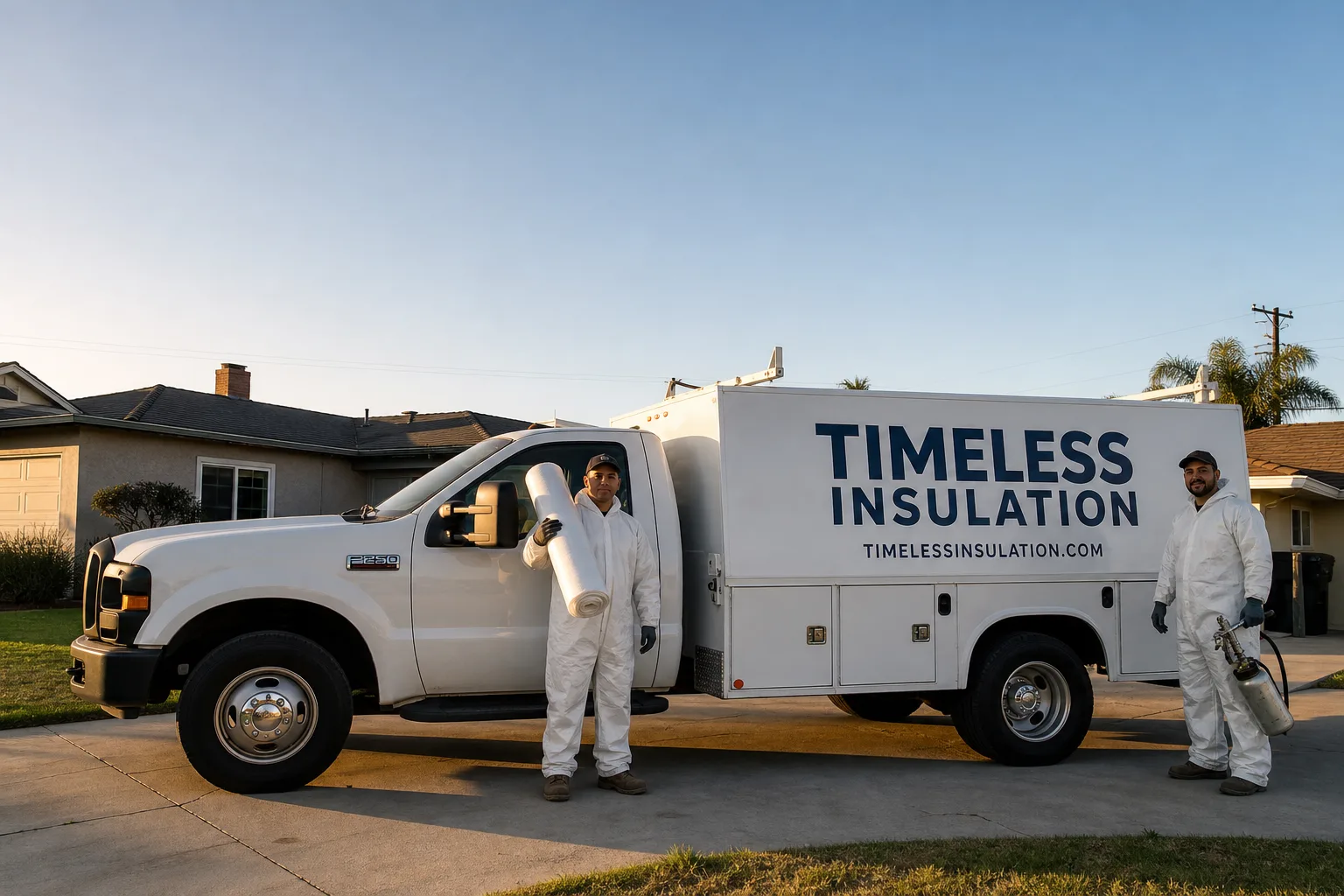
Fast, Reliable Spray Foam Insulation Across Hawaiian Gardens
Spray foam insulation in Hawaiian Gardens costs $2.20 to $7.50 per board foot installed, with most mid-century retrofit jobs here landing between $2,800 and $9,400 depending on whether we’re foaming a garage ceiling, sealing rim joists, or reinsulating a full attic. We service all of the 90716 ZIP code and typically reach Hawaiian Gardens homes within 24 to 48 hours of your call. If your ceilings bake by mid-afternoon and your air conditioner runs nonstop from June through September, the problem usually isn’t the AC. It’s what’s missing between your roof and your living space. Nelson Ibarra and our Spray Foam Insulation team specialize in retrofitting the aging, close-set homes that make up most of Hawaiian Gardens.
Call (866) 507-5394 for a free estimate. We’ll walk the attic, measure the cavities, and tell you exactly what open-cell or closed-cell foam will cost before any work is scheduled.
Why Timeless Insulation Is Hawaiian Gardens’s Preferred Spray Foam Insulation Company
Hawaiian Gardens is a small, built-out city. Most of the single-family homes date to the 1950s and 1960s, and they sit on lots where neighboring walls are only a few feet away. That changes how insulation work gets planned. We know the neighborhoods off Carson Street and Norwalk Boulevard, and we know that attic access here often means working through a narrow interior hatch rather than an open gable. Our crews have foamed band joists, garage ceilings, and roof decks across 90716, and we plan every job around the venting and access constraints that come with tight lot lines.
What sets Timeless Insulation apart is the material portfolio. We carry spray foam from both Icynene and Demilec, so we can specify open-cell for interior sound control or closed-cell for structural rigidity and higher R-value per inch. We’re not a general contractor who insulates when framing is slow. Insulation is the entire trade. Every conversation, every recommendation, every person on site is focused on one thing: getting the right material into the right cavity.
Garage Spray Foam Insulation in Hawaiian Gardens
Garage Spray Foam Insulation in Hawaiian Gardens is one of the most effective upgrades for homes where the attached garage acts like a heat reservoir, pushing warm air into the kitchen and bedrooms that share its walls. Many of the homes here have uninsulated garage ceilings or thin fiberglass batts that were installed decades ago. Foaming the garage ceiling and the band joist where the garage meets the house creates a thermal break that stops outdoor heat from reaching your living space. On a typical two-car garage in 90716, expect to pay $1,800 to $3,600 for closed-cell foam at the ceiling and rim joist. The work usually takes one day, and you can put boxes back on the shelves by evening.
Interior temperature control for attached garages
An attached garage with a dark shingle roof can reach 120 degrees or more during a Hawaiian Gardens summer. That heat doesn’t stay in the garage. It radiates through the shared wall and ceiling assembly into the home. Closed-cell foam at the garage ceiling isolates that heat at the source, so the rooms above and beside the garage stop absorbing it.
Rim joist sealing for tight lots
On homes built mid-century, the rim joist area is usually baffled or batts only, leaving a continuous gap for air and heat to move. We see this on virtually every tract home we inspect in the city. Sealing the rim joists with closed-cell Demilec foam stops the stack effect and blocks the hottest outside air from entering floor and wall cavities, which matters a lot when neighboring walls sit only a few feet away and there is no airflow buffer.
Closed Cell Spray Foam Insulation in Hawaiian Gardens
Closed Cell Spray Foam Insulation in Hawaiian Gardens is the right call for homes that need the highest R-value per inch, moisture resistance, and structural stiffening in one product. Closed-cell foam runs about $4.00 to $7.50 per board foot installed across the region, and for a typical attic deck in one of the city’s older homes, you’re looking at $5,000 to $9,000 depending on square footage and access difficulty. The payback shows up fast. In our experience with the city’s hot, dry summer pattern, closed-cell foam keeps attic temperatures dramatically lower than fiberglass, which reduces the heat load on the ceilings below and lets the air conditioner cycle less aggressively.
When closed-cell is the right choice on compact lots
Closed-cell foam adds density and rigidity. On the tight lot lines common along Hawaiian Gardens streets, that rigidity helps in roof decks and wall cavities where neighboring structures leave no room for exterior access. It also acts as an air barrier, which matters when Santa Ana winds push fine dust and hot air against the building envelope. We typically recommend Demilec closed-cell for rim joists and roof decks and reserve Icynene open-cell for interior walls where sound control matters more than maximum R-value.
Retrofit fit for mid-century wall cavities
Most wall cavities in 1950s and 1960s homes here are shallower than modern code allows. Closed-cell foam delivers R-6.5 to R-7 per inch, which means a 2×4 cavity can hit a meaningful R-value without furring out walls. That’s a practical advantage for Hawaiian Gardens residents who do not want to lose floor space by building walls outward.
Trusted Brands We Service in Hawaiian Gardens
We carry eight insulation brands so we can specify the material that fits the actual condition of your home, not just what’s on our truck. For spray foam work in Hawaiian Gardens, we regularly install Icynene open-cell and Demilec closed-cell products. We also stock Knauf fiberglass for hybrid jobs where foam handles the air sealing and batts handle the bulk fill. Having Rockwool and CertainTeed in the line means we can offer a fire-rated or sound-dampening option where the job calls for it. Our recommendation for your attic or garage is driven by what your house needs, not by what we’re trying to move out of the warehouse.
Common Spray Foam Insulation Problems We See in Hawaiian Gardens Homes
- Sagging builder-grade batts at top plates. The original fiberglass batts in mid-century attics eventually pull away from the top plates and leave convective gaps that feed hot air directly into the ceiling assembly. Spray foam fills and seals those gaps permanently.
- Tight clearances against neighboring walls. On lots where houses sit four to six feet apart, re-roofing or foaming from the outside is often impossible. We plan attic access through interior hatches and work carefully around venting that has to stay within the property line.
- Unvented cavity moisture and heat buildup. Hawaiian Gardens sits in a coastal-adjacent basin where humid mornings are common, even in summer. Applying open-cell foam too thick in one pass on small retrofit cavities can leave the core uncured. We foam in controlled lifts so the material cures correctly.
- Roof deck heat soak during summer afternoons. The city’s inland-influenced summer temperatures regularly climb past 90 degrees, and dark composition shingles absorb that heat all day. Without foam at the roof deck, that stored heat radiates down into bedrooms for hours after sunset.
Pricing for Spray Foam Insulation in Hawaiian Gardens, CA
Here’s what you can expect in the 90716 market. Open-cell spray foam runs $2.20 to $3.80 per board foot installed. Closed-cell runs $4.00 to $7.50 per board foot. A full attic roof deck on a 1,200-square-foot home falls between $4,800 and $9,000. Garage ceiling foam runs $1,800 to $3,600. Rim joist sealing runs $900 to $2,200 for most single-story homes. The two biggest cost drivers in Hawaiian Gardens are access difficulty, since many older homes have tight or low attic entry points, and venting reconfiguration, which we plan before any foam is applied. We give written, line-item quotes so you know exactly what each part of the job costs. Call (866) 507-5394 for pricing on your specific floor plan.
We Also Serve Cities Near Hawaiian Gardens
Timeless Insulation works throughout the Los Angeles basin, including Hawaiian Gardens and the neighboring communities of Los Alamitos, Cypress, La Palma, and Rossmoor. If you live in one of those cities and want the same material-portfolio approach we bring to every job here, we’ll come out and walk the property the same way.
Serving Hawaiian Gardens, CA — Our Local Coverage Area
We’re based in the Hawaiian Gardens area and know this community well. Use the map below to see our service coverage — if you’re nearby, we can almost certainly help.
FAQs About Spray Foam Insulation in Hawaiian Gardens
Yes. An attached garage with an uninsulated ceiling acts like a heat collector, and the warm air it holds pushes into the shared wall and ceiling assembly all afternoon. Foaming the garage ceiling and rim joist cuts that heat transfer at the source. Most homeowners with attached garages notice the rooms above and beside the garage running several degrees cooler within the first week. Call (866) 507-5394 and we can measure airflow before quoting.
Yes, but the venting plan has to be designed around the property constraints before foam goes in. In unvented or semi-vented attics, we may move supply air to the gable ends or add high-wall vents that stay within your lot line. On a compact Hawaiian Gardens lot, the answer is usually a hybrid approach: closed-cell at the roof deck and repositioned venting at the only accessible wall. We do not foam first and figure out ventilation later. The plan is part of the quote.
Most mid-century Hawaiian Gardens homes benefit from closed-cell foam at the roof deck and rim joists, where heat gain and air movement are the main problems, and open-cell foam for interior walls where sound control is the priority. Closed-cell gives more R-value per inch, which matters in the shallow 2×4 cavities common in 1950s and 1960s construction. The material choice should follow the climate reality: this city is driven by heat gain, not cold retention.
Yes. Spray foam is installed directly into the cavity or against the roof deck, so it does not sag, settle, or pull away from top plates the way fiberglass batts do over time. Once applied, it remains adhered and becomes an air barrier as well as an insulation layer. If your original builder-grade batt has separated at the eaves or top plates, foam closes those gaps permanently. It is not a patch. It replaces the function the old batt lost.
Spray foam costs more upfront than fiberglass batt, typically $1,800 to $3,600 for a garage ceiling versus $600 to $1,200 for re-batting. The difference is in performance and permanence. Batts leave air gaps that let attic heat reach the garage ceiling surface. Closed-cell foam forms a continuous air seal and does not degrade the way 60-year-old fiberglass has. If the goal is to stop heat gain into the house, foam does what batts cannot. Call (866) 507-5394 and we’ll give you numbers for both options.
Call Timeless Insulation for Spray Foam Insulation in Hawaiian Gardens
If your home was built in the 1950s or 1960s and still carries its original insulation, the math is simple. The heat is getting in through degraded batts, unsealed rim joists, and uninsulated garage ceilings. We carry the materials to fix all three, and we’ll tell you which one your house actually needs. Free estimates. Written quotes. Work planned around your lot lines and your venting. Call (866) 507-5394 and ask for Nelson.
Written by Nelson Ibarra, Owner at Timeless Insulation, serving Hawaiian Gardens and the surrounding Los Angeles basin.