Rockwool Attic Insulation in Compton: A Homeowner’s Guide
Rockwool attic insulation in Compton is a specialty solution built from volcanic rock that delivers three things standard fiberglass can’t match: fire resistance up to 1,800°F, water repellency that shrugs off roof leaks and coastal humidity, and sound deadening that cuts street traffic and airliner noise through the roof plane noticeably. It costs 20-40% more per square foot installed than fiberglass batts, so the real question isn’t whether the material is good (it is) but whether your specific Compton house justifies the premium. If you’d rather skip the research and talk it through, call (866) 507-5394 and we’ll give you a straight answer on whether Rockwool belongs in your attic.
What most Compton homeowners don’t hear from their installer is that Rockwool rarely gets recommended for attic work, not because it’s wrong for the job but because most insulation contractors don’t stock it in attic-appropriate forms. Batts get stocked for wall soundproofing jobs, which are occasional. Attic-fit Rockwool products sit in a warehouse most shops don’t want to carry. At Timeless Insulation, we stock Comfortbatt, Safe’n’Sound, and blown Rockwool specifically because we’re an insulation-only contractor and carrying the full eight-brand material portfolio (including Rockwool, Owens Corning, and Johns Manville) is how we make sure the recommendation matches the house rather than whatever is left on the truck.
Key Takeaways
- Rockwool is stone wool spun from volcanic basalt rock plus recycled slag. It won’t burn, won’t hold water, and rats won’t nest in it.
- Rockwool costs roughly $1.25 to $2.25 per square foot installed in Compton attics, compared to $0.80 to $1.50 for fiberglass batts.
- The product form matters more than the brand. Comfortbatt is the attic batten, Safe’n’Sound is for interior partitions and shared walls, and blown Rockwool is for irregular joist bays and retrofit pours.
- Compton sits in a Los Angeles County high fire hazard severity zone. A Class A fire rated attic assembly genuinely changes your exposure, especially for insurance renewals.
- Rockwool’s rigid dimensional stability means it can sit in direct contact with non-IC-rated recessed light housings in a way fiberglass cannot.
What Makes Rockwool Different From Fiberglass and Cellulose in an Attic
Fiberglass and cellulose are both fine materials in the right application. We install them every week. But here’s the honest comparison in an attic under a Compton summer: fiberglass loses some R-value when temperatures climb because air convection through the batt accelerates. Cellulose settles over time, dropping from its as-blown depth by 8-12% in many attics. Rockwool does neither. Stone wool batts are denser by roughly three times compared to fiberglass, and that density translates directly into fewer convective air loops inside the insulation layer and a more stable thermal boundary.
The manufacturing process is simple to explain: basalt rock and slag get melted at around 2,600°F and spun into fibers, then compressed into batts with a binder that burns off under extreme heat without the material losing its form. That’s the detail that matters in a Compton attic. Fiberglass binder degrades at about 212°F sustained, which means long-term contact with a hot surface costs you loft and R-value. Rockwool’s dimensional stability holds to 1,800°F. For an attic that sees 120-130°F surface temperatures on roofing in July, the material isn’t even breathing hard.
The other difference is water. Compton sits in a Mediterranean climate with a dry season that makes roof leaks harder to notice for months. When fiberglass gets wet from a slow leak, it compresses and loses R-value permanently. Rockwool is hydrophobic, meaning water beads and rolls off the fibers. It doesn’t wick, doesn’t sag, doesn’t turn into a damp blanket feeding mold. If you’ve got an older roof but aren’t replacing it for five years, that’s a real argument for stone wool overhead.
One more thing we see in Compton regularly: roof rat activity. The city and nearby Willowbrook, Lynwood, and Gardena all have documented roof rat populations, and an attic is a warm place for nesting. Fiberglass and cellulose both offer nesting material. Rockwool doesn’t. It’s dense, inorganic, and gives rats and insects nothing to eat or tear apart for bedding. That’s not a marketing claim we’ve pulled from a catalog; it’s the reason pest control companies call us after treating an attic to recommend the homeowner re-insulate with stone wool before the rats return.
Rockwool Product Forms: What Belongs in a Compton Attic and What Doesn’t
This is where homeowners get confused, because Rockwool sells several products with nearly identical packaging. Here’s the breakdown specific to attics in the Compton market.
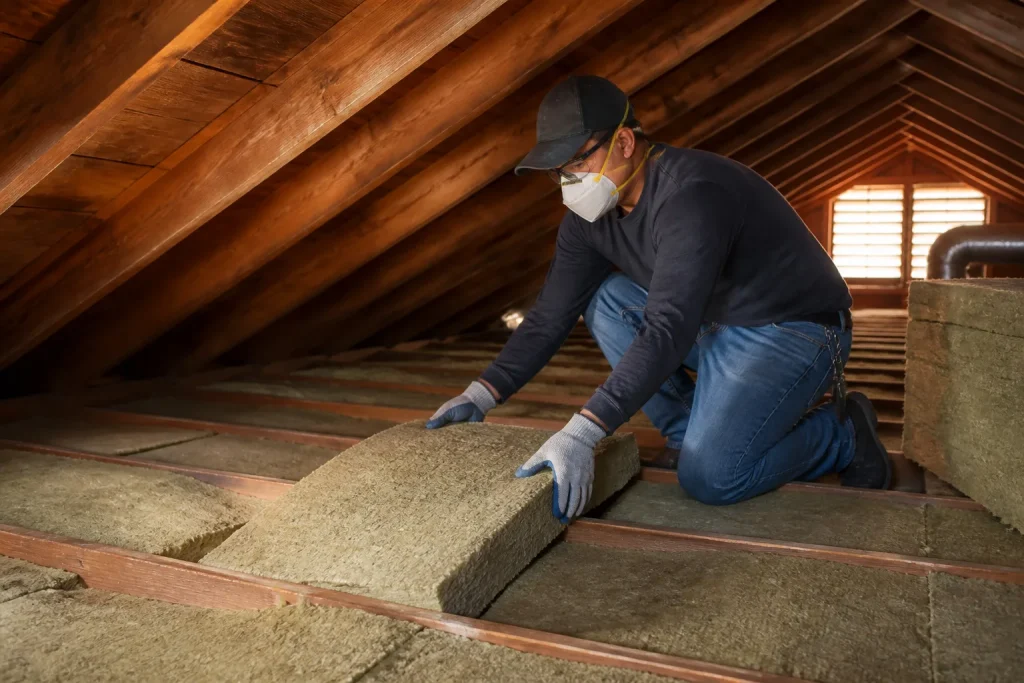
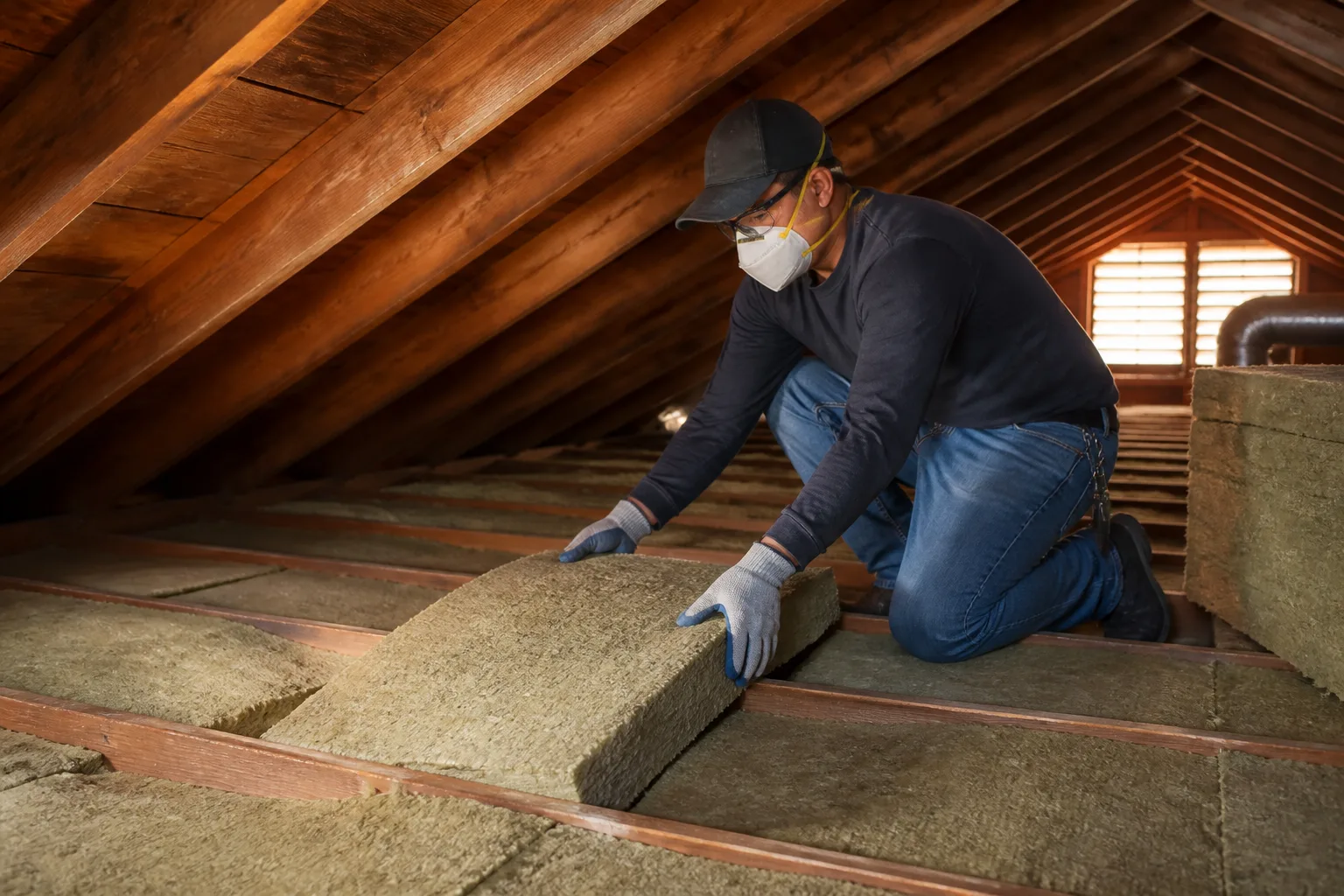
Comfortbatt: The right batten for attic floors and exterior walls. Comfortbatt is semi-rigid batt insulation designed for thermal applications. It comes in R-values from R-11 to R-30, sized to standard 16-inch and 24-inch on-center framing. In a Compton attic with open rafter bays you’ll typically run R-30 in the flat between ceiling joists, or R-19/R-21 in cathedralized assemblies. Comfortbatt cuts with a serrated knife and friction-fits into the bay, meaning no staples, no sagging, no second pass to fill gaps.
Safe’n’Sound: For interior partitions, not attics. Safe’n’Sound is built for interior sound control inside walls between rooms and floors, not for thermal resistance at the building envelope. It’s denser than Comfortbatt, which is great for sound, but its published thermal resistance is lower. You would not use Safe’n’Sound as your attic’s primary thermal barrier. We mention this because many homeowners Google “Rockwool attic insulation” and land on Safe’n’Sound product pages, buy it, and end up with the wrong tool for the job. If you’re insulating an attic, Comfortbatt or blown Rockwool is the product. If you’re killing noise between a bedroom and a living room, Safe’n’Sound is excellent.
Blown Rockwool: For odd joist spacing and retrofit pours. Rockwool also ships as loose fill, typically installed with a commercial blowing machine. It’s more expensive than blown cellulose or blown fiberglass, but it’s a specialty solution for homes in Compton with non-standard joist spacing, deep bays, or hard-to-reach corner eaves in older Spanish-style homes around Richland Farms. We carry blown Rockwool for those situations. Most Compton homes we walk predate California’s 1978 Title 24 insulation requirements, meaning the attic is either uninsulated or under-insulated by current code, and a loose-fill stone wool pour over existing batts is a straightforward upgrade.
Fire Resistance: What Class A Rating Means in a Compton Attic
Compton is mapped under a Cal Fire High Fire Hazard Severity Zone classification in some portions, and the entire city sits within the greater Los Angeles County wildland-urban interface discussion, even if the immediate neighborhood is urban residential. What that means in plain terms: ember intrusion into attic vents is rated insurance risk, not just theoretical concern.
A Class A fire rating on an insulation product refers to the surface burning characteristics: flame spread index of 0-25, smoke developed index of 0-450. Rockwool scores a flame spread of 0 and smoke developed of 5, essentially the lowest scores available. Fiberglass has a flame spread of 25 or lower depending on binder, and cellulose is fire-retardant treated but still organic material.
The practical difference in an attic assembly: If an ember enters through a soffit vent or an electrical fault arcs in a junction box, stone wool won’t contribute fuel. It doesn’t ignite. It doesn’t produce smoke. It doesn’t lose structural form as heat rises, meaning it continues insulating while everything around it is dealing with the event. For a Compton homeowner doing a roof replacement, adding a stone wool layer under the new deck is one of the cheapest passive fire-resistance upgrades you can make to the building envelope.
The recessed light conversation is related but distinct. Older Compton homes, especially the 1940s-1960s housing stock around the Civic Center area and north of Rosecrans, often have non-IC-rated recessed can lights in the ceiling. The rule for fiberglass is clear: keep the insulation at least three inches clear of the fixture. If the attic guy doesn’t do that, hot spots develop, the binder in the fiberglass degrades, and the insulation loses effectiveness directly around the fixture, which is where the most heat leaks anyway. Rockwool can sit in direct contact with a recessed housing, because nothing in the batt breaks down until temperatures far above what a can light produces. It simplifies the install and eliminates the gap that’s otherwise a direct thermal bypass.
What Rockwool Attic Insulation Costs in Compton (And When the Premium Is Worth It)
Straight numbers, based on what we see in Compton attics:
- Fiberglass batt (R-30): $0.80 to $1.50 per square foot installed
- Cellulose blown (R-38): $0.90 to $1.60 per square foot installed
- Rockwool Comfortbatt (R-30): $1.25 to $2.25 per square foot installed
- Rockwool blown (R-38): $1.50 to $2.75 per square foot installed
For a typical 1,200-square-foot Compton attic, that’s roughly $1,500 to $2,700 for Rockwool versus $960 to $1,800 for fiberglass, all-in and before any utility rebates your installer should help you find. The premium is real, and there are honest cases where we tell homeowners not to spend it. If your attic is dry, framing is standard, the roof deck is new, and you’re simply trying to reduce cooling load, fiberglass or GreanFiber cellulose is the right economic call. But the premium starts earning its keep in these situations that are not rare in Compton:
- You have non-IC-rated recessed lights. The Rockwool contact allowance eliminates the bypass gap and future degradation, and most Compton houses over 40 years old have at least a few of these fixtures.
- You live with roof rat pressure. The difference between a re-infestation seasonal cycle and a one-time fix is often the insulation material.
- Your roof has minor leaks you’re deferring. Stone wool doesn’t need to be torn out and replaced after a one-time leak event, whereas a soaked fiberglass batt is done.
- Noise is part of the problem. Planes on approach to Long Beach Airport, the 91 and 710 corridors, and the Metro Blue Line all produce low-frequency noise through the attic. Stone wool’s density cuts sound transmission measurably better than fluffy fiberglass or settled cellulose.
- You’re in a high-fire-hazard map zone. Passive fire protection built into the attic plane is worth the cost difference if insurance renewal gets stricter, which it has in other LA County markets.
If you genuinely don’t know which side of that list your house falls on, call us at (866) 507-5394. We’ll walk the attic with you, we carry all eight brands (Rockwool, GreenFiber, Owens Corning, Johns Manville, and the rest of the portfolio), and the material recommendation will follow what we see up there rather than what the truck happens to carry.
Compton-Specific Installation Notes
Building codes in Compton follow California Title 24, which calls for R-38 attic insulation in climate zone 6 for new construction with 2×10 ceiling joists, or R-30 where the joist depth limits to 2×8. Most existing Compton homes fall short of that, not because anyone did anything wrong but because the code didn’t require it in 1962. The upgrade path is straightforward: air seal the penetrations, then bring the attic up to current R-value with batt or blown material.
One local condition worth understanding: Compton’s housing includes a high proportion of Spanish-style homes with shallow-pitch clay tile roofs and a mix of original wood and contemporary composition shingle replacements. The tile roofs have large thermal mass but vent poorly, and the composition re-roofs often sealed up what little venting existed. Rockwool’s vapor-open, air-permeable structure is useful in those assemblies because it won’t trap moisture against the roof deck the way closed-cell spray foam can if the venting is wrong. That’s an installation detail that matters and that a general contractor who insulates three attics per month will never flag for you.
When to Call a Pro
If your Compton attic is accessible through a standard hatch and you’re comfortable working on your knees in a hot, tight space for an afternoon, batt installs are approachable. But know the failure points: the gap around a chimney flue, the three-inch clearance around flue pipes and non-IC lights with fiberglass, the soffit vents you can’t block without creating moisture problems, and joist bays that aren’t actually 16 inches on center because the framer had a rough Monday in 1961. That last one is not hypothetical. We’ve rebuilt an old gunite-pool-adjacent attic over near the Compton Airport where no two joist bays measured the same, which made the whole space a blown-in job whether the homeowner liked it or not.
If any of the following are true for you, call a pro instead of a free Saturday:
- The attic has vermiculite insulation from before 1990, which may contain asbestos and must be tested before any work.
- The roof has multiple deck patches or visible water staining on the underside.
- The attic has old knob-and-tube wiring, which cannot be buried under insulation.
- The access is limited (pull-down stair in a hallway closet, scuttle hole above a garage ladder) and maneuvering batts up there is a two-day job with a real strain risk.
Related Services in Compton
If Rockwool isn’t the right material for your attic after reading all this, fair enough. We also install attic insulation in Compton in every material form, spray foam insulation in Compton for air-sealing and high-R-value applications through Demilec and Icynene, and blown in insulation in Compton using GreenFiber cellulose or blown fiberglass. Three install methods, one specialist team, and we’ll recommend the one that fits the house.
What happens when you call
- 1
A real person answersNo phone trees — you reach a local pro.
- 2
You get an upfront price rangeHonest numbers before anyone is dispatched.
- 3
A background-checked tech heads outLicensed & insured, dispatched right away.
- 4
You approve before work beginsNothing starts until you say go.
The Bottom Line
Rockwool attic insulation in Compton is the right call when fire risk, moisture exposure, pest pressure, or noise are part of your insulation problem, not just heat control. It costs more than fiberglass for a reason: stone wool doesn’t rot, burn, soak, or sag. For standard dry attics on a tight budget, we’ll be the first to point you toward fiberglass or GreenFiber cellulose and send you a bid for that instead. But commission-driven advice that steers every Compton homeowner into whatever batt’s cheapest is exactly why we keep eight brands on the inventory list and stock Comfortbatt in the forms suited to attic work. If you’re in Compton and want a straight recommendation for roof plane in the shape it’s in right now, call us at (866) 507-5394. Free estimate, no obligation, and the consultation is a real one.
Frequently Asked Questions
How much does Rockwool attic insulation cost in Compton CA?
Rockwool attic insulation in Compton typically runs $1.25 to $2.25 per square foot installed for Comfortbatt batts, which works out to $1,500 to $2,700 for a typical 1,200-square-foot attic. Blown Rockwool runs slightly higher at $1.50 to $2.75 per square foot for R-38 coverage. That’s 20-40% above fiberglass pricing, and Call (866) 507-5394 for an exact measurement and quote on your Compton attic. Estimates are free.
Is Rockwool better than fiberglass for attic insulation?
In specific conditions, yes. Rockwool beats fiberglass for fire resistance (1,800°F stability vs. roughly 212°F binder degradation), water repellency (won’t absorb leaks), sound dampening, and pest resistance because it’s inert and won’t feed rodents or insects. Fiberglass wins on upfront cost and is perfectly adequate for many dry, standard attics. For a Compton attic with recessed lights, roof rats, or deferred roof maintenance, Rockwool is the better tool.
Can Rockwool go in direct contact with recessed lights in an attic?
Rockwool batts in direct contact with non-IC-rated recessed light housings will not degrade or lose R-value the way fiberglass binder does under sustained heat. Always verify fixture ratings before installation and leave proper clearance for halogen fixtures where the metal housing itself becomes the heat source. For exact clearances in your Compton attic, give us a call at (866) 507-5394.
Does Rockwool attic insulation reduce outside noise in Compton?
Rockwool’s density (roughly three times that of fiberglass) translates to measurable improvement in sound transmission loss through the attic. Noise from the 710, 91, air traffic, and nearby industrial corridors along Alameda Street enters through roof sheathing and ceiling joists, and a dense mineral wool layer damps that vibration transfer noticeably.
Written by the team at Timeless Insulation, serving Compton since 2012.
Need Insulation Help?
Call Timeless Insulation — licensed & insured, here with fast after-hours help in Lynwood.
(866) 507-5394