
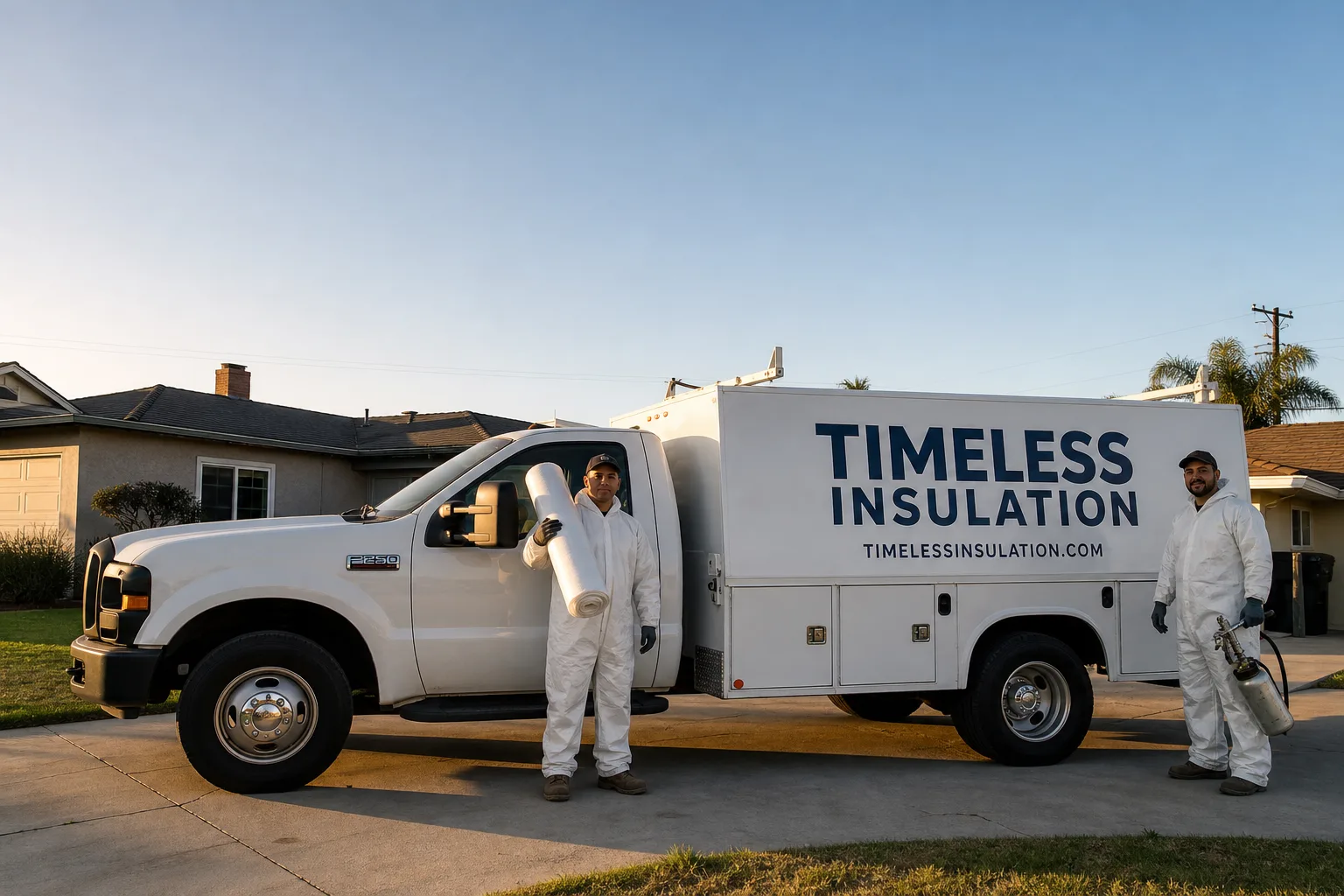
Fast, Reliable Spray Foam Insulation Across Rolling Hills Estates
Spray foam insulation in Rolling Hills Estates typically costs $3.50 to $7.50 per square foot installed, with most whole-attic projects in the 90505 ZIP landing between $8,500 and $22,000 depending on foam depth and the complexity of your roofline. We reach most Rolling Hills Estates homes within 60 to 90 minutes, which matters when you have a fog-damp rafter bay that needs sealing before the next marine layer rolls in. Timeless Insulation has worked on custom ranches and split-levels along Palos Verdes Drive North, through the equestrian properties off Dapplegray Lane, and into the hillside cul-de-sacs near Peninsula Center. If you’re noticing condensation on open-beam ceilings or rooms that never seem to hold temperature, call Nelson Ibarra’s team at (866) 507-5394 and we’ll walk you through what closed-cell foam can actually fix here.
Why Timeless Insulation Is Rolling Hills Estates’s Preferred Spray Foam Insulation Company
Rolling Hills Estates homes are not tract-built boxes. Most were built between the 1950s and 1970s by custom and semi-custom builders who framed open-beam ceilings, vaulted living spaces, and irregular attic cavities that standard fiberglass was never really designed for. That’s the homes we know, because that’s where we work. When a homeowner off Crenshaw Boulevard calls about a west-facing hillside wall that bakes every afternoon while their east-facing bedroom stays cold, we know the fix is rarely more insulation everywhere. It’s the right insulation in the right assembly.
We carry eight manufacturer lines, including Icynene, Demilec, and CertainTeed, specifically because a 1960s cathedralized ceiling on a fog-exposed lot needs a different foam than a rim joist in a hillside crawl space. That portfolio matters in Rolling Hills Estates, where no two houses are framed alike. Our crew doesn’t sell one product. We stock open-cell and closed-cell foam so the recommendation is driven by your house, not by our truck.
The work is quiet, clean, and contained. That matters when you’re living in an occupied home during a retrofit, which is the norm here. We mask floors, protect exposed beams, and run HEPA-filtered vacuums. You get a dry attic and an air seal you can verify, without us disturbing the details that make your house worth keeping original.
Rim Joist Spray Foam in Rolling Hills Estates
Rim joist spray foam in Rolling Hills Estates runs $1,200 to $3,800 for a typical home, depending on how many joist bays are accessible and whether we’re working in a full-height basement, a hillside crawl space, or a finished lower level with limited access. The rim joist, or box sill, is where your floor framing meets the foundation wall. In Rolling Hills Estates, that joint is often the single largest source of exterior air leakage in an older ranch or split-level, particularly on the downhill side of homes built into the Peninsula’s slopes. Sealing it with closed-cell foam cuts the stack effect that pulls damp marine air up through your house.
We also get called to Rolling Hills Estates rim joists where moisture is already the problem, not temperature. Fog cycles push dampness against wood framing in hillside crawl spaces and basements with poor drainage. Open-cell foam can worsen that by holding water. The right application seals the band and keeps vapor out. That’s the kind of material decision you get from an insulation-only specialist, not a general contractor guessing.
Finished Basement Access Work
Many Rolling Hills Estates homes have converted lower levels and finished daylight basements. Rim joist foam can still be applied through small access panels or by working from the interior after drilling minimal access holes we patch and seal after. We’ve done this on homes throughout 90505 without gutting finished drywall.
Hillside Drainage and Moisture Management
If your rim joist bays smell musty after a heavy fog or rain, don’t foam over active water. We check for drainage, grading, and vapor conditions first. Timeless Insulation’s team will not spray foam onto a wet assembly. We identify the moisture source, recommend corrections if they’re simple, and seal only when the wood is sound.
Crawl Space Spray Foam Insulation in Rolling Hills Estates
Crawl space spray foam in Rolling Hills Estates typically costs $4,200 to $12,500, varying by square footage, access height, and whether we’re sealing the walls, the subfloor, or the entire envelope. Hillside and canyon-adjacent homes here often sit over vented crawl spaces that were acceptable in the 1960s but haven’t aged well. Marine-layer damp moves through those vents, condenses on cold ductwork, and gets pulled up into the house. Closed-cell foam applied to crawl space walls seals the space and eliminates that moisture path.
We’ve inspected crawl spaces in Rolling Hills Estates where visible daylight showed through the rim band and the floor above felt 10 degrees colder than the hallway. That’s not a heating problem. It’s an air-sealing problem. Foam fixes it at the point of entry.
Encapsulation-Style Sealing Without the Upsell
If you just need the perimeter walls and rim joists sealed, that’s what we quote. We don’t insist on full encapsulation just because it’s a bigger line item. For many Rolling Hills Estates homes, sealing walls and band joists gets you 90 percent of the comfort and moisture benefit at a lower cost.
Protecting Hardwood Floors Above
Original hardwood flooring performs differently over a humid crawl space than over a sealed one. Periodic cupping, gapping, and that distinct cold-foot feeling on winter mornings are common complaints in Rolling Hills Estates. Closed-cell crawl space foam locks out moisture from below and stabilizes the environment under your floor. The result is more even temperatures and fewer seasonal movement problems in the wood above.
Trusted Brands We Service in Rolling Hills Estates
Timeless Insulation is certified to install both Icynene and Demilec spray foam systems, which gives us access to open-cell and closed-cell products with the right performance range for Palos Verdes Peninsula conditions. We also stock CertainTeed insulation for hybrid applications where existing batt work needs to be replaced or supplemented. Because we carry these brands as part of an eight-manufacturer portfolio, we’re not tied to one foam chemistry. A Rolling Hills Estates homeowner who needs a vapor-closed air seal gets closed-cell Demilec. A homeowner focused on sound isolation between interior floors gets open-cell Icynene. Same crew, same specialty, different product because the job demands it, and we keep a deep local stock of these materials in our Compton yard so turnaround to 90505 is measured in hours, not weeks.
Common Spray Foam Insulation Problems We See in Rolling Hills Estates Homes
- Closed-cell foam applied too thin in open-beam ceilings. We regularly inspect Rolling Hills Estates attics where someone sprayed two inches of closed-cell foam on a cathedralized deck, thinking it was enough. It isn’t. At that depth, the first cold surface moves to the interior and condensation forms on the drywall or wood. On a fog-exposed hillside lot, that becomes visible staining within one winter.
- Rim joist foam trapping moisture against wood in hillside homes. When drainage isn’t addressed first, foam can seal moisture in just as well as it seals air out. We’ve opened rim bays in Rolling Hills Estates where hidden rot was advancing behind foamed-over framing. The foam didn’t cause it. It hid it. Proper sequencing and inspection matter.
- DIY foam kits in vaulted and open-beam framing. Rolling Hills Estates’ irregular attic geometry is the worst place to attempt a two-tank DIY kit. Missed voids, incomplete coverage, and off-ratio foam are the norm. Homeowners tell us the kit “mostly worked” until their energy bill didn’t drop and condensation returned in the corners they couldn’t reach.
- Sagging fiberglass left in place under new foam designs. Some Rolling Hills Estates homes still have the original batt insulation from the Nixon administration, now sagging and saturated from decades of marine-layer damp. Removing it before spray foam is not optional in this climate, because a moist batt under foam will just keep decaying against the deck. We see this most often in the 1960s ranch homes off Via Coronel.
Pricing for Spray Foam Insulation in Rolling Hills Estates, CA
Expect to pay $3.50 to $4.75 per board foot for open-cell foam and $5.50 to $7.50 per board foot for closed-cell in Rolling Hills Estates, with the higher end of each range driven by difficult access on hillside lots and the cost of working around exposed beams without damaging them. A typical attic retrofit in the 90505 ZIP runs $9,000 to $18,000 for closed-cell work; a crawl space and rim joist package lands between $5,500 and $14,000. Some homes need only the rim joists sealed, which is the least expensive meaningful upgrade you can make in a 1960s split-level. The biggest cost variables in Rolling Hills Estates are attic access height, cathedralized ceiling area, and whether existing insulation must be removed first. We always quote removal separately so you see exactly what you’re paying for. Call (866) 507-5394 and we’ll give you an honest range for your specific house before anyone schedules anything.
We Also Serve Cities Near Rolling Hills Estates
Timeless Insulation runs crews into Manhattan Beach, Torrance, Lomita, and Palos Verdes Estates throughout the week, but our work in Rolling Hills Estates has taught us the most about custom homes with open-beam framing. If you’re in a neighboring city with a newer tract-built house, our Spray Foam Insulation team can still help, but know that the Peninsula’s older custom stock is where our moisture-control approach was forged. Call us whether you’re off Palos Verdes Drive East or closer to the coast.
Serving Rolling Hills Estates, CA — Our Local Coverage Area
We’re based in the Rolling Hills Estates area and know this community well. Use the map below to see our service coverage — if you’re nearby, we can almost certainly help.
FAQs About Spray Foam Insulation in Rolling Hills Estates
Yes, and in most Rolling Hills Estates open-beam attics the correct application is closed-cell foam sprayed directly onto the underside of the roof deck between rafters, then left exposed or covered with minimal trim depending on your preference. The foam follows the existing framing, so the beams themselves stay visible and untouched. We mask every beam during installation and photograph the results so you can see exactly where foam was applied. The look after installation is a clean, even surface between the wood members, not a spray over them. Call (866) 507-5394 for an on-site assessment and we’ll tell you if your rafter depth is sufficient for full closed-cell coverage.
Closed-cell spray foam handles marine-layer damp by acting as both an air seal and a vapor retarder, preventing warm, moist exterior air from reaching the cold underside of your roof deck where it would otherwise condense. In Rolling Hills Estates, where fog can roll in most mornings of the year, this is the primary reason we recommend closed-cell over open-cell for roof deck applications. On a fog-exposed hillside lot off Palos Verdes Drive East, we’ve removed fiberglass batts so saturated they weighed twice what they did when installed. Closed-cell foam stops that cycle at the source. For an exact evaluation of your attic’s moisture risk, call (866) 507-5394 and Nelson Ibarra will schedule an inspection.
Closed-cell spray foam is the best choice for Rolling Hills Estates hillside crawl spaces because it adds structural rigidity to the walls, stops air movement, and does not absorb the moisture that marine-layer damp and hillside drainage bring into the space. Open-cell foam in a crawl space here acts like a sponge and should not be used. We apply closed-cell to the perimeter walls and rim joists, never between floor joists in a crawl space, because that seals against the wrong surface and can trap wood moisture. For a crawl space evaluation in 90505, call (866) 507-5394 and we’ll inspect humidity levels, drainage, and access before quoting.
Yes, we can spray foam rim joists in finished basements and tight-access hillside homes in Rolling Hills Estates using small access openings that we cut precisely, spray through, and then patch, leaving no visible disruption to finished interior space. For basements with drywall ceilings, we may work from the exterior where possible. The key is reaching the band joist, which is accessible in nearly every home with the right approach. We’ve sealed rim joists in rolling hillside homes where the only access was a three-foot crawl door. Call (866) 507-5394 and we’ll tell you how we’d handle your specific layout.
In nearly every Rolling Hills Estates home with original fiberglass from the 1950s through 1970s, yes, the old insulation must be removed before spray foam is applied, because the marine-layer damp has typically saturated or sagged it and it will continue to degrade under new foam. The only exception is when the existing insulation is dry, clean, and located in areas we’re not foaming. Removal in Rolling Hills Estates runs $1.50 to $3.50 per square foot depending on attic access and how much material is present. We quote it as a separate line item so you see exactly what’s being done. For a detailed removal and retrofit estimate, call (866) 507-5394.
Written by Nelson Ibarra, Owner at Timeless Insulation, serving Rolling Hills Estates and the Palos Verdes Peninsula with insulation-only expertise.