
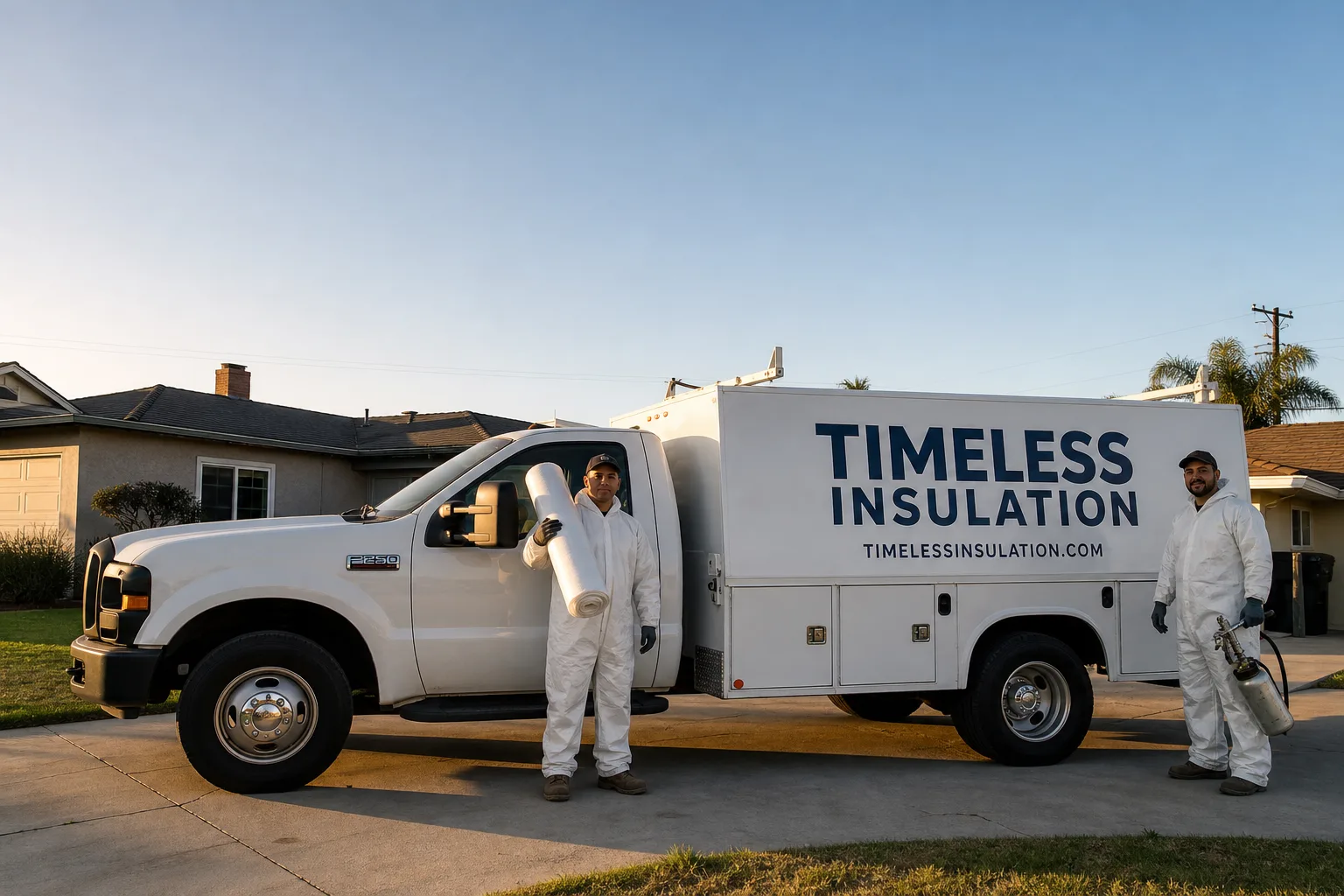
Fast, Reliable Spray Foam Insulation Across Manhattan Beach
Spray foam insulation in Manhattan Beach works differently than it does ten miles inland. The marine layer, salt air, and raised sand-section foundations change what gets specified, where it goes, and how thick it needs to be. We’ve worked on walk-street rebuilds, stilt homes near The Strand, and narrow custom contemporaries west of Sepulveda, so we know what this coastal environment does to insulation over time. If you’re planning a new build, an addition, or a retrofit in the 90266 or 90267 zip codes, call Timeless Insulation at (866) 507-5394 for a straight answer on material selection and a free estimate.
Why Timeless Insulation Is Manhattan Beach’s Preferred Spray Foam Insulation Company
Manhattan Beach homeowners don’t call us for a generic insulation job. They call because their architect specified closed-cell foam against a vaulted roof deck and the contractor needs it done to the engineer’s detail. Or because condensation showed up on the underside of a floor over a pier-and-beam crawl space and someone finally diagnosed the vapor drive problem. We carry both Icynene and Demilec spray foam lines, so we’re not forcing one chemistry into every application. The right product for a sand-section crawl space is not automatically the right product for an interior partition wall, and we say so.
Our crews know the difference between working a sub-5,000 square foot lot near Robinson Street and a wider section lot up by Manhattan Village. Tight setbacks, hard-lidded contemporary rooflines, and neighbors six feet away all shape how we stage equipment, ventilate while foam cures, and clean up. We show up when we say we will, and the work is done by insulation technicians, not a general labor crew that also hangs drywall on Tuesdays. Nelson Ibarra built this company around a single trade, and that focus shows up in how fast we can diagnose a moisture problem over the phone before we ever put a ladder against the house.
Closed Cell Spray Foam Insulation in Manhattan Beach
Closed Cell Spray Foam Insulation is the workhorse product for Manhattan Beach’s raised foundations, vaulted ceilings, and salt-exposed assemblies. It cures into a rigid, structural foam with an R-value around 6.5 to 7 per inch, and critically for this climate, it acts as a vapor retarder at about 1.5 to 2 inches of thickness. That matters west of Sepulveda, where ocean humidity finds its way into crawl spaces and against roof decks. We spray it on the underside of stilt-level floors, rim joists, rafter bays, and anywhere a vapor drive is pushing moisture through the assembly.
A typical closed-cell job in Manhattan Beach runs $2.10 to $3.40 per board foot installed, depending on depth and access. Vaulted contemporary roofs with tight rafter bays and no attic access cost more per square foot than a straightforward rim joist package. Homes in the sand sections near the beach often require sealed or coated faces on the foam, which adds a modest amount but prevents the uncoated surface from wicking marine moisture over the long term.
Rim Joist and Crawl Space Sealing
The rim joist is where the floor framing meets the foundation, and in Manhattan Beach’s pier-and-beam homes, it is the single most common air and moisture leak point. We spray closed-cell foam to fully encapsulate the rim, sealing the thermal boundary and blocking the salt-laden air that corrodes fasteners and draws condensation into the floor cavity. The difference is noticeable immediately, especially in homes where the hardwood floors feel damp or cold on a June gloom morning.
Vaulted Roof Deck Applications
Contemporary Manhattan Beach homes with open-plan living areas and no attic need foam applied directly to the underside of the roof deck. Closed-cell sprayed to the engineered rafter depth creates an unvented, conditioned roof assembly that stops thermal bridging through the framing. This is where thin application fails. If the foam is not thick enough across every rafter, the thermal bridge stays, and the marine layer will condense on the underside of the deck exactly where you cannot see it until a stain appears on the ceiling.
Open Cell Spray Foam in Manhattan Beach
Open Cell Spray Foam carries a lower R-value per inch, around 3.5 to 3.8, but it excels at air sealing and sound control. In Manhattan Beach, we use it selectively: interior partition walls between floors of a narrow contemporary, ceiling cavities where street noise from Highland Avenue or Manhattan Beach Boulevard bleeds through, and anywhere a homeowner wants the acoustic dampening that closed-cell does not provide as effectively. Open-cell is vapor-permeable, which means it breathes. That is an advantage inside conditioned spaces and a liability in sand-section crawl spaces, where persistent humidity can condense inside the foam’s open cell structure.
Open-cell spray foam in Manhattan Beach typically runs $0.85 to $1.60 per board foot installed. It is the more economical choice for interior soundproofing work, and we often pair it with closed-cell at the building envelope: closed-cell for the crawl space and roof, open-cell for the walls and between-floor partitions. Carrying both Icynene and Demilec product lines means we can match the right chemistry to each location without compromise.
Interior Sound Control
On a walk-street rebuild in the sand section near the beach, we sprayed closed-cell foam to the underside of a new contemporary’s open-plan roof deck and sealed the stilt-level crawl-space rim joists where salt-laden marine air had already begun corroding fasteners on the original 1950s bungalow framing. We foamed the vaulted rafter bays to the tight lot line, then returned with Icynene on the interior partition walls to keep the open plan whisper-quiet between floors. The homeowner reported the morning marine-layer damp and street noise both noticeably reduced.
Interior Wall Cavities
For a multi-story home on a narrow lot, open-cell foam in the interior walls quiets footfall, plumbing noise, and conversation bleed between rooms. This is a different job than exterior insulation, and it matters most in Manhattan Beach’s tall, narrow floor plans where bedrooms stack directly above living spaces. The foam fills the full cavity, eliminating the gaps and voids that fiberglass batts leave around electrical boxes and plumbing.
Trusted Brands We Service in Manhattan Beach
We carry Icynene and Demilec spray foam among our Spray Foam Insulation lineup, which also includes options from Rockwool and CertainTeed for jobs that need mineral wool or batt products alongside the foam work. For Manhattan Beach customers, carrying multiple manufacturers means we stock the right material for the specific assembly rather than stretching one product into every application. If your architect specified Demilec closed-cell at the rim and Icynene open-cell for the partition walls, we have both on our trucks. That shortens the job and removes the “we’ll have to order that” delays that plague coastal projects with narrow delivery windows and tight parking.
Common Spray Foam Insulation Problems We See in Manhattan Beach Homes
- Uncoated open-cell foam in sand-section crawl spaces. The persistent ocean humidity condenses inside the open cell structure, and that trapped moisture corrodes embedded fasteners and wiring. We see this most often in pier-and-beam homes where a previous contractor treated the crawl space like an inland attic job.
- Closed-cell sprayed too thin across vaulted contemporary rafter bays. The mild coastal climate hides thermal bridging until the marine layer condenses on the underside of the roof deck. By the time a homeowner sees the stain on the ceiling, the foam has to be stripped and resprayed to full depth.
- Off-gassing and trapped moisture behind foam on original 1940s-1960s cottage walls. When a walk-street addition wraps old sheathing with spray foam before the original wall assembly gets detailed for airtightness, moisture that was previously drying through the wall gets trapped. We diagnose this before spraying, not after.
- Corrosion at the foam-to-steel interface. Salt air attacking steel connectors and fasteners at the rim joist means the foam has to fully encapsulate the metal. Partial coverage leaves a corrosion cell. We see this on stilt homes near The Strand where the crawl space is open to ocean breezes year-round.
Pricing for Spray Foam Insulation in Manhattan Beach, CA
Closed-cell spray foam in Manhattan Beach runs $2.10 to $3.40 per board foot installed. Open-cell runs $0.85 to $1.60 per board foot. A typical rim joist encapsulation on a 1,500 square foot sand-section home lands between $2,800 and $5,200. A full roof deck on a 2,500 square foot contemporary with vaulted ceilings runs $11,000 to $19,000 depending on rafter depth and access. What moves the number: crawl space access, scaffolding on stilt homes, tight lot staging, and whether the engineer requires a sealed or coated foam face for salt-air exposure. Call (866) 507-5394 and we’ll walk the job with you and give you a written number. Estimates are free, and you’ll know exactly what material goes where and why.
We Also Serve Cities Near Manhattan Beach
Timeless Insulation regularly works on spray foam projects in Redondo Beach, Rolling Hills Estates, Palos Verdes Estates, and Torrance. The coastal building environment we deal with in Manhattan Beach extends up and down the South Bay, and our crews know the Title 24 coastal-zone requirements across all of these jurisdictions.
Serving Manhattan Beach, CA — Our Local Coverage Area
We’re based in the Manhattan Beach area and know this community well. Use the map below to see our service coverage — if you’re nearby, we can almost certainly help.
FAQs About Spray Foam Insulation in Manhattan Beach
Closed-cell foam is specified in Manhattan Beach’s sand sections because it acts as a vapor retarder at around 1.5 to 2 inches thick, which open-cell does not. Homes on raised pier-and-beam foundations near the beach sit over sandy, well-draining soil with persistent ocean humidity moving up through the crawl space. Open-cell foam’s vapor permeability means that moisture condenses inside the foam’s structure and corrodes embedded fasteners and wiring over time. Closed-cell with a sealed or coated face resists that wicking and holds its thermal performance. Call (866) 507-5394 and we’ll tell you honestly whether your specific crawl space needs closed-cell or whether open-cell is acceptable for the interior work.
Yes. Open-cell spray foam in interior partition walls and between-floor cavities is one of the most effective sound control measures available for Manhattan Beach’s tall, narrow floor plans. The foam fills the entire cavity and eliminates the air gaps that transmit sound through fiberglass batts. We use Icynene open-cell for this application regularly, and homeowners notice the difference immediately in stacked bedroom-over-living-room layouts. For a quote on interior soundproofing with spray foam in Manhattan Beach, call (866) 507-5394.
Yes, materially. Manhattan Beach’s coastal-zone designation under Title 24 means the energy code’s prescriptive packages shift toward moisture and vapor management rather than the extreme-heat R-value requirements inland jurisdictions face. The code still mandates minimum insulation levels, but the assembly details matter more: where the vapor retarder sits, whether the foam face needs coating, and how the building envelope handles the marine layer. We work with Manhattan Beach architects and engineers on these details every week, and we spray to the specified assembly, not a generic number. Call (866) 507-5394 if you need an installer who can read a coastal-zone spec sheet.
It can, if the original wall assembly is not detailed for airtightness before the foam goes in. Older Manhattan Beach cottages built in the 1940s through 1960s relied on natural air movement through the wall cavity to dry out moisture. When spray foam seals that cavity, trapped moisture has nowhere to go unless the sheathing, housewrap, and flashing are addressed first. We inspect the existing assembly before spraying and flag problem areas rather than burying them. For a free assessment of an old cottage wall before your rebuild, call (866) 507-5394.
We specify closed-cell foam and fully encapsulate the rim joist and any steel connectors so the foam completely isolates the metal from salt-laden air. Partial coverage creates a corrosion cell where the foam edge meets exposed steel, and that edge fails faster than no insulation at all. In sand-section crawl spaces near the beach, we pay particular attention to fastener heads, hold-downs, and strapping, and we recommend a sealed or coated foam face where the exposure is constant. For a crawl space evaluation in Manhattan Beach, call (866) 507-5394.
Contact Timeless Insulation for Spray Foam in Manhattan Beach
If you are planning a new build west of Sepulveda, an addition on a walk street, or a retrofit on a 1950s beach cottage, call us before the walls go up. We will walk your plans or your existing structure, explain what the marine layer and salt air actually do to spray foam, and give you a written quote for exactly what your job needs. No generic recommendations, no one-size-fits-all material. Call (866) 507-5394 today for a free estimate in Manhattan Beach and the surrounding South Bay.
Written by Nelson Ibarra, Owner at Timeless Insulation, serving Manhattan Beach and the South Bay with spray foam expertise since the company’s founding.