
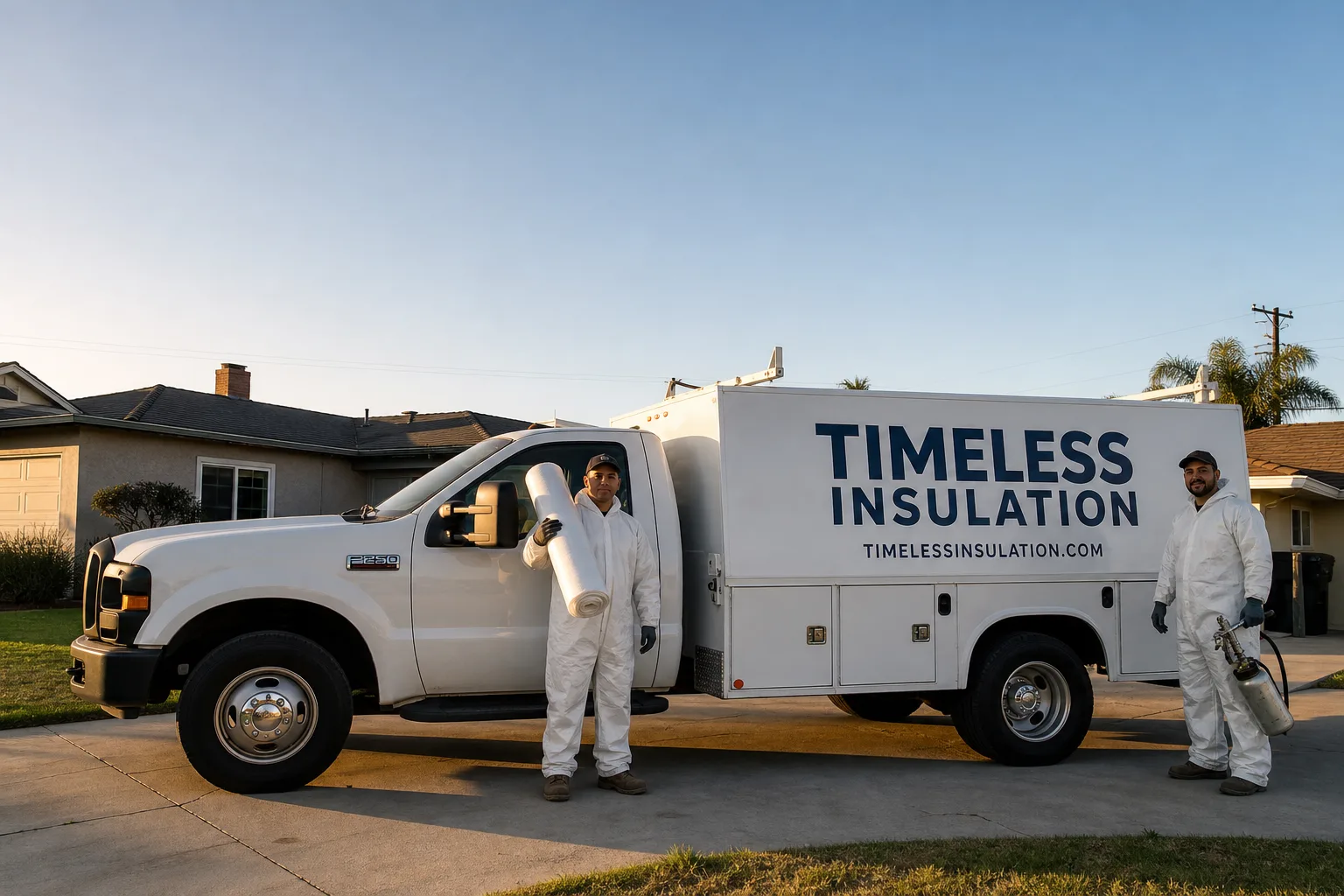
Fast, Reliable Spray Foam Insulation Across Ladera Heights
Spray foam insulation in Ladera Heights typically costs $2.50 to $6.80 per square foot for open-cell and $3.90 to $8.70 per square foot for closed-cell, with most whole-home retrofits landing between $8,000 and $22,000 depending on cavity access and roof configuration. The ridge conditions here change the math: west-facing walls and flat roofs bake hard under afternoon sun, and a foam spec that ignores that heat load fails early. We work the 90056 zip code daily from our Compton shop, usually reaching Ladera Heights within an hour. Call (866) 507-5394 for a free estimate, and we’ll walk your exact roofline and wall assembly before recommending anything.
The right foam for a 1960s ranch off La Tijera Boulevard is not automatically the right foam for a two-story contemporary up on the ridge. We’d rather show you why that’s true than sell you whichever product is easiest to load that morning.
Key Takeaways
- Open-cell spray foam in Ladera Heights runs $2.50-$6.80/sq ft; closed-cell runs $3.90-$8.70/sq ft.
- West-edge ridge homes need heat-load planning before foam, not just cavity fill.
- Shallow low-slope attics on pre-Title 24 homes need air sealing first or the foam underperforms.
- We carry Icynene and Demilec foam lines, which means open-cell and closed-cell from one crew.
- Free estimates: call (866) 507-5394.
Why Timeless Insulation Is Ladera Heights’s Preferred Spray Foam Insulation Company
Spray Foam Insulation is our core trade, not a side line. Every technician on a Ladera Heights job is an insulation specialist who works with foam daily, whether we’re sealing a rim joist on a hillside crawl space or foaming a low-slope roof deck edge. Homeowners in this area tell us the same thing: they want one trip, one clean install, and a material that actually addresses the ridge heat, not a generic fiberglass batt shoved into the same cavities that have been baking for sixty years. Nelson Ibarra runs the crew, and he’s built our approach around matching the material to the specific wall, roof, and solar orientation in front of us.
Ladera Heights has a particular kind of housing stock that rewards patience and precision. These are not production tract homes. Each rancher has its own quirks: original stucco, shallow attic framing, a flat built-up roof that someone re-coated in the 1990s, a garage that faces the afternoon sun. That’s why our approach starts with the assembly before the product. We’re not rushing a standard package onto a house that was never built for one.
Crawl Space Spray Foam Insulation in Ladera Heights
Crawl space spray foam insulation in Ladera Heights means sealing the boundary between your living floors and the dirt or vented air beneath a 1950s-70s rancher, and on the ridge it’s often the difference between a house that holds its conditioned air and one that leaks it straight into the hillside. Most of the original ranch homes here sit on vented crawl spaces that were framed without any thermal boundary at the floor, so daytime heat travels up through the joist bays and by 4pm the living room is fighting both the west sun and the warm air rising from below.
A closed-cell foam installed directly to the crawl space walls and rim joist band does two jobs at once: it stops the air movement that carries heat and humidity upward, and it gives you the continuous R-value that fiberglass batts hanging under a floor simply cannot deliver. On this ridge, where the marine layer moves in overnight and burns off by late morning, that humidity control matters. Open-cell foam will not give you the same moisture resistance in a vented crawl, so we default to closed-cell under floors unless the space is fully encapsulated with a vapor barrier and dehumidification plan. Expect to pay $3,900 to $8,700 for a typical 1,200 to 1,800 square foot crawl in the 90056 zip code.
Rim Joist Sealing With Closed-Cell
The rim joist is where your floor framing meets your foundation wall, and in these older Ladera Heights homes it’s almost always unsealed. We spray a continuous closed-cell band along the entire rim, which kills the air leaks that let hot afternoon air pour into the floor system. This one detail, done before any other floor insulation, often cuts the perceived heat gain on the first floor more than anything else.
Batt-to-Foam Transitions in Hillside Crawls
Some ridge homes have a partial daylight basement on the downhill side and a vented crawl on the uphill side. The transition between those two conditions needs a tight air seal and a thermal break, and closed-cell foam handles it better than fiberglass or cellulose. We pay close attention to the uphill wall where soil contact and drainage create a cold, damp side that can condense on the wrong material.
Garage Spray Foam Insulation in Ladera Heights
Garage spray foam insulation in Ladera Heights is a job we spec individually because west-facing garages here act like solar collectors. The door faces the afternoon sun, the wall assembly is original stucco with no cavity insulation, and the attic or roof above the garage is usually shallow and unvented. What happens is predictable: the garage hits 140°F by late afternoon and radiates heat into any room that shares a wall or ceiling with it, which in these ranch layouts often means a bedroom or a den.
We foam the garage ceiling with open-cell when there’s living space above, which slows the heat migration and quiets the space at the same time. For shared walls, especially west-facing walls, we use closed-cell because the higher R-value per inch matters when you’re working inside a 2×4 stud bay built before energy codes existed. A typical attached two-car garage in Ladera Heights runs $2,800 to $5,600 for ceiling and shared-wall foam, with a single shared wall alone coming in around $1,200 to $2,400.
Shared-Wall Heat Break
When a garage wall shares a plane with a bedroom or kitchen, that wall becomes a thermal bridge on sunny afternoons. Closed-cell foam in the stud cavities turns it into a genuine break, stopping the radiant and conductive heat transfer that makes the adjacent room unusable between 3pm and 7pm from May through October. We check for existing electrical penetrations before spraying, because on these older homes the wiring runs are often stapled to the same studs we’re about to fill.
Flat Garage Roof Underside
Many Ladera Heights garages have a flat or low-slope built-up roof with no attic space at all. In those assemblies the foam goes directly to the underside of the roof deck, and the material choice depends on whether the roof is vented. Closed-cell gives you air seal and R-value in one pass, which is usually the only practical option when there’s no venting cavity to work with.
Trusted Brands We Service in Ladera Heights
We spray both open-cell and closed-cell foam from lines we know well: Icynene for open-cell applications and Demilec for closed-cell work where density, moisture resistance, and higher R-per-inch are required. We also stock Rockwool for the fire-rated and sound-dampening details around mechanical rooms and party walls, and we’ll bring it in on any Ladera Heights job where a hybrid foam-and-mineral-wool assembly makes more sense than foam alone. Carrying multiple brands means we’re not married to one manufacturer’s performance envelope. Nelson’s rule is simple: the wall tells us what it needs, and we order the material that answers it.
For Ladera Heights customers, that means faster turnaround on specialty products and no delay waiting for a distributor run from the Valley. We keep the common foam kits, Rockwool batts, and air-sealing materials stocked locally at our Compton shop.
Common Spray Foam Insulation Problems We See in Ladera Heights Homes
- Roof decks foamed without a thermal plan on low-slope assemblies. A flat built-up roof on a ridge-facing home traps heat under the foam if there’s no venting or radiant barrier above it. We’ve opened up assemblies where closed-cell was applied to the underside of a hot roof deck and the foam had started to retain heat instead of shedding it, making the interior warmer by late afternoon than it was before.
- Skipping attic air sealing before foaming shallow 1950s-70s attic spaces. When the attic temp is running 30-40°F above outdoor air, the air moving through top plates and can lights bypasses whatever foam you add at the roofline. Air sealing has to come first or the foam is just a lid on a leaking box.
- Foam on original stucco walls without accounting for marine-layer to inland temperature swings. The overnight marine layer dumps cool, damp air onto walls that baked all day. That daily expansion and contraction cycle plus intermittent condensation will cause adhesion failures if the substrate wasn’t prepped and the right foam selected for the wall’s moisture drive.
- Garage foam added as an afterthought without addressing the door. In Ladera Heights the garage door itself is often the uninsulated metal face absorbing direct west sun. Foaming the walls and ceiling helps, but if the door panel is uninsulated the space still cooks. We’ll spec a reflective barrier on the inside of the door or recommend a door retrofit alongside the foam work.
Pricing for Spray Foam Insulation in Ladera Heights, CA
| Service | Typical Ladera Heights Range |
|---|---|
| Open-cell spray foam (whole attic/roofline) | $2.50-$6.80 per sq ft |
| Closed-cell spray foam (walls, rims, crawl spaces) | $3.90-$8.70 per sq ft |
| Crawl space spray foam (1,200-1,800 sq ft) | $3,900-$8,700 |
| Garage ceiling and shared-wall foam (2-car attached) | $2,800-$5,600 |
The biggest cost driver in Ladera Heights is access. Shallow attics, low-slope roof decks, and hillside crawls make material movement slower than a standard attic in the flats. A rancher with a 24-inch attic clearance and a 3/12 roof is going to run toward the higher end of these ranges simply because of the time it takes to move and spray safely in that space. Second factor is substrate prep: original stucco walls that have never been opened need cleaning and occasionally a primer pass before foam will bond properly. We quote free and we quote honestly. Call (866) 507-5394, and Nelson will give you a number tied to your specific walls, not a square-footage formula.
We Also Serve Cities Near Ladera Heights
In addition to Ladera Heights, our crew handles spray foam insulation work in View Park-Windsor Hills, Culver City, Lennox, and Westmont. The drive from our Compton shop is short, which keeps response times tight and scheduling flexible for multi-property owners who need work done across adjacent zip codes. Same crew, same brands, same approach to the specific building assembly in front of us.
Serving Ladera Heights, CA — Our Local Coverage Area
We’re based in the Ladera Heights area and know this community well. Use the map below to see our service coverage — if you’re nearby, we can almost certainly help.
FAQs About Spray Foam Insulation in Ladera Heights
Ridge homes in Ladera Heights take direct, unshaded afternoon sun on west-facing walls and flat roofs, which pushes attic temperatures 30-40°F above outdoor air by 4pm, so the foam has to be specified for that heat load and tied into air sealing and a radiant barrier, not just installed as cavity fill. In the flats below, you mostly deal with ambient heat; on the ridge you’re fighting direct solar gain on a hotter assembly.
Yes, but the sequence matters: we air-seal the top plates and any penetrations first, then spray the roofline with open-cell or closed-cell depending on whether the roof assembly is vented, and we only foam the roof deck directly when there’s a venting or thermal plan that prevents heat from being trapped inside the assembly. Applying foam to a low-slope built-up roof without that plan can overheat the roof and shorten its life.
No. All the work happens inside the existing wall cavities, attic space, roof framing, or crawl space, so there’s no change to the roofline, no dormers added, no exterior alteration that would trigger a view-preservation or neighborhood character review. The only visible difference is a tighter, cooler house with the same mid-century silhouette intact.
Yes, we regularly foam attached and detached garages in the 90056 zip code, focusing on the ceiling when there’s living space above and on west-facing shared walls that absorb afternoon heat through original stucco. We’ll also recommend a reflective barrier on the inside of an uninsulated metal door so the whole garage stops behaving like a solar oven.
Crawl space work in these 1950s-70s ranchers usually means sealing the rim joist band and applying closed-cell foam to the crawl walls or floor system, which stops the hot rising air and marine-layer humidity from pushing into the living space. In a vented crawl, closed-cell is the material that holds up to that moisture cycle; open-cell will absorb it. Call (866) 507-5394 and we’ll come inspect your crawl before recommending anything.
Contact Timeless Insulation for Spray Foam in Ladera Heights
On the west edge of the ridge, an uninsulated 1960s rancher is not just uncomfortable, it’s actively cooking itself every afternoon. The fix is a foam spec that accounts for the solar load, the shallow attic, and the original stucco. We’ll walk the house with you, explain what your walls and roof actually need, and give you a free estimate for the work. Call (866) 507-5394 and ask for Nelson. Same-day visits available for Ladera Heights homeowners who need answers now.
Written by Nelson Ibarra, Owner at Timeless Insulation, serving Ladera Heights and the surrounding ridge communities.