
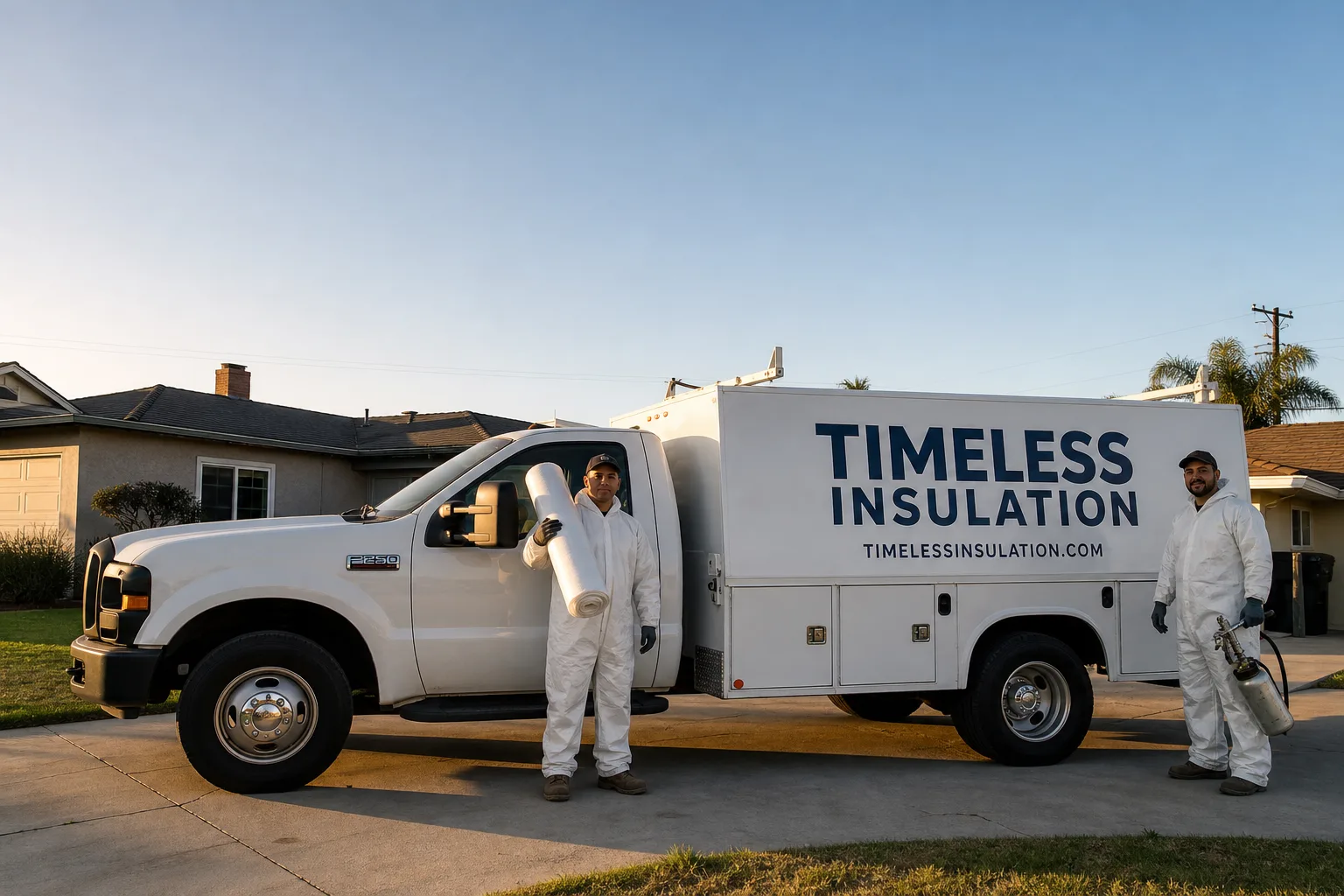
Fast, Reliable Spray Foam Insulation Across Culver City
Spray foam insulation in Culver City typically runs $2,400 – $5,600 for a standard attic job and $4,800 – $9,200 for full wall cavities in an older home, with most projects completed in one to two days. In the 1920s – 40s bungalow blocks of 90230 and 90232, open soffit and attic venting combined with the marine-layer damp routinely leaves moisture-stained framing behind original wall cavities, so spray foam here is a ventilation-and-air-sealing decision before it’s an R-value decision. Our crew knows those streets, those wall assemblies, and the way fog settles into a Spanish Revival on a June morning. If your Culver City home fights damp, noise, or afternoon heat, call (866) 507-5394 for a free estimate from a team that works this housing stock every week.
Why Timeless Insulation Is Culver City’s Preferred Spray Foam Insulation Company
Timeless Insulation is an insulation-only contractor, led by Nelson Ibarra, and that narrow focus shows up on every Culver City job. We don’t frame, we don’t roof, we don’t do HVAC on the side. We insulate. That means the person who answers your questions about open-cell versus closed-cell foam has actually installed both, in houses like yours, in this city.
Culver City homeowners call us because we carry open-cell and closed-cell spray foam through both Icynene and Demilec product lines, so the recommendation comes from what your 1930s bungalow or 1960s ranch actually needs, not from whatever is sitting on the truck. When a homeowner near Carlson Park asks whether closed-cell will trap moisture behind original lath and plaster, we can explain the vapor dynamics and suggest an open-cell alternative without talking around the question. That kind of direct answer is what builds trust here.
Response time from our Compton base to Culver City is usually 45 – 60 minutes for estimates and same-week scheduling for most installations. We’re on the 10, the 405, or surface streets through West Adams depending on the hour, and we know which Culver City blocks have alley access and which need a shorter hose run from the street.
Spray Foam Attic Insulation in Culver City
Spray Foam Attic Insulation in Culver City means working with low-slope roofs, shallow attic cavities, and the ventilation quirks that come with houses built between 1920 and 1955. A typical attic spray foam job here runs $2,400 – $5,600, depending on square footage, roof pitch, and whether we’re also correcting soffit venting or air-sealing before foam goes in. Homeowners ask for this when upstairs rooms won’t hold temperature, when street noise bleeds through the roofline, or when an energy audit shows most of the conditioned air leaving through the ceiling plane.
Open-Cell for Sound and Moisture Buffering
In Culver City’s marine layer climate, open-cell spray foam (we install Icynene open-cell regularly) gives attic assemblies a way to manage the damp air that rolls in off the Westside. It isn’t a vapor barrier, which is often exactly what you want when the bigger problem is condensation, not arctic cold. Open-cell also deadens street noise meaningfully, which matters on busier corridors like Washington and Venice Boulevard.
Closed-Cell for Structural Rigidity in Retrofit Homes
When a Culver City homeowner is already doing seismic bolting or shear-wall work, closed-cell spray foam through Demilec can stiffen the roof deck and add real racking strength. That’s a common pairing in 90230 and 90232, where retrofit culture is active and inspectors expect insulation work to align with structural upgrades. Closed-cell attic jobs in Culver City generally run on the higher end, $4,000 – $5,600, because the material expands less per board foot and we often work around existing bracing and access limitations.
Spray Foam Wall Insulation in Culver City
Spray Foam Wall Insulation in Culver City usually means retrofitting original framed wall cavities that have sat empty for 70 to 100 years. A full wall-cavity spray foam project here runs $4,800 – $9,200 on a typical two- or three-bedroom bungalow or ranch, with the range driven by cavity depth, access (interior drywall removal versus exterior drilled-and-fill), and whether knob-and-tube-era wiring needs to be left clear per code. Homeowners pursue this when a room on the foggy side of the house always feels cold, when a bedroom wall radiates afternoon heat, or when they can hear their neighbor’s driveway gate at 6 a.m.
Drilled-and-Filled for Finished Walls
On occupied Culver City homes where tearing out plaster is a non-starter, we can drill from the exterior or interior and inject spray foam into existing stud bays. The key with 1920s – 40s framing is air-sealing the open soffit and attic venting path first, otherwise the foam seals the wall but the marine-layer damp still migrates in from above. We’ve done this enough times in 90232 to check the vent path before we ever pick up a drill.
Full-Cavity Work During Renovation
If a homeowner is already down to studs for a remodel, full open-cavity spray foam gives the tightest air seal and the highest effective R-value per inch of any material we install. For Culver City renovations, we typically recommend open-cell Icynene in wall cavities for the moisture-buffering behavior it provides in this damp air, and reserve closed-cell for rim joists, crawlspace banding, or areas where space is too tight for thick foam.
On a 1930s Spanish Revival bungalow off the Carlson Park blocks of 90232, our crew opened a knee-wall and found damp-stained original framing behind uninsulated wall cavities fed by open soffit venting. We air-sealed and corrected the venting path first, then closed the wall cavities with Icynene spray foam, and the homeowner reported the foggy-morning chill and street noise both dropped.
Trusted Brands We Service in Culver City
We run both Icynene and Demilec spray foam product lines, which means we can offer open-cell and closed-cell options from dedicated foam manufacturers rather than picking up a generic barrel from the local supply yard. For Culver City homes where spray foam isn’t the right call, we also carry Rockwool stone wool and CertainTeed fiberglass, so the conversation stays honest. If a wall cavity has a moisture pattern that foam would trap, we’ll tell you, and we’ll show you the mineral wool option instead. Spray Foam Insulation is one of three methods we install, and we carry eight brands so we can recommend the best one for you, not the only one we stock.
Common Spray Foam Insulation Problems We See in Culver City Homes
- Moisture-trapped framing from unvented foam jobs. Contractors who don’t know Culver City’s marine layer will spray closed-cell foam into a 1920s – 40s attic without solving the damp-air path first. The foam traps moisture against original framing, and rot starts inside the wall.
- Foamed wall cavities with open soffit venting still feeding them. An original bungalow’s open soffit and attic venting let foggy Westside air migrate into the wall from above. Foaming the cavity without air-sealing that path is sealing a bucket with a hole in the lid.
- Under-specified attic heat gain on the east/south side. Sunny Culver City afternoons push attic temperatures up even when the marine layer keeps the street level mild. Ranch add-ons on the east side of town need more than a mild-climate R-value guess.
- Knob-and-tube-era wiring left buried under foam. Many 90230 and 90232 homes still carry original wiring. Code requires safe clearance around live knob-and-tube, and the foam install has to be planned around it, not over it.
Pricing for Spray Foam Insulation in Culver City, CA
Expect attic spray foam in Culver City to run $2,400 – $5,600, with most 900 – 1,200 square foot attics landing around $3,600 – $4,400. Wall cavity work on an older bungalow or ranch is $4,800 – $9,200 depending on access, cavity depth, and whether we’re drilling-and-filling or spraying open stud bays. The factors that move the number are square footage, open-cell versus closed-cell, attic access difficulty (low-slope 1920s roof lines are tighter than a modern attic), and whether ventilation or air-sealing corrections are needed before the foam goes in. We quote the job as a complete project, not by the hour, and estimates are free.
We Also Serve Cities Near Culver City
From our Compton base, we’re a short drive to Ladera Heights, Venice, View Park-Windsor Hills, and West Hollywood, and we bring the same moisture-and-venting expertise to those housing stocks. If you’re searching for Spray Foam Insulation in Culver City, we’re your local crew, and we cover the full Westside reach. Call for scheduling or a same-week estimate.
Serving Culver City, CA — Our Local Coverage Area
We’re based in the Culver City area and know this community well. Use the map below to see our service coverage — if you’re nearby, we can almost certainly help.
FAQs About Spray Foam Insulation in Culver City
Yes, it changes the order of operations completely. In a fog-driven climate like Culver City’s, we solve the moisture transport path before we put foam in. That means checking soffit venting, attic vent paths, and any open cavities before choosing between open-cell and closed-cell. Call (866) 507-5394 and we’ll walk your house first, not just quote a material.
Yes, and we do it regularly in 90230 and 90232, either by drilled-and-filled from the exterior when the walls are finished or by full-cavity spray when walls are already open. The important part is air-sealing the venting path from the attic and soffits before the foam goes in, or the same marine-layer damp that caused the problem will keep finding its way in.
Yes, open-cell spray foam is one of the better materials we install for reducing street and traffic noise through the roof plane, and Culver City homeowners near Washington Boulevard, Venice Boulevard, or La Cienega notice the difference immediately. It won’t make a wall street-silent by itself, but the combination of air-sealing plus foam density does more than fiberglass batts alone.
Because roof deck heat gain doesn’t care whether the air temperature at street level is 72 or 92; sunny Culver City afternoons push attic temperatures into the 120s and 130s on the east and south side of town. If your attic insulation was installed to a mild-climate guess instead of a measured heat gain number, it’s undersized. That’s one of the direct cost-of-comfort issues we correct with spray foam on the roof deck.
For unit turnover, sound between units, and long-term thermal stability, yes, open-cell spray foam in the ceiling plane of a 1950s – 70s low-rise often pays back within a few years of reduced heating and cooling. We can work unit-by-unit, and we’re used to Culver City apartment access constraints like narrow alleys, second-floor runs, and noise-sensitive neighbors during business hours.
Ready to talk numbers? Call Timeless Insulation at (866) 507-5394 for a free estimate. We’ll come out to your Culver City home, look at what’s actually going on inside the walls and above the ceiling, and give you a real number with a real recommendation, no pressure and no vague ranges. Nelson Ibarra and the team have been trimming energy bills and quieting Westside houses for years. Let’s see what your place needs.
Written by Nelson Ibarra, Owner at Timeless Insulation, serving Culver City from our Compton headquarters.