
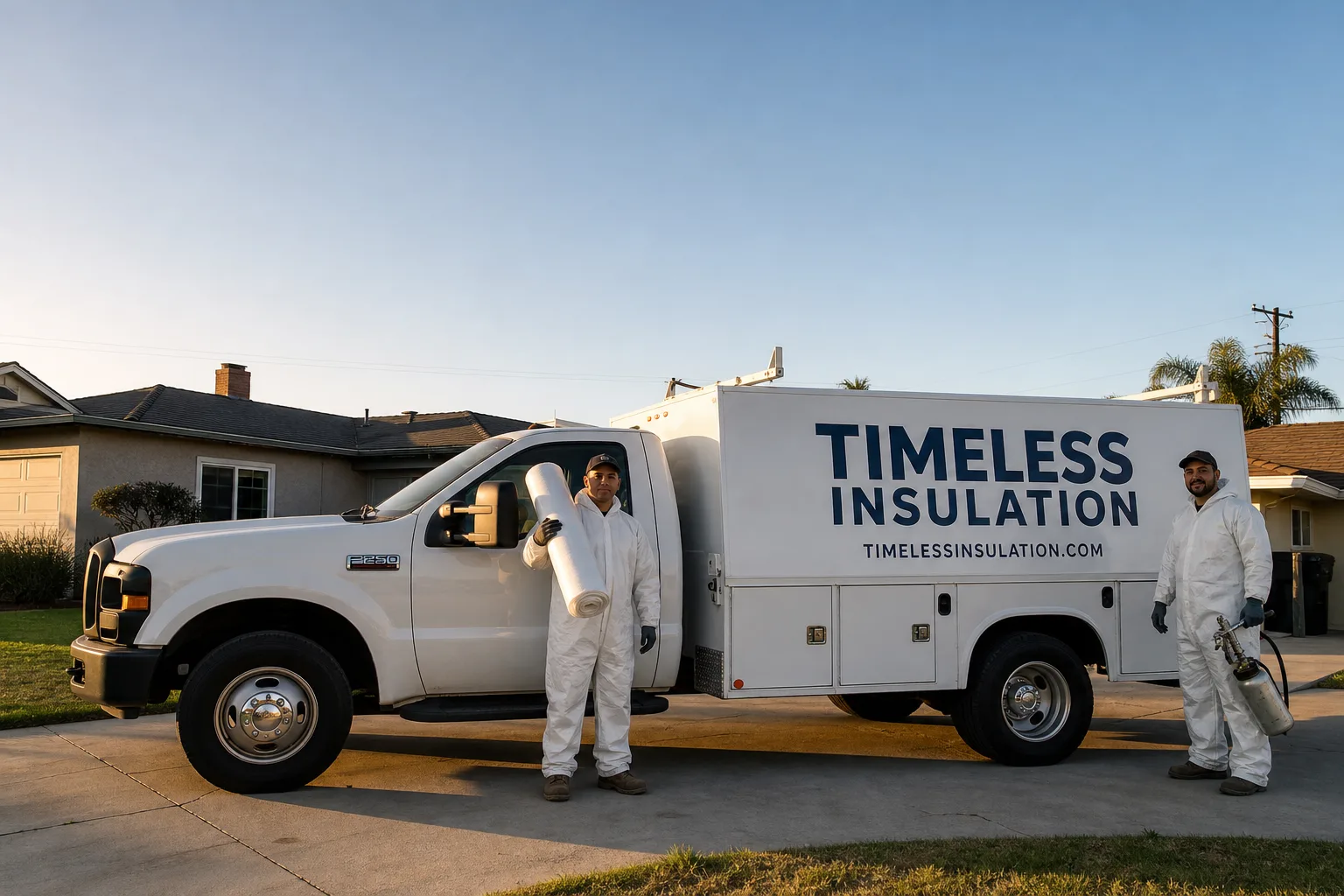
Fast, Reliable Spray Foam Insulation Across Bellflower
Spray foam insulation in Bellflower typically runs $3.50 to $7.50 per square foot installed, with most 1950s tract bungalow attic and garage projects landing between $2,800 and $6,500. We reach every Bellflower neighborhood same-day or next-day, and we know exactly what these postwar stucco homes need. If you’re tired of rooms that bake by 3 p.m. and an AC that never shuts off, call (866) 507-5394 and we’ll walk you through what’s actually going on in your attic. No pressure, just a straight answer on what your roof deck is doing to your electric bill.
Why Timeless Insulation Is Bellflower’s Preferred Spray Foam Insulation Company
We work Bellflower’s older tracts every week. Not once a month. Our crews know the 90706 and 90707 zip codes well enough to predict what they’ll find before the ladder goes up: settled original insulation, open can lights, and room additions that were never properly separated from the attic. That’s the real advantage of calling a specialist like us over a general contractor. Insulation is the only thing we do.
Nelson Ibarra built Timeless Insulation around one idea: carry enough material options that the home tells us what it needs, not the other way around. We stock open-cell and closed-cell spray foam through both Icynene and Demilec, plus fiberglass, mineral wool, and blown-in cellulose for jobs where foam isn’t the right call. In Bellflower, it usually is the right call for roof decks and garage conversions, but we’ll tell you if it’s not. Call (866) 507-5394 and you’ll get that straight.
Garage Spray Foam Insulation in Bellflower
Garage Spray Foam Insulation in Bellflower is one of the most cost-effective upgrades we do, because most of these postwar homes have attached garages that were never insulated at all or converted garages where the old garage door opening was framed in with a bare, uninsulated wall. The first thing we check is the ceiling cavity above the garage, then the kneewall or boundary wall facing the house. In a Bellflower summer, an uninsulated attached garage turns into a heat chamber by noon, and that heat presses directly against the conditioned living space for the rest of the day. Closed-cell foam on the garage ceiling and the common wall cuts that transfer hard.
A garage ceiling spray foam job in Bellflower typically runs $1,800 to $3,400 depending on square footage and access. The payback shows up in the rooms adjacent to the garage, which stop running five to eight degrees warmer than the rest of the house.
Converted Garage Boundaries
Bellflower has a lot of converted garages. Some are done well. Most aren’t. The old garage slab stays cold in winter and the roof above stays hot in summer, and nobody sealed the boundary between that space and the original house. We spray foam the ceiling and kneewall to create one continuous thermal boundary. On a recent 1950s bungalow off the 91 Freeway corridor, our crew found exactly that: a converted garage left as a bare, uninsulated thermal hole between the house and the afternoon heat. Foaming that boundary changed the room’s comfort overnight.
Closed Cell Spray Foam Insulation in Bellflower
Closed Cell Spray Foam Insulation in Bellflower is the material we recommend most often for roof decks and garage ceilings, because it does two jobs at once: it insulates at roughly R-6.5 per inch and it acts as an air and moisture barrier. That second part matters in Bellflower specifically, where the inland coastal climate brings cool damp mornings and hot dry afternoons. Open-cell foam absorbs moisture over time in that cycle. Closed-cell doesn’t. For a roof deck application in a 90706 or 90707 home, closed-cell foam sprayed directly to the underside of the roof sheathing stops solar heat gain before it ever radiates into the attic.
Expect closed-cell spray foam in Bellflower to run $2.25 to $3.75 per board foot, which translates to roughly $4,500 to $7,500 for a typical 1,200 square foot attic roof deck. It’s the higher-cost option, and for good reason. We carry it through both Icynene and Demilec so you get the right foam for the specific roof pitch and framing you actually have, not whatever one product we happen to stock.
Roof Deck First, Not Walls
Bellflower’s housing stock is dominated by single-story stucco tract homes with shallow vented attics and wood-frame construction. The sun beats down on the roof all day, the attic superheats, and that heat radiates down through the ceiling into the living room. Spraying closed-cell foam against the roof deck converts the attic from a solar oven into a conditioned buffer zone. In this climate zone, that’s the single biggest comfort improvement you can buy.
Trusted Brands We Service in Bellflower
We carry eight manufacturer brands so we can recommend the best one for the job, not the only one we stock. For Bellflower spray foam work we lean on Icynene and Demilec for both open-cell and closed-cell applications, and we keep Rockwool and CertainTeed on hand for situations where a hybrid approach makes sense: foam on the roof deck, mineral wool or fiberglass batts on partition walls. That flexibility matters in older Bellflower homes where no two attics are framed the same way. We keep local inventory staged for fast turnaround in Bellflower, so a green light on a quote usually means installation within the same week.
Common Spray Foam Insulation Problems We See in Bellflower Homes
- Settled original insulation left in place. Most 1950s and 60s Bellflower attics have blown-in insulation that’s compacted down to a few inches of near-useless material. Spraying foam over a failed, uneven base without addressing it first wastes the R-value you paid for.
- Unsealed can lights and top-plate bypasses. We find open holes around recessed lights and unsealed framing gaps in nearly every Bellflower tract home we open up. Hot attic air pours through those gaps and skips right past the new foam. Air sealing comes before spraying. Always.
- Room additions with uneven insulation boundaries. When a bedroom or family room was added on, the ceiling insulation often stops at the original roofline. The addition bakes while the rest of the house cools. Foaming the addition roof deck separately fixes that thermal short circuit.
- Converted garage thermal holes. The boundary between a converted garage and the original house is rarely insulated at all. Foam on the ceiling and common wall turns that space from a heat source into a conditioned room.
Pricing for Spray Foam Insulation in Bellflower, CA
Here’s what you can expect to pay in Bellflower for spray foam work right now. Open-cell attic floor and wall cavity foam runs $2.00 to $3.25 per board foot, or about $2,200 to $4,800 for typical projects. Closed-cell roof deck foam runs higher, as noted above. Garage ceiling and converted garage boundary work lands between $1,800 and $3,400. Rim joist spray foam in crawlspace and raised foundation homes, which we see in some older Bellflower neighborhoods, runs $900 to $1,800 for a full perimeter. What moves the number: attic access, existing insulation removal, and how much air sealing the bypasses require before we spray. We give free estimates, and the quote you get is the price you pay. Call (866) 507-5394 to schedule a walkthrough.
We Also Serve Cities Near Bellflower
Our crews cover Bellflower and the surrounding communities daily, including Bellflower itself, Paramount, Norwalk, Artesia, and Cerritos. If you’re in any of those cities and dealing with the same postwar tract home issues, the same team that does our Spray Foam Insulation work in Bellflower will handle your job. One specialist team, not a rotating cast of subcontractors.
Serving Bellflower, CA — Our Local Coverage Area
We’re based in the Bellflower area and know this community well. Use the map below to see our service coverage — if you’re nearby, we can almost certainly help.
FAQs About Spray Foam Insulation in Bellflower
Spray foam makes more sense in Bellflower because the problem here is solar heat gain on the roof deck, not heat loss through the ceiling in winter. Batts laid on the attic floor slow heat moving down through the ceiling, but they do nothing to stop the roof deck from superheating in the first place. Closed-cell foam sprayed to the underside of the sheathing stops the heat at the source, which cuts AC load far more than any additional floor insulation would. The mild winters in the 90706 and 90707 zip codes mean heating-season performance barely matters. It’s the summer that’s eating your electric bill. Call (866) 507-5394 and we’ll tell you honestly if your attic is a foam candidate or a batts candidate.
Yes, in almost every case. Converted garages in Bellflower sit at the hottest corner of the house, with afternoon sun on the roof and a slab floor that stays cold in winter. The boundaries between the conversion and the original house were rarely insulated when the work was done. Spray foam on the garage ceiling and kneewall creates one sealed thermal boundary and stops the conversion from pulling heat into the main house all afternoon. We’ve done enough of these in Bellflower to know what a difference it makes. A typical converted garage boundary foam job runs $1,800 to $3,400.
Yes, and they matter more than most people realize. Unsealed can lights are direct openings from the living space into a superheated attic. In a 1950s Bellflower bungalow, those openings let 140-degree attic air pour straight into the living room, and they completely bypass whatever insulation you add. We air-seal and box around each fixture before spraying foam, because sealing the bypasses is what actually delivers the R-value you paid for. Skipping that step is like installing a great AC unit and leaving the windows open. For an exact assessment of your attic bypasses, call (866) 507-5394 for a free walkthrough.
Closed-cell is the right answer for a Bellflower roof deck. It delivers roughly double the R-value per inch of open-cell, and it acts as a vapor and air barrier, which matters in Bellflower’s inland coastal climate where cool damp mornings alternate with hot dry afternoons. Open-cell foam in that moisture cycle can absorb water over time. Closed-cell won’t. The tradeoff is cost: closed-cell runs about 50 to 60 percent more per board foot. For roof deck applications specifically, we recommend closed-cell through our Icynene and Demilec lines, and we’ll show you the numbers side by side before anyone sprays anything.
We remove it, or we work over it only after we’ve evaluated what’s left. Most 1950s and 60s Bellflower attics have original blown-in insulation that’s settled to a few inches of compressed, ineffective material. If the old insulation is dry and the attic is vented, we can seal the bypasses and spray foam to the roof deck, effectively creating a new conditioned attic above the old floor insulation. But if the old material is compacted, rodent-damaged, or holding moisture, we remove it before anything new goes in. The goal is one continuous thermal boundary, not a foam layer floating over a failed base. Estimates cover whatever removal is needed. Call (866) 507-5394 to get your attic assessed.
Written by Nelson Ibarra, Owner at Timeless Insulation, serving Bellflower since day one.