
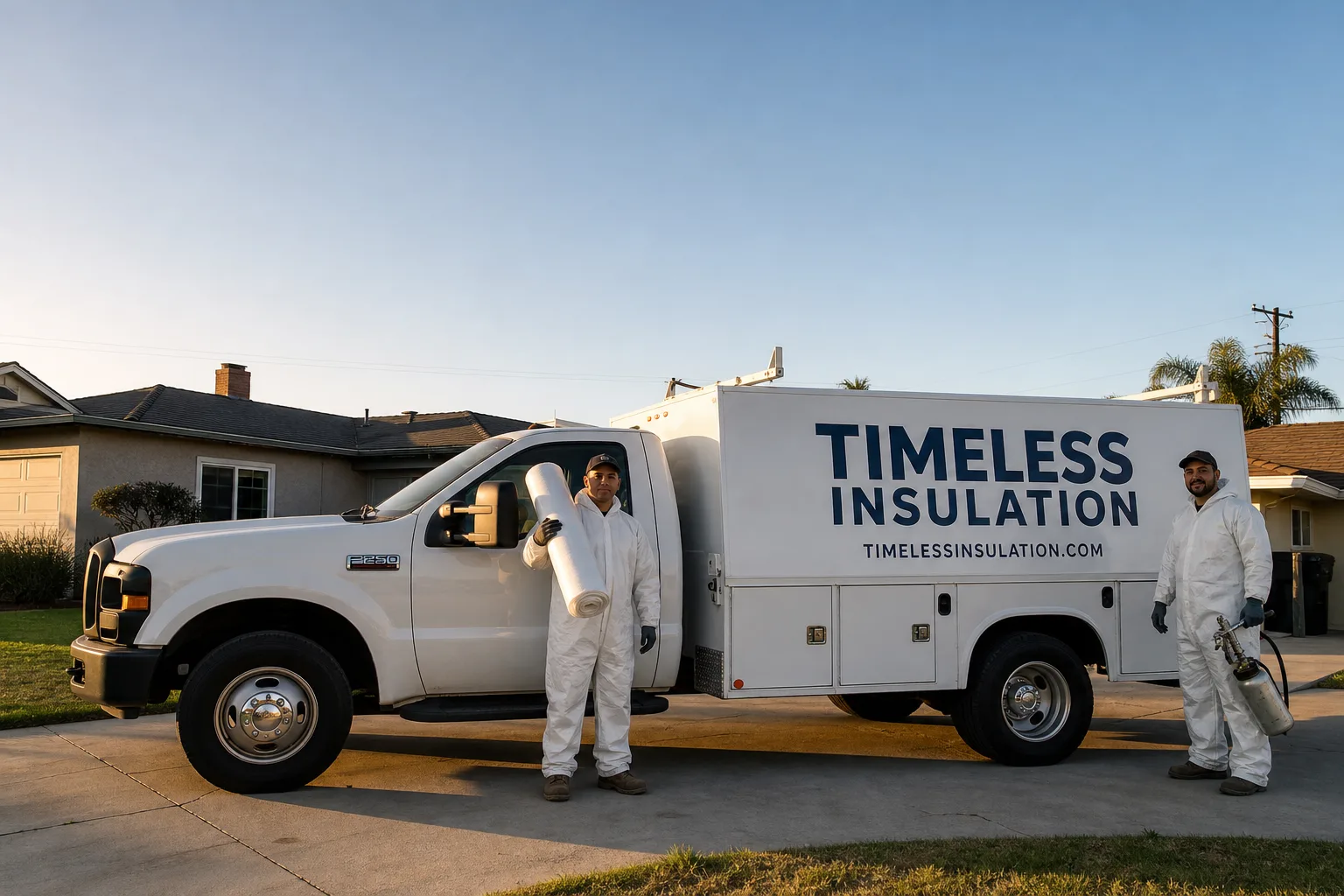
Fast, Reliable Spray Foam Insulation Across Artesia
Spray foam insulation in Artesia typically costs $2,800 to $6,500 for a full attic application, with smaller jobs like rim joist sealing running $900 to $1,800. Most Artesia projects are completed in one day because the housing stock here is remarkably uniform – post-war single-story tract homes with shallow gable roofs that our crews can assess and insulate block by block. If you live off Pioneer Blvd., South Street, or anywhere in the 90701 or 90702 zip codes, you’re dealing with the same attic geometry as your neighbors, which means we already know what your roof deck needs. Call (866) 507-5394 for a free estimate from a team that treats Artesia’s compact grid as familiar territory, not a new discovery.
Why Timeless Insulation Is Artesia’s Preferred Spray Foam Insulation Company
Artesia isn’t a big city, and that works in our favor. At roughly 1.6 square miles, the entire town is smaller than some single ZIP codes we serve. Every crew we send here has worked the same streets before – the 1960s stucco tracts near Artesia Park, the blocks running south of the 91, the long commercial stretches along Artesia Blvd. Our familiarity with the housing stock means we arrive knowing what to expect: low-pitch roofs, wood-frame walls, attics with original or thin batt insulation, and afternoon heat that turns back bedrooms into ovens by mid-summer. Homeowners in Artesia call us because we diagnose at the block level. When you tell us you’re off Norwalk Blvd. or down a side street from Pioneer Blvd., we already have a mental map of your roof geometry and ventilation.
The team is led by Nelson Ibarra, who built Timeless Insulation around a simple idea: carry more materials than anyone else so every recommendation fits the house, not the truck. That matters in Artesia, where a 1958 tract home has different needs than a mixed-use building on Pioneer Blvd. with a restaurant below it. We’re an insulation-only contractor. Spray foam, attic insulation, blown-in – nothing else. That focus means our technicians spend every workday thinking about thermal bypass, foam adhesion, and ventilation, not splitting their attention across unrelated trades.
Spray Foam Insulation Contractors in Artesia
Spray Foam Insulation Contractors in Artesia handle the full scope of a foam application: evaluating your attic or wall cavities, specifying open-cell or closed-cell foam based on your roof geometry and heat exposure, preparing the surface, and applying foam to the correct depth. In Artesia, the typical job is a 1950s to 1970s single-story stucco home with a shallow gable roof. The roof deck bakes under long, dry summer sun, and that radiant heat transfers directly into the attic and then into living spaces. A full spray foam attic application in Artesia runs $2,800 to $6,500, while a rim joist sealing project – addressing the band board where your floor meets the foundation – runs $900 to $1,800.
Closed-Cell Foam for Perimeter and Roof Deck Applications
Closed-cell foam delivers about R-6.5 per inch and acts as an air barrier, vapor retarder, and structural stiffener all at once. For Artesia’s low-pitch roofs, closed-cell against the roof deck stops radiant heat before it enters the attic at all. We use Demilec closed-cell products on many Artesia jobs because the higher R-value per inch matters when you’re working with tight eave clearance.
Rim Joist Sealing in Artesia’s Post-War Slab Homes
Most Artesia tract homes sit on slab foundations with exposed rim joists around the perimeter. Those rim joists leak air year-round, but in summer they let hot air push into the house while your AC fights it. Spray foam rim joist sealing closes that thermal bypass in a single afternoon. Homeowners off Pioneer Blvd. and South Street report that rim joist work drops their warmest room’s temperature noticeably within the first week.
Spray Foam Attic Insulation in Artesia
Spray Foam Attic Insulation in Artesia means coating the underside of the roof deck with foam so heat stays out of the attic entirely. That’s a different approach from blown-in or batt insulation, which sit on the attic floor and leave the attic space itself hot. In Artesia, where summer afternoons push attic temperatures past 140 degrees and low-pitch roofs leave little airflow, that distinction matters. A standard Artesia spray foam attic job – removing failed batts, air-sealing the top plates, and spraying several inches of foam against the roof deck – runs $2,800 to $6,500 depending on square footage and whether we’re using open-cell or closed-cell product.
Open-Cell Icynene for a Quiet, Even Envelope
Open-cell foam delivers about R-3.8 per inch and costs less per board foot than closed-cell, which makes it the smarter financial choice for many Artesia attics where eave clearance isn’t the limiting factor. We use Icynene open-cell foam on roofs where there’s enough depth to spray 6 to 8 inches and the homeowner wants both thermal performance and sound dampening. Given how close Artesia homes sit to Pioneer Blvd. and the 91 corridor, noise reduction is often a welcome side benefit.
Air-Sealing First, Foam Second
Before we spray anything, we seal the attic’s air leaks: top plates, electrical penetrations, plumbing chases, and any gaps where the drywall meets the framing. In Artesia’s tract homes, these gaps are remarkably consistent because the framing was done in production runs – entire blocks share the same leak points. Foam over unsealed gaps is wasted foam. We seal first, then spray, because that’s what produces the numbers on your energy bill.
Trusted Brands We Service in Artesia
We carry spray foam from Icynene and Demilec because they cover different applications: Icynene for open-cell work where depth isn’t constrained and Demilec for closed-cell work where every inch of R-value counts. We don’t push one product onto every job in Artesia. A shallow-gable roof with low eaves often calls for closed-cell. A standard attic with room to spray six inches can take open-cell and save money. We also stock Rockwool for shared-wall fire-blocking applications that come up in Artesia‘s mixed-use buildings along Pioneer Blvd. When you call, you’ll get a recommendation tied to your specific roof and wall assembly, not to what we happen to have left on the shelf.
Common Spray Foam Insulation Problems We See in Artesia Homes
- Under-applied perimeter foam on shallow gable roofs. Installers who don’t know Artesia’s low eave clearances often spray too thin at the roof’s edges, leaving a thermal bypass that re-creates the afternoon heat gain the foam was meant to stop. Our crews compensate by spraying thicker at the perimeter and verifying coverage before we leave.
- Failed original batt insulation left under new foam. Many 1950s and 1960s Artesia attics still have the original 2-inch batts, collapsed and compressed from decades of heat. Leaving them in place under fresh foam traps moisture against the roof deck. We remove failed batts before spraying.
- Grease-contaminated roof cavities on Pioneer Blvd. mixed-use buildings. When an apartment sits above a restaurant, exhaust grease migrates into the shared roof cavity and prevents foam from bonding to the sheathing. We degrease and prime those surfaces first – a step most crews skip because they’ve never worked a mixed-use strip like Pioneer Blvd.
- Thermal bypass through shared walls in tight-lot homes. Artesia lots are small, which means many homes nearly touch their neighbors. Air leaks through shared or nearly-shared walls go unnoticed until foam goes in and the remaining gaps become obvious. We check wall-to-roof connections carefully on every Artesia job.
Pricing for Spray Foam Insulation in Artesia, CA
Here’s what spray foam insulation actually costs in Artesia right now. A full open-cell spray foam attic application in a 1,200 to 1,800 square foot tract home runs $2,800 to $4,500. The same attic in closed-cell foam runs $4,200 to $6,500 because the material is denser and the installed R-value is higher. Rim joist sealing on a typical Artesia slab home costs $900 to $1,800. Garage ceiling spray foam, common on the older attached garages here, runs $600 to $1,400. Spray foam roof deck work on a low-pitch roof – where we spray directly against the underside of the sheathing – is $3,200 to $5,800 depending on accessibility. We quote every job in writing before we start, and estimates are free. Call (866) 507-5394 and Nelson Ibarra or one of our project leads will walk the job with you.
We Also Serve Cities Near Artesia
Our crews cover Spray Foam Insulation work in Artesia and the surrounding communities. We’re regularly on the road to Cerritos, La Palma, Hawaiian Gardens, and Norwalk. If you’re in one of those cities and need spray foam, attic insulation, or blown-in work, the same team and the same eight-brand material portfolio apply. Call (866) 507-5394 and tell us where you are.
Serving Artesia, CA — Our Local Coverage Area
We’re based in the Artesia area and know this community well. Use the map below to see our service coverage — if you’re nearby, we can almost certainly help.
FAQs About Spray Foam Insulation in Artesia
Low-pitch roofs put the roof deck closer to your ceiling, which means less attic airflow and more direct radiant heat transfer into the house. In Artesia’s tract homes, that means the roof deck itself must be air-sealed and insulated, not just the attic floor. Spray foam handles this well because it can be applied directly to the underside of the deck, but it has to be sprayed thick enough at the eaves – the area where heat enters first. We’ve learned to over-apply at the perimeter on these roofs because under-application there recreates the exact heat gain the foam is meant to stop. Call (866) 507-5394 if you want us to assess your roof specifically.
Yes, in most cases we can work from the attic or roof access without interrupting the business below. The real challenge on Pioneer Blvd. mixed-use buildings is grease-laden sheathing in the roof cavity. Restaurant exhaust migrates up and coats the underside of the roof deck, and foam won’t adhere to it. We degrease and prime those surfaces before spraying, which keeps the foam bonded for decades. We also coordinate with business hours so our crew is out of the way during busy service periods. Call (866) 507-5394 and we’ll schedule a walkthrough at a time that works for everyone.
Both, depending on the roof. Closed-cell delivers roughly R-6.5 per inch and stops radiant heat with less thickness, which makes it the right call for Artesia’s shallow-gable roofs with tight eave clearance. Open-cell delivers about R-3.8 per inch and costs less per board foot, so it’s the better value on attics with enough depth to spray six to eight inches. For most 1950s-to-1970s tract homes in Artesia, open-cell Icynene against the roof deck solves the heat problem at the right price. For perimeter work or rim joists, we lean Demilec closed-cell. Call (866) 507-5394 for a material recommendation based on your actual roof.
We carry Icynene open-cell and Demilec closed-cell spray foam, plus Rockwool for fire-blocking and sound-dampening applications that come up on Artesia’s mixed-use and shared-wall buildings. That’s the point of our portfolio: we’re not tied to one manufacturer. Your house gets the material that matches its construction, not the product we happen to stock exclusively. We also maintain access to CertainTeed and Johns Manville products when the job calls for them. If you want specifics on what we’d spec for your house, call (866) 507-5394.
Spray foam isn’t a fire-blocking material by itself, but closed-cell foam paired with Rockwool mineral wool at the wall-to-roof and floor-to-wall transitions creates a fire-resistive assembly that slows spread between units. In Artesia’s Pioneer Blvd. buildings, where apartments sit directly above restaurants and shops, that separation matters for code compliance and your safety. We work with local inspectors and do the fire-blocking correctly the first time. Call (866) 507-5394 if you have a mixed-use property and you’re not sure what the current fire separation looks like.
Written by Nelson Ibarra, Owner at Timeless Insulation, serving Artesia and surrounding communities.