
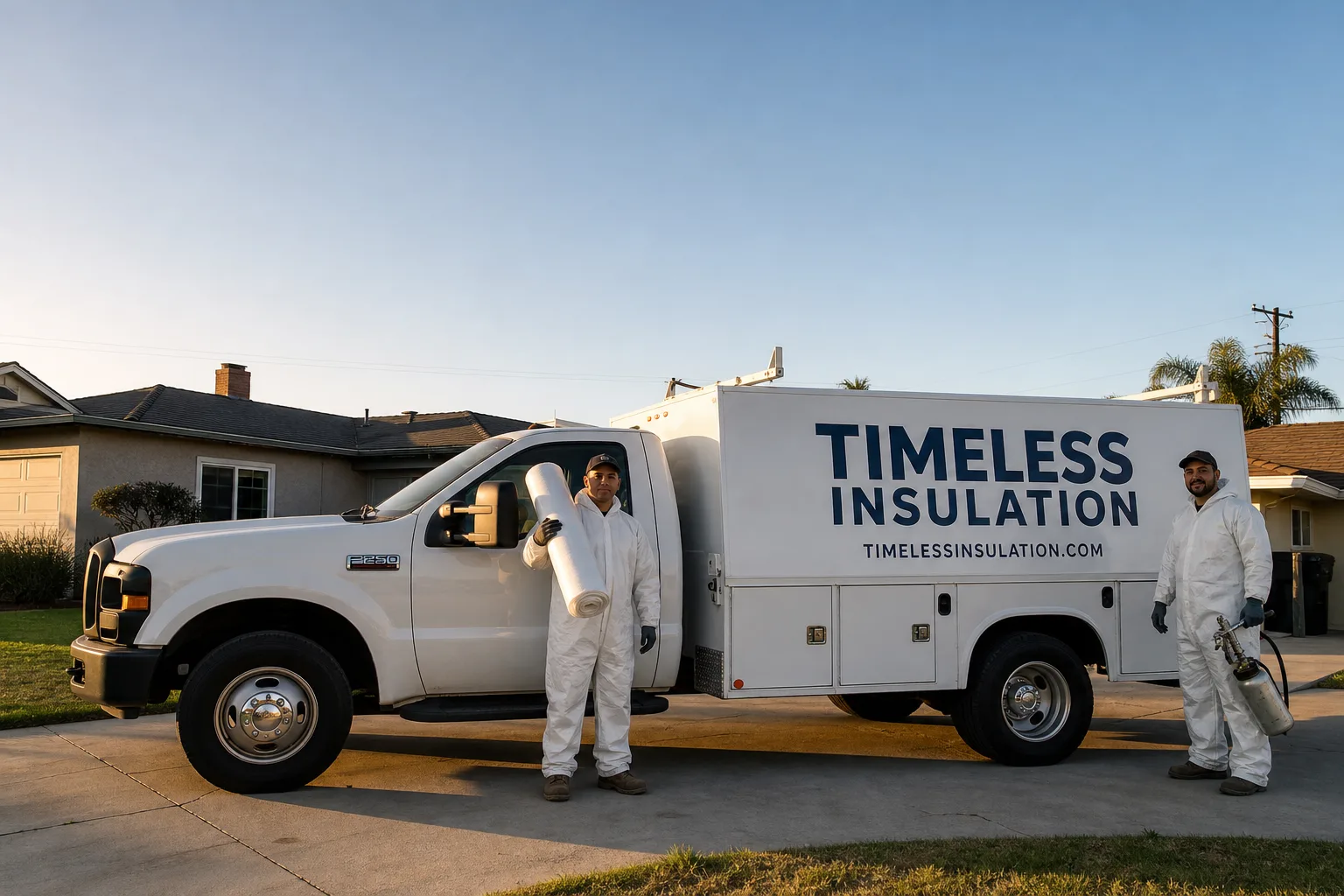
Fast, Reliable Attic Insulation Across Manhattan Beach
Attic insulation in Manhattan Beach is a moisture-and-corrosion problem first, not a heat problem. The marine layer rolling off the Pacific keeps attic dew points high year-round, and the salt air attacks insulation hardware, fasteners, and vapor barriers long before R-value becomes the deciding factor. If you’re dealing with damp insulation, condensation stains on ceilings, or energy bills that don’t match a mild coastal climate, call Timeless Insulation at (866) 507-5394. We work throughout Manhattan Beach, from the sand-section walk streets to the Hill Section, and we diagnose coastal attic failures the way inland crews can’t.
Our team knows Manhattan Beach’s housing stock: original 1940s – 1960s beach cottages jammed onto narrow lots, tall contemporary rebuilds with vaulted hard-lidded roofs, and raised foundations sitting on sandy, well-draining soil. Each one presents a different attic insulation challenge. We carry eight brands because no single product solves all three. That’s the job.
Why Timeless Insulation Is Manhattan Beach’s Preferred Attic Insulation Company
Most insulation contractors treat Manhattan Beach like any other Los Angeles suburb. They spec R-38 fiberglass and move on. But the sand sections west of Sepulveda are a different world. Crawl-space vapor drive from sandy, well-draining soil pushes ground moisture upward through raised foundations, saturating subfloor insulation and forcing vapor barriers to fail from below. Meanwhile, the morning marine layer condenses on the underside of hard-lidded contemporary roof decks, soaking fibrous batts and breeding mold in vaulted ceiling cavities. Nelson Ibarra built Timeless Insulation around this exact problem set: coastal moisture management, not generic thermal fill.
We also service what we install. We carry Rockwool, CertainTeed, Icynene, and Demilec product lines specifically because they address the conditions we find in Manhattan Beach attics. If a Rockwool Comfortbatt installation in a Hill Section remodel needs adjustment three years later, we have the material on hand. That’s the difference between a specialist and someone who shows up with whatever’s on the truck.
Attic Insulation Removal in Manhattan Beach
Attic insulation removal in Manhattan Beach is often the first step before any real fix can happen. We pull out old, failed material: sagging fiberglass batts that have lost loft, cellulose matted down by condensation, foil-faced batts delaminating from coastal humidity. Then we assess what’s underneath. A typical removal in Manhattan Beach runs $1,200 – $2,800 depending on attic size and access, with vaulted or hard-lidded ceilings adding labor because we work through limited access points and often need scaffolding or containment.
When Coastal Moisture Has Destroyed the Existing Material
Salt-laden air doesn’t need a roof leak to ruin insulation. Over years, vapor condenses on the underside of hard-lidded roof decks, saturating whatever fibrous material is touching it. We regularly remove batts that weigh three times their original spec because they’ve been absorbing ocean humidity. If you see water stains on ceiling drywall near the peak, that’s the insulation failing, not the roof membrane.
Prepping for a Corrective Install
Removal without correction is just cleanup. We remove failed material, inspect the top plates and penetrations, and recommend a vapor-retarder strategy sized for the coastal marine layer before anything new goes in. On sand-section homes with raised foundations, we also check what’s happening below the floor deck, because the subfloor cavity often explains attic moisture patterns.
Insulation Contractors in Manhattan Beach
Insulation contractors in Manhattan Beach fall into two groups: general contractors who insulate as a line item, and dedicated insulation specialists. We’re the second. That matters because the build-out of old beach cottages into multi-story contemporary homes on narrow walk-street and sand-section lots means insulation here is usually specified for new luxury construction engineered for ocean air and Title 24 coastal-zone compliance. General crews going off a generic spec sheet miss the vapor-drive details that sink these projects within a few seasons.
The Specialist Difference on Coastal Jobs
We read the plans and the site conditions together. A hard-lidded contemporary roof on a 4,800-square-foot walk-street lot behaves differently than a vented attic in an original 1950s bungalow. We spec open-cell Icynene or Demilec closed-cell where airtightness matters, Rockwool Comfortbatt where fire rating and moisture resilience are non-negotiable, and CertainTeed fiberglass where budget and roof geometry call for a straightforward batt fit.
When You Need a Contractor Who Can Handle the Details
Tight lot lines in Manhattan Beach mean attics are small, access is awkward, and staging happens in cramped walk-street conditions. We’ve worked enough sand-section rebuilds to know that the insulation contractor is often the last trade in before drywall, and the first one blamed when condensation appears later. Our crews work with the roofer’s ventilation plan and the HVAC contractor’s platform layout. Single-trade focus means we actually coordinate with the other specialists on site.
Trusted Brands We Service in Manhattan Beach
We install and service insulation from Rockwool, CertainTeed, Icynene, and Demilec, among others. For Manhattan Beach attics, the brand matters less than the material match: stone wool where salt-air moisture is relentless, closed-cell spray foam for hard-lidded vaults, fiberglass batts for vented bungalow attics with standard framing. We stock common replacement components for coastal failures, including vapor-retarder products, support netting, and corrosion-resistant fasteners, so repairs to Manhattan Beach homes don’t wait on a distributor order. The goal is the right product for your specific roof geometry and foundation type, not the one brand we happen to sell.
Common Attic Insulation Problems We See in Manhattan Beach Homes
- Condensation-soaked batts in vaulted ceilings. The marine layer keeps attic dew points high, and hard-lidded contemporary roofs have no vented attic space to dry things out. Foil-faced fiberglass batts sag, compress, and drip onto ceiling drywall within a few seasons if the vapor retarder isn’t sized for coastal conditions.
- Vapor drive from sand-section crawl spaces. Raised foundations on sandy, well-draining soil wick ground moisture upward. Subfloor insulation saturates from below, and that moisture eventually migrates into the attic cavity, confusing even experienced inspectors who’ve never worked near the beach.
- Corroded insulation support hardware. Salt air attacks fasteners, hangers, and radiant-barrier staples. We find support netting pulled loose and batts dropped onto ceiling drywall because the staples rusted through in under a decade. Inland crews rarely see this failure mode.
- Title 24 coastal-zone compliance gaps. New luxury construction on walk streets must meet coastal-zone energy and moisture requirements. We see installs where the insulation meets R-value on paper but fails the moisture-management requirements because the vapor retarder was specified for a dry climate.
Pricing for Attic Insulation in Manhattan Beach, CA
A typical attic insulation job in Manhattan Beach runs $3,500 – $9,000, depending on what kind of attic you have. Removal of failed material runs $1,200 – $2,800. Blown-in cellulose or fiberglass for a standard vented bungalow attic runs $2,200 – $4,500. Closed-cell spray foam on a vaulted, hard-lidded contemporary roof runs $6,500 – $12,000 because of the access work and coastal-grade detailing. Rockwool Comfortbatt runs $4,000 – $8,000 installed, with vapor-retarder strategy included where the marine layer demands it. Sand-section homes on raised foundations may add $800 – $2,000 for subfloor cavity work. Every estimate is free, and Nelson Ibarra walks the job himself before we quote.
We Also Serve Cities Near Manhattan Beach
We regularly work south into Manhattan Beach and the surrounding coastal cities: Redondo Beach, Rolling Hills Estates, Palos Verdes Estates, and Torrance. The marine layer doesn’t stop at the city line, and neither do the insulation problems it creates. Call us at (866) 507-5394 if you’re nearby and dealing with coastal attic moisture.
Serving Manhattan Beach, CA — Our Local Coverage Area
We’re based in the Manhattan Beach area and know this community well. Use the map below to see our service coverage — if you’re nearby, we can almost certainly help.
FAQs About Attic Insulation in Manhattan Beach
The salt-laden marine layer condenses on the underside of roof decks and keeps fibrous insulation damp for months at a time, while sandy, well-draining soil under raised foundations pushes ground moisture upward into subfloor and attic cavities. Inland LA attics dry out after morning fog burns off. Yours often doesn’t. That persistent moisture rots the insulation and the hardware holding it up. Call (866) 507-5394 for an attic inspection if you’re seeing ceiling stains or musty smells near the roofline.
In most cases, yes. We access the cavity through the existing openings, remove failed material, and install closed-cell spray foam or Rockwool Comfortbatt with a vapor-retarder strategy sized for the coastal marine layer. If the ceiling drywall is already water-stained, we’ll tell you honestly whether spot replacement is needed before insulation goes back in. Call (866) 507-5394 and we’ll send someone to look at your roof geometry and give you a straight answer.
We recommend Rockwool Comfortbatt for moisture resilience and fire resistance in vaulted cavities, Icynene open-cell spray foam for airtightness in complex rooflines, and Demilec closed-cell for the tightest vapor control on hard-lidded contemporary roofs. CertainTeed fiberglass batts work well in vented bungalow attics with standard framing. Your home’s foundation type and roof geometry determine the material, not a brand preference.
Salt air corrodes fasteners, support netting, and radiant-barrier staples within five to ten years. We routinely find insulation batts dropped onto ceiling drywall because the staples holding them rusted through. That’s why we use corrosion-resistant hardware on every Manhattan Beach install and check existing hardware during removal jobs. It’s a detail inland crews skip because they’ve never had to think about it.
Almost always, yes. Sand-section crawl spaces wick ground moisture upward, which migrates into the attic cavity even if your roof deck is dry. The vapor retarder has to be sized for the marine layer’s humidity loads, not a generic inland spec. We’ll check your crawl space before quoting attic work, because the two cavities are connected in ways most homeowners never see. Call (866) 507-5394 for a free insulation assessment.
Homes in the Sand Section Have a Problem Inland Crews Don’t Understand
On a walk-street rebuild near the sand section, we opened a hard-lidded contemporary roof and found the previous builder’s foil-faced batt insulation sagging and compressing, with condensation dripping onto a corroded HVAC platform. We removed the failed batts, sealed the top plates with closed-cell foam, and installed Rockwool Comfortbatt with a dedicated vapor-retarder strategy sized for the coastal marine layer. The homeowner’s winter condensation stains on the ceiling disappeared within one season.
That’s the pattern. Manhattan Beach’s insulation failures are driven by salt air, high dew points, and crawl-space vapor drive, not by extreme heat. The old framing-era assumption that an attic just needs “enough R-value” doesn’t survive contact with a hard-lidded contemporary roof two blocks from the Pacific. The right fix starts with understanding why the old material failed in the first place. Manhattan Beach demands that kind of thinking, and Timeless Insulation has built its entire service around it.
If your attic insulation is wet, sagging, or missing in action, call our Manhattan Beach insulation team at (866) 507-5394. Nelson Ibarra will come out, walk the attic and the crawl space, and tell you exactly what’s happening and what it’ll take to fix it. Free estimate, no pressure, and a material recommendation you can actually verify.
Written by Nelson Ibarra, Owner at Timeless Insulation, serving Manhattan Beach’s sand sections, Hill Section, and walk-street rebuilds with coastal-grade attic insulation.