
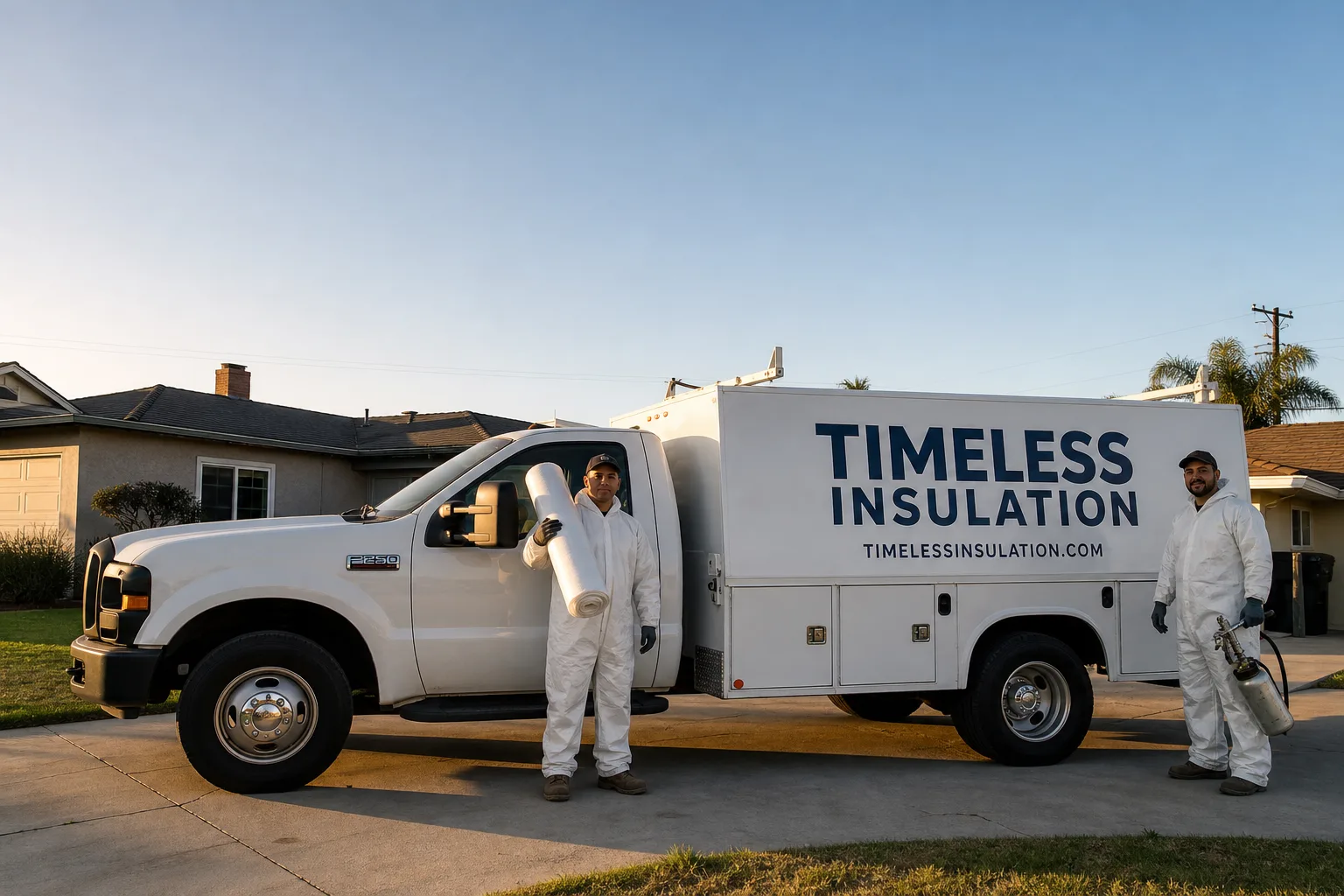
Fast, Reliable Attic Insulation Across Los Angeles
Attic insulation in Los Angeles usually means something different than it does in most of the country. Here, we’re not fighting winter cold. We’re fighting the heat-island effect, afternoon sun beating on flat roofs, and pre-1960 construction that was never designed with modern insulation in mind. Our crews work the 90001 – 90010 corridor daily, from Koreatown to Watts to West Adams, so we know exactly what’s behind those stucco walls and tar-and-gravel roofs. If you’re tired of rooms that won’t cool down by 6 p.m., call (866) 507-5394 for a free assessment.
Why Timeless Insulation Is Los Angeles’s Preferred Attic Insulation Company
Timeless Insulation is a dedicated insulation contractor, not a generalist who happens to carry a few batts. We carry material from eight manufacturers – Knauf, CertainTeed, Rockwool, Icynene, Owens Corning, Johns Manville, Demilec, and GreenFiber – so the recommendation you get is based on your roof assembly and wall construction, not on whatever is loaded in the truck. In South and Central LA, that usually means closed-cell spray foam against roof decks, rigid foam board over flat roofs, and drill-and-fill work behind stucco. Our Attic Insulation team has worked on 1920s Spanish bungalows near West Adams and 1950s duplex blocks in Huntington Park. Same building type, different failure points. You learn that only by doing the work here.
Nelson Ibarra leads every project. He’s the person who walks the property, checks the roof deck, and tells you whether you need ventilation, a radiant barrier, or a full hot-roof assembly. No scripted sales pitch. Just a clear explanation of what the material does and why it fits your home.
We know Attic Insulation in Los Angeles means working around tight clearances, alley-loaded garages, street parking limits, and property managers who want work done during specific windows. We schedule around that. Response time to most Los Angeles neighborhoods is same-week, and estimates are free.
Attic Ventilation in Los Angeles
Attic Ventilation in Los Angeles gets complicated fast, because a large share of the housing stock between 90001 and 90010 doesn’t have a vented attic at all. The flat or low-pitch tar-and-gravel roofs on pre-1960 bungalows and duplexes have no ridge vent, no soffit path, and no air channel. In a conventional vented-attic market, you’d cut vents and call it done. Here, you often can’t. The assembly itself has to change.
Flat-Roof Ventilation Reality
When there’s no vent path, adding soffit vents does nothing except invite moisture into a sealed cavity. In these homes, we address “ventilation” by managing heat at the roof deck with rigid board or closed-cell spray foam, and by making sure any existing knee-wall or side-wall cavities can breathe rather than trap heat. If a roof does have some pitch and a small attic cavity, we install baffles and ensure cross-ventilation before any insulation goes in.
What Ventilation Prep Costs Here
Attic baffles and ventilation prep in Los Angeles typically runs $250 – $450 for a standard bungalow attic, depending on access and how much old insulation has to be moved. For flat-roof homes where ventilation isn’t possible, the cost shifts to the insulation assembly itself, which we’ll quote honestly before any work begins.
Radiant Barrier in Los Angeles
Radiant Barrier in Los Angeles is one of the most misunderstood products in this market, and unlike Reflectix repair in Los Angeles, it can’t be applied as a simple retrofit. Stapled to the underside of roof rafters in a conventional vented attic, it reflects heat. But on the flat-roof, no-attic homes that dominate the 90001 – 90010 corridor, a radiant barrier under the roof deck does almost nothing by itself. It has to be paired with rigid foam or spray foam to actually lower ceiling temperatures.
Where Radiant Barrier Actually Works
On a 1920s Spanish stucco bungalow near West Adams, we found original flat tar-and-gravel roofing with summer roof-deck temps past 150°F. We installed 2-inch rigid foam board over the deck, sealed the seams with closed-cell foam, and added a radiant barrier above the ceiling line. Interior ceiling temperature dropped roughly 15°F. The radiant barrier helped, but it was the foam board doing the heavy lifting.
When to Skip It
If you have a crawl-in knee wall we have to keep accessible for plumbing or electrical repairs, we will tell you not to staple radiant barrier across the rafters. It blocks access and creates rework later. Dense duplex blocks in Koreatown and West Adams have enough service chases to keep track of without making future work harder. Sometimes the right answer is to leave the radiant barrier out.
Trusted Brands We Service in Los Angeles
Timeless Insulation stocks and installs material from Knauf, CertainTeed, Rockwool, and Icynene, among others, with local availability for Los Angeles customers. That means we’re not waiting on a regional distributor when a flat roof needs closed-cell foam before a heat wave. Rockwool shows up often in this market when fire resistance matters near dense multi-family blocks. Icynene covers both open-cell and closed-cell spray foam depending on whether you’re sealing a roof deck or filling a stud cavity. Nelson Ibarra and the crew will tell you exactly which product matches your roof assembly and why.
Common Attic Insulation Problems We See in Los Angeles Homes
- Blown-in fiberglass trapped in a flat-roof cavity. It has no vent path, so heat and moisture sit against the roof deck and accelerate deterioration. This is the most common mistake we correct.
- No insulation behind exterior stucco. Those 1910s – 1950s bungalow stud bays are open hollows. Attic work alone won’t stop afternoon heat gain when the walls are thermal bridges.
- Radiant barrier blocking access. In crawl-in knee walls, a stapled barrier can seal off plumbing and electrical runs. We plan access routes before recommending it.
- Knob-and-tube wiring in wall cavities. Older South LA homes still have it. Any drill-and-fill wall work has to be done carefully to avoid contact with old conductors.
Pricing for Attic Insulation in Los Angeles, CA
A typical attic insulation job in Los Angeles runs $1,800 – $4,500, depending on whether you have a ventilated attic that needs blow-in or a flat roof that needs rigid board or spray foam. Blown-in attic insulation runs $1.50 – $2.80 per square foot installed. Closed-cell spray foam for a hot-roof assembly runs $2.50 – $4.50 per square foot. Radiant barrier plus foam board runs $3.00 – $5.00 per square foot for flat-roof applications. Homes in the 90036 – 90039 ZIPs with conventional pitched attics land on the lower end; flat-roof bungalows in 90001 – 90010 land higher. Call (866) 507-5394 for a free quote on your specific roof assembly.
We Also Serve Cities Near Los Angeles
Our team works throughout Koreatown, Echo Park, Silver Lake, and Hollywood, handling the same flat-roof and stucco-wall challenges you’ll find across Los Angeles. Access, parking, and property rules change block to block. We know which neighborhoods require scaffold permits and which property managers want work done on specific weekdays.
Serving Los Angeles, CA — Our Local Coverage Area
We’re based in the Los Angeles area and know this community well. Use the map below to see our service coverage — if you’re nearby, we can almost certainly help.
FAQs About Attic Insulation in Los Angeles
Yes. On flat-roof bungalows with no attic cavity, we install rigid foam board or closed-cell spray foam directly to the roof deck, creating a hot-roof assembly that handles heat without ventilation. This is standard practice in South and Central LA, where pre-1960 construction dominates. Call (866) 507-5394 and we’ll assess your roof deck specifically.
The heat-island effect pushes summer roof-deck temperatures past 150°F in dense neighborhoods like Watts, Huntington Park, and West Adams. Insulation here has to be solar-gain control first, not winter warmth. That’s why reflective barriers and closed-cell foam matter more than high R-value blown-in alone.
Drill-and-fill dense-pack cellulose or low-expansion foam works best for open stud bays behind stucco. We approach these carefully because knob-and-tube wiring is common in 1910s – 1950s bungalows. Closed-cell foam gives you moisture resistance plus thermal break in one pass, and it’s what we recommend most often.
In most cases, no special permit is required for insulation itself, but parking restrictions are real. In Koreatown and parts of Huntington Park, red zones and permit-only streets mean we coordinate with you on where the truck can stay. We handle that planning before the crew arrives.
Radiant barrier under a flat roof only works when paired with rigid foam or spray foam at the roof deck. Alone, it reflects little heat because there’s no air gap to work with. We install it as part of a hot-roof assembly, not as a standalone fix.
Get a Free Estimate for Attic Insulation in Los Angeles
Tell us your street, your roof type, and what rooms get hottest in the afternoon. Nelson Ibarra will walk the property and give you a straight answer about which material fits. Call (866) 507-5394 or reach out through the site. Free estimates, no pressure, and a plan that actually matches how your Los Angeles home is built.
Written by Nelson Ibarra, Owner at Timeless Insulation, serving Los Angeles and surrounding neighborhoods with insulation-only expertise.